

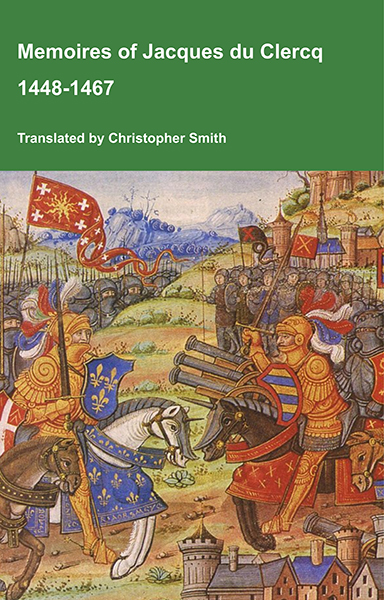
This is a translation of the 'Memoires of Jacques du Clercq', published in 1823 in two volumes, edited by Frederic, Baron de Reissenberg. In his introduction Reissenberg writes: 'Jacques du Clercq tells us that he was born in 1424, and that he was a licentiate in law and a counsellor to Philip the Good, Duke of Burgundy, in the castellany of Douai, Lille, and Orchies. It appears that he established his residence at Arras. In 1446, he married the daughter of Baldwin de la Lacherie, a gentleman who lived in Lille. We read in the fifth book of his Memoirs that his father, also named Jacques du Clercq, had married a lady of the Le Camelin family, from Compiègne. His ancestors, always attached to the counts of Flanders, had constantly served them, whether in their councils or in their armies.' The Memoires cover a period of nineteen years beginning in in 1448, ending in in 1467. It appears that the author had intended to extend the Memoirs beyond that date; no doubt illness or death prevented him from carrying out this plan. As Reissenberg writes the 'merit of this work lies in the simplicity of its narrative, in its tone of good faith, and in a certain air of frankness which naturally wins the reader’s confidence.' Du Clercq ranges from events of national and international importance, including events of the Wars of the Roses in England, to simple, everyday local events such as marriages, robberies, murders, trials and deaths, including that of his own father in Book 5; one of his last entries.
Available at Amazon in eBook and Paperback format.
Before 24th February 1788 [his father] Captain John Lukis [aged 35] and [his mother] Sarah Collings [aged 39] were married.
On 24th February 1788 Frederick Collings Lukis was born to [his father] Captain John Lukis [aged 35] and [his mother] Sarah Collings [aged 39] at La Grange, St Peter Port.
On 17th February 1813 Frederick Collings Lukis [aged 24] and Elizabeth Collings [aged 21] were married. They had three daughters and six sons. They were first cousins.
In 1816 [his mother] Sarah Collings [aged 67] died.
On 8th April 1817 [his son] Reverend William Collins Lukis was born to Frederick Collings Lukis [aged 29].
In 1832 [his father] Captain John Lukis [aged 79] died.
Archaeological Journal Volume 1 Pages 222-232. Archaeological Journal/Volume 1/On the Primeval Antiquities of the Channel Islands by F. C. Lukis [aged 55].
Archaeological Journal Volume 1 Pages 142-151. Observations on the Primeval Antiquities of the Channel Islands by F. C. Lukis [aged 55]
On 28th April 1853 Frederick Collings Lukis [aged 65] became a Fellow of the Society of Antiquaries of London.
The History of William Marshal was commissioned by his son shortly after William’s death in 1219 to celebrate the Marshal’s remarkable life; it is an authentic, contemporary voice. The manuscript was discovered in 1861 by French historian Paul Meyer. Meyer published the manuscript in its original Anglo-French in 1891 in two books. This book is a line by line translation of the first of Meyer’s books; lines 1-10152. Book 1 of the History begins in 1139 and ends in 1194. It describes the events of the Anarchy, the role of William’s father John, John’s marriages, William’s childhood, his role as a hostage at the siege of Newbury, his injury and imprisonment in Poitou where he met Eleanor of Aquitaine and his life as a knight errant. It continues with the accusation against him of an improper relationship with Margaret, wife of Henry the Young King, his exile, and return, the death of Henry the Young King, the rebellion of Richard, the future King Richard I, war with France, the death of King Henry II, and the capture of King Richard, and the rebellion of John, the future King John. It ends with the release of King Richard and the death of John Marshal.
Available at Amazon in eBook and Paperback format.
Proceedings of the Somerset Archaeological and Natural History Society Volume 8 Pages 35-62. Happily, through the careful investigations of archaeologists in different countries, our knowledge of this subject is becoming pretty exact, as well as extensive. To Mr. Lukis [aged 70] we are indebted for active and careful investigations in the Channel Islands, especially in the island of Guernsey, where he has brought to light much that may greatly assist us in forming just conclusions respecting other places where similarly constructed barrows have been discovered. So much mystery has hitherto hung over the stone chamber, and the ancient mound of earth which occasionally covers it, that much is due to those who have given to the world correct information as to the purposes for which they were designed. Mr. Lukis, with much labour, explored forty of these ancient sepulchral remains in the Channel Islands, and some in France and England, and says: I have found a very remarkable similarity pervading all, as though a definite architectural law had regulated their construction, and a precise plan had determined the mode of interment.... From numerous accounts which have reached us, we have reason to conclude that the same structures are to be found in most parts of the world." This being the testimony of a very careful investigator, we shall go on to see to what class of tumuli, and to what people, the curious sepulchre at Wellow may be referred.
On 11th April 1865 [his wife] Elizabeth Collings [aged 74] died.
Frederick Lukis 1865. Archæological Notes Made By Captain Francis Dubois Lukis H.M's 64th Regiment During A Visit To Buxton Derbyshire In 1865 By Frederick C Lukis [aged 78] FSA.
On 15th November 1871 Frederick Collings Lukis [aged 83] died.
Father: Captain John Lukis
GrandFather: Unamed Father Collings
Mother: Sarah Collings