


Biography of Geoffrey Chaucer 1343-1400
Paternal Family Tree: Chaucer
Around 1343 Geoffrey Chaucer was born.
Before 1367 Geoffrey Chaucer (age 24) and Philippa Roet (age 20) were married at St Mary de Castro Leicester, Leicestershire [Map].
Around 1367 [his son] Thomas Chaucer was born to Geoffrey Chaucer (age 24) and [his wife] Philippa Roet (age 21).
In Jun 1368 Lionel Plantagenet 1st Duke of Clarence (age 29) and Violante Visconti (age 14) were married in the Church of Santa Maria Maggiore, Milan. The wedding festivities were lavish and ostentatious. The banquet, held outside, included 30 courses of meat and fish presented fully gilded. Between the courses the guests were given gifts such as suits of armor, bolts of cloth, war horses, arms, and hunting dogs. Among the guests were Geoffrey Chaucer (age 25), Petrarch, Jean Froissart and John Hawkwood. He the son of King Edward III of England (age 55) and Philippa of Hainault Queen Consort England (age 53).

Around 1387 [his wife] Philippa Roet (age 41) died.
In Sep 1389 the Scrope vs Grosvenor Case was brought to the Court of Chivalry. Up to that time two families, Scrope and Grosvenor, had been using the armorial  Scrope Arms: Azure, a bend or.
Several hundred witnesses were called including John of Gaunt 1st Duke Lancaster (age 49), Geoffrey Chaucer (age 46) and John Savile of Shelley and Golcar (age 64).
On 03 Sep 1386 Owain ap Gruffudd "Glyndŵr" Mathrafal Prince Powys (age 27) gave evidence at the Church of John the Baptist, Chester [Map].
The Court decided in favour of Scrope.
Neither party was happy with the decision so King Richard II (age 22) was called upon to give his personal verdict.
On 27 May 1390 he confirmed that Grosvenor could not bear the undifferenced arms.
As a consequence of the case the Grosvenor has for many years used the name Bendor for horses and nicknames.
On 25 Oct 1400 Geoffrey Chaucer (age 57) died. He was buried at Poets Corner Westminster Abbey [Map].
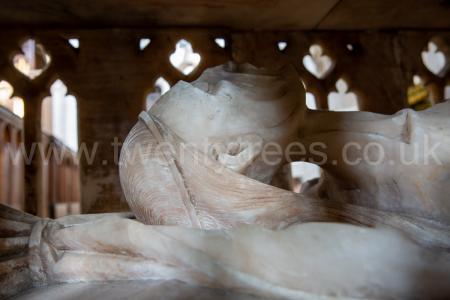
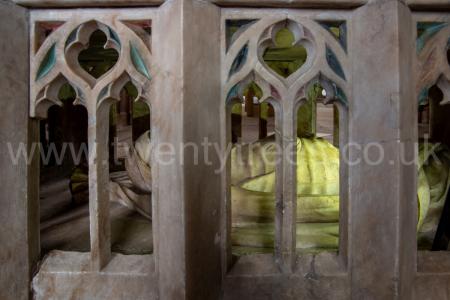
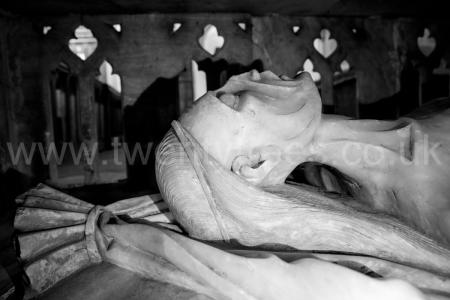
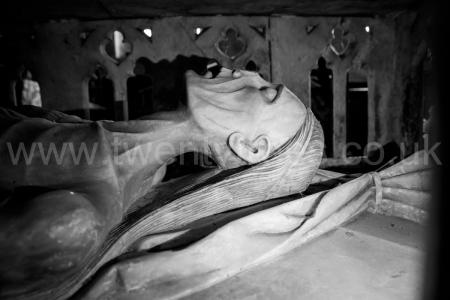
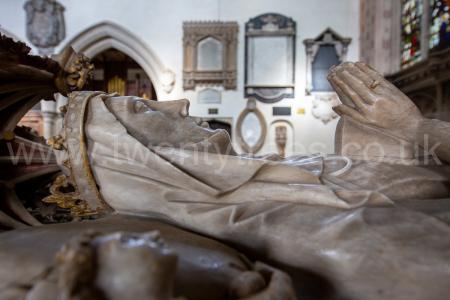
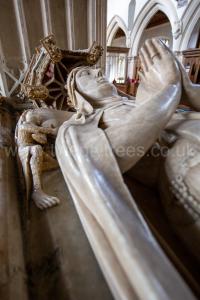
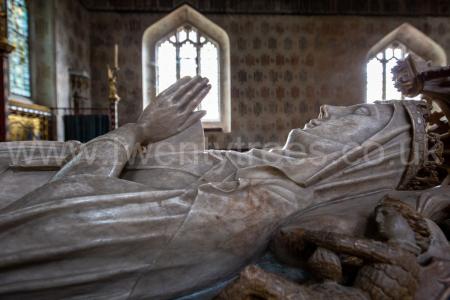
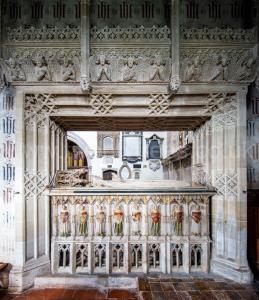
After 20 May 1475. St Mary's Church, Ewelme [Map]. Monument to Alice Chaucer Duchess Suffolk (deceased). Wrist Garter. The effigy was, apparently, viewed to determine how a lady should wear the garter at the re-commencement of Lady of the Garter appointments in 1901 after a gap of several hundred years. A particularly fine Cadaver Underneath the chest on which Alice's effigy lies. Full-length in a shroud. Chest with Angels with Rounded Wings holding Shields.
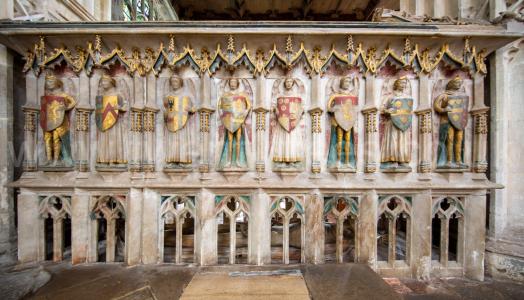
Detail of the South Side of the Monument to Alice Chaucer Duchess Suffolk (deceased).
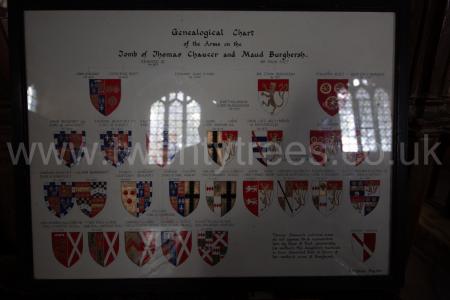
1 Roet Arms impaled  Chaucer Modern Arms. Alice's paternal grandparents.
2  De La Pole Arms impaled
  Stafford Arms. Her third husbands parents Michael de la Pole 2nd Earl Suffolk and Katherine Stafford Countess Suffolk.
3  Montacute and Monthermer Arms impaled Francis? Possibly Alice's second husband's parents John Montagu 3rd Earl Salisbury and Maud Francis Countess of Salisbury.
4 De La Pole Arms quartered Chaucer Modern Arms.
5 Roet Arms quartered Chaucer Modern Arms.
8 De La Pole Arms impaled  England Henry IV Arms signifying Alice's son John's (age 32) marriage to Elizabeth of York (age 31) sister of King Edward IV of England (age 33).
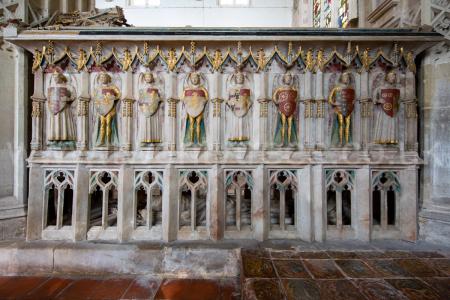
Detail of the North Side of the monument to Alice Chaucer Duchess Suffolk (deceased). Arms from left to right ...
1 De La Pole Arms quartered Chaucer Modern Arms impaled Unknown.
2 De La Pole Arms impaled Chaucer Modern Arms. Her third husband William "Jackanapes" de la Pole 1st Duke of Suffolk.
3 De La Pole Arms quarted Chaucer Modern Arms. Alice's son John de la Pole 2nd Duke of Suffolk (age 32) by her second husband William "Jackanapes" de la Pole 1st Duke of Suffolk.
5 Montacute and Monthermer Arms quartering impaled Chaucer. Alice's second husband Thomas Montagu 1st Count Perche 4th Earl Salisbury.
6 Roet Arms. Alice's paternal grandmother [his former wife] Philippa Roet.
7 England Henry IV Arms impaling Roet Arms probably signifying John of Gaunt 1st Duke Lancaster and [his former sister-in-law] Katherine Roet Duchess Lancaster, Katherine being the sister of Alice's paternal grandmother Philippa Roet who married Geoffrey Chaucer.
8 Roet Arms impaling Chaucer Modern Arms. Her paternal grandparents Geoffrey Chaucer and Philippa Roet.
Katherine Stafford Countess Suffolk: Around 1376 she was born to Hugh Stafford 2nd Earl Stafford and Philippa Beauchamp Countess Stafford. She a great x 3 granddaughter of King Edward "Longshanks" I of England. Before 1394 Michael de la Pole 2nd Earl Suffolk and she were married. She by marriage Countess Suffolk. She the daughter of Hugh Stafford 2nd Earl Stafford and Philippa Beauchamp Countess Stafford. He the son of Michael de la Pole 1st Earl Suffolk and Katherine Wingfield Countess Suffolk. She a great x 3 granddaughter of King Edward "Longshanks" I of England. On 08 Apr 1419 Katherine Stafford Countess Suffolk died.
Philippa Roet: Around 1346 she was born to Giles "Payne" Roet. Before 1367 Geoffrey Chaucer and she were married at St Mary de Castro Leicester, Leicestershire. Excerpta Historica Page 152. Philippa, his eldest daughter, is stated to have been the maid of honour to Philippa Queen of Edward the Third who by the name of "Philippa Pycard" obtained a grant of one hundred shillings per annum on the 20th January 1370, and married Geoffrey Chaucer, to whom, in consequence, it is supposed, of this connexion, the Duke of Lancaster granted the Castle of Dodington. Of John of Gaunt's connexion with Chaucer, however, no proof has been found; and the circumstance of the lady assigned to him for his wife being styled "Philippa Pycard," instead of Roelt, renders the assertion, that she was the sister of the Duchess of Lancaster, extremely doubtful. Around 1387 Philippa Roet died.
Evelyn's Diary. 09 Jun 1654. Dined at Marlborough [Map], which having been lately fired, was now new built. At one end of this town, we saw my Lord Seymour's (age 64) house, but nothing observable save the Mount, to which we ascended by windings for near half a mile. It seems to have been cast up by hand. We passed by Colonel Popham's (age 49), a noble seat, park, and river. Thence, to Newbury [Map], a considerable town, and Donnington, famous for its battle, siege, and castle, this last had been in the possession of old Geoffrey Chaucer. Then to Aldermaston, a house of Sir Humphrey Forster's, built à la moderne. Also, that exceedingly beautiful seat of my Lord Pembroke (age 33), on the ascent of hill, flanked with wood, and regarding the river, and so, at night, to Cadenham, the mansion of Edward Hungerford (age 21), Esq, uncle to my wife (age 19), where we made some stay. The rest of the week we did nothing but feast and make good cheer, to welcome my wife (age 19).


Pepy's Diary. 14 Jun 1663. By and by in comes Sir J. Minnes (age 64) and Sir W. Batten (age 62), and so we sat talking. Among other things, Sir J. Minnes (age 64) brought many fine expressions of Chaucer, which he doats on mightily, and without doubt he is a very fine poet1. Sir W. Pen (age 42) continues lame of the gout, that he cannot rise from his chair. So after staying an hour with him, we went home and to supper, and so to prayers and bed.
Note 1. Pepys continued through life an admirer of Chaucer, and we have the authority of Dryden (age 31) himself for saying that we owe his character of the Good Parson to Pepys's recommendation.
Evelyn's Diary. 03 Aug 1667. Went to Mr. Cowley's (deceased) funeral, whose corpse lay at Wallingford House, and was thence conveyed to Westminster Abbey [Map] in a hearse with six horses and all funeral decency, near a hundred coaches of noblemen and persons of quality following; among these, all the wits of the town, divers bishops and clergymen. He was interred next Geoffry Chaucer, and near Spenser. A goodly. Monument is since erected to his memory.
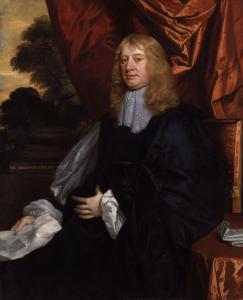
[his daughter] Elizabeth Chaucer was born to Geoffrey Chaucer and Philippa Roet.