

William of Worcester's Chronicle of England
William of Worcester, born around 1415, and died around 1482 was secretary to John Fastolf, the renowned soldier of the Hundred Years War, during which time he collected documents, letters, and wrote a record of events. Following their return to England in 1440 William was witness to major events. Twice in his chronicle he uses the first person: 1. when writing about the murder of Thomas, 7th Baron Scales, in 1460, he writes '… and I saw him lying naked in the cemetery near the porch of the church of St. Mary Overie in Southwark …' and 2. describing King Edward IV's entry into London in 1461 he writes '… proclaimed that all the people themselves were to recognize and acknowledge Edward as king. I was present and heard this, and immediately went down with them into the city'. William’s Chronicle is rich in detail. It is the source of much information about the Wars of the Roses, including the term 'Diabolical Marriage' to describe the marriage of Queen Elizabeth Woodville’s brother John’s marriage to Katherine, Dowager Duchess of Norfolk, he aged twenty, she sixty-five or more, and the story about a paper crown being placed in mockery on the severed head of Richard, 3rd Duke of York.
Available at Amazon in eBook and Paperback format.
Paternal Family Tree: Le Marchant
On 9th February 1766 Major-General John Le Marchant was born.
On 29th October 1789 Major-General John Le Marchant (age 23) and Mary Carey were married.
Around 1795 Major-General John Le Marchant (age 28) designed, in collaboration with the Birmingham sword cutler Henry Osborn, a new cavalry sabre, which was adopted for the light cavalry.
On 3rd July 1795 [his son] Denis Le Marchant 1st Baronet was born to Major-General John Le Marchant (age 29) at Newcastle upon Tyne, Northumberland [Map].
Around 1796 Major-General John Le Marchant (age 29) wrote "The Rules and Regulations of the Sword Exercise of the Cavalry" which was adopted by the army as part of its official regulations.
In 1797 Major-General John Le Marchant (age 30) was promoted to Lieutenant-Colonel at the direct behest of the King with whom Le Marchant had developed a friendly relationship.
In 1801 Major-General John Le Marchant (age 34) was granted £30,000 by Parliament for establishing the High Wycombe and Great Marlow schools for the military instruction of officers. The two original departments being afterwards combined and removed to a purpose-built Royal Military College at Sandhurst. In 1804 Le Marchant received the personal thanks of King George III, who said "The country is greatly indebted to you".
In 1811 Major-General John Le Marchant (age 44) was promoted to Major-General was given the command of a brigade of heavy cavalry in 1811, and greatly distinguished himself in several actions.
In 1811 [his wife] Mary Carey died in childbirth.
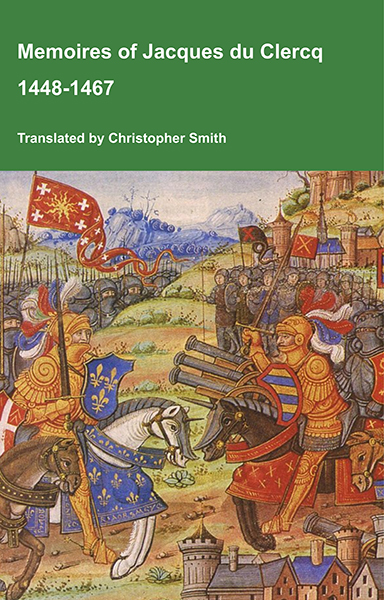
This is a translation of the 'Memoires of Jacques du Clercq', published in 1823 in two volumes, edited by Frederic, Baron de Reissenberg. In his introduction Reissenberg writes: 'Jacques du Clercq tells us that he was born in 1424, and that he was a licentiate in law and a counsellor to Philip the Good, Duke of Burgundy, in the castellany of Douai, Lille, and Orchies. It appears that he established his residence at Arras. In 1446, he married the daughter of Baldwin de la Lacherie, a gentleman who lived in Lille. We read in the fifth book of his Memoirs that his father, also named Jacques du Clercq, had married a lady of the Le Camelin family, from Compiègne. His ancestors, always attached to the counts of Flanders, had constantly served them, whether in their councils or in their armies.' The Memoires cover a period of nineteen years beginning in in 1448, ending in in 1467. It appears that the author had intended to extend the Memoirs beyond that date; no doubt illness or death prevented him from carrying out this plan. As Reissenberg writes the 'merit of this work lies in the simplicity of its narrative, in its tone of good faith, and in a certain air of frankness which naturally wins the reader’s confidence.' Du Clercq ranges from events of national and international importance, including events of the Wars of the Roses in England, to simple, everyday local events such as marriages, robberies, murders, trials and deaths, including that of his own father in Book 5; one of his last entries.
Available at Amazon in eBook and Paperback format.
On 11th April 1812 Major-General John Le Marchant (age 46) led the 5th Dragoon Guards in a perfectly timed flank charge, in echelon of squadrons, which defeated two strong columns of French cavalry under General Charles Lallemand. The French had been attacking British light cavalry under Sir Stapleton Cotton (age 38), who were being forced to give ground.
On 22nd July 1812 the Battle of Salamanca was fought at which an Anglo-Portuguese army under the Earl of Wellington (age 43) defeated Marshal Auguste Marmont's French forces at Arapiles [Map].
Brother General Thomas Bradford (age 34) and Lieutenant-Colonel Henry Hollis Bradford (age 31) fought.
Major-General John Le Marchant (age 46) was killed in action. Wellington is reported as saying to Le Marchant that he must take the first favourable opportunity to engage the enemy's infantry, "You must then charge at all hazards" was his final instruction. Following up the attack of the 5th Infantry Division Le Marchant led the 3rd and 4th Dragoons and the 5th Dragoon Guards in what was probably the most destructive charge made by a single brigade of cavalry in the whole Napoleonic period. The left wing of the French army were on the point of being defeated by the 3rd and 5th divisions of Anglo-Portuguese infantry when Le Marchant's dragoons charged in and destroyed battalion after battalion. Many of the French infantrymen sought the protection of the British infantry to escape the sabres of the dragoons. Le Marchant, knowing he had achieved a magnificent success, was leading a squadron against the last of the formed French infantry when he was shot and his spine broken. See Fletcher's "Galloping at Everything: The British Cavalry in the Peninsula and at Waterloo 1808-15". Spellmount, Staplehurst. ISBN 1-86227-016-3. 1999, pp. 185–188.


