

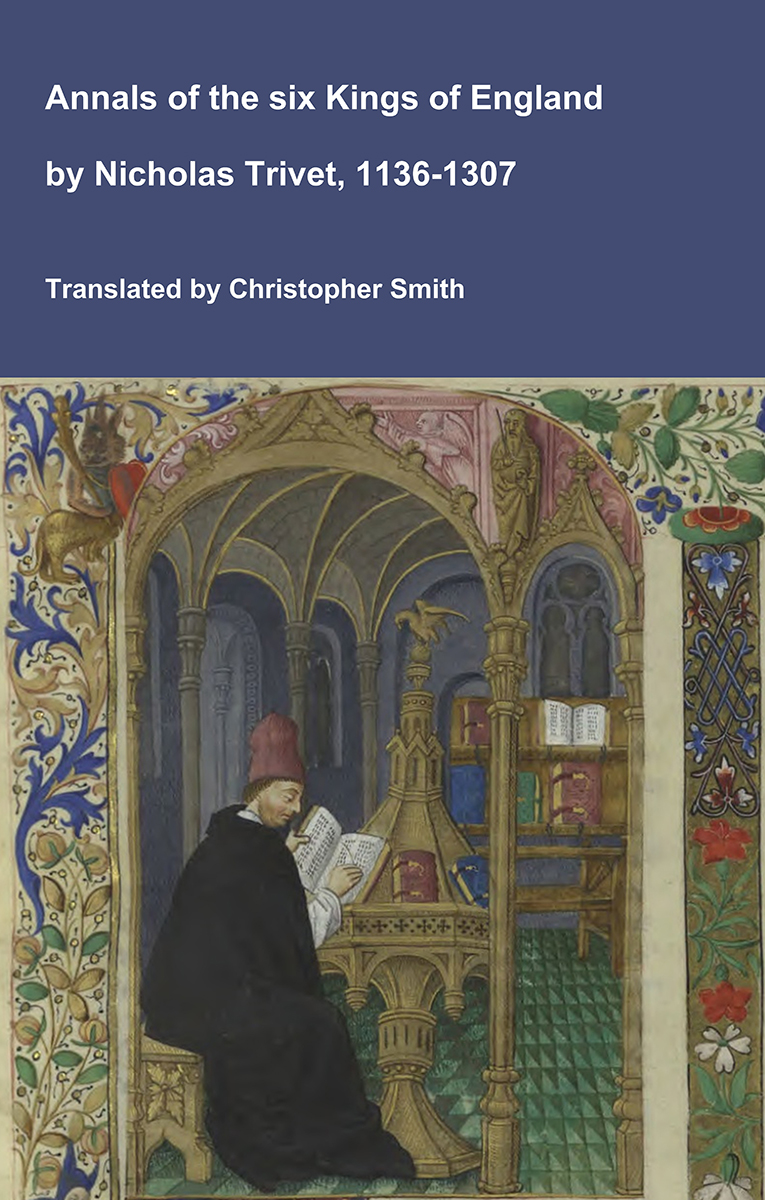
Annals of the six Kings of England by Nicholas Trivet
Translation of the Annals of the Six Kings of England by that traces the rise and rule of the Angevin aka Plantagenet dynasty from the mid-12th to early 14th century. Written by the Dominican scholar Nicholas Trivet, the work offers a vivid account of English history from the reign of King Stephen through to the death of King Edward I, blending political narrative with moral reflection. Covering the reigns of six monarchs—from Stephen to Edward I—the chronicle explores royal authority, rebellion, war, and the shifting balance between crown, church, and nobility. Trivet provides detailed insight into defining moments such as baronial conflicts, Anglo-French rivalry, and the consolidation of royal power under Edward I, whose reign he describes with particular immediacy. The Annals combines careful year-by-year reporting with thoughtful interpretation, presenting history not merely as a sequence of events but as a moral and political lesson. Ideal for readers interested in medieval history, kingship, and the origins of the English state, this chronicle remains a valuable and accessible window into the turbulent world of the Plantagenet kings.
Available at Amazon in eBook and Paperback format.
Margaret Entwhistle was born to [her father] Thomas Entwhistle.
In 1485 Robert Brudenell (age 24) and Margaret Entwhistle were married.
In 1497 [her son] Thomas Brudenell was born to [her husband] Robert Brudenell (age 36) and Margaret Entwhistle.
In 1502 Margaret Entwhistle died.
In 1505 [her former husband] Robert Brudenell (age 44) and Philippa Power were married.
On 30th January 1531 [her former husband] Robert Brudenell (age 70) died. Monument to Robert Brudenell and his two wives: Margaret Entwhistle and Philippa Power in St Peter's Church, Deene [Map]. The incription reads: Of your charite pray for the soules of Syr Robert Brudenell, Knight, late Chief Justice of the Kyngg's Common Bench at Westm. And Margaret, and Dame Philippe his wyves. Syr Robert dyed the xxx daye of Januaris, Anno Domini M[C/V]XXXI, and the said dame Philippe dyed xxviii daye of March, Anno Domini M[C/V]XXXII, and lye here, on whose soulles Jhu have mercy. Chunky Lions Mane. Swirling Tail.
Philippa Power: In 1505 Robert Brudenell and she were married. On 28th March 1532 she died.


Adeline Horsey Recollections. The Brudenells have been landowners in Northamptonshire since the time of Henry III, and in 1518 [her former husband] Sir Robert Brudenell, a Justice of the King's Bench [Map], bought Deene [Map] from William Litton. Robert Brundenell made a large fortune, and his wife, Margaret Entwyssel, became heiress to her brother's estates of Staunton Wyvile, which naturally added to the wealth of the family. In 1520 Sir Robert settled Deene on his eldest son, [her son] Thomas, and eleven years later he died and was buried in the transept of Deene Church [Map].
A History of the County of Leicestershire: Volume 5 Gartree Hundred: Stonton Wyville. The under-tenant in 1086 was another Hugh, founder of the family of Widville or Wyville from which the village took its name. His descendants held the manor until 1494 when the last William Wyville died, leaving a widow Margaret and the manor of Stonton in the hands of trustees. William's heir was his niece Katherine Warde, a child of eleven, who married Thomas Entwistle, the son of one of her uncle's trustees. The manor was leased from Thomas and Katherine by Sir Robert Brudenell, who married William Wyville's widow very shortly after her first husband's death, and in 1499 he purchased its reversion from them. The Brudenells did not obtain full possession of the manor until 1533, after Sir Robert's death. It descended in the Brudenell family, and was usually leased to a younger branch until the early 18th century. A lease for 61 years was made in 1582 and in 1635 the manor-house and demesne were leased, each time to Edmund Brudenell. In 1957 the owner was Mr. George Brudenell of Deene (Northants.).
[her son] Anthony Brudenell was born to Robert Brudenell and Margaret Entwhistle.