

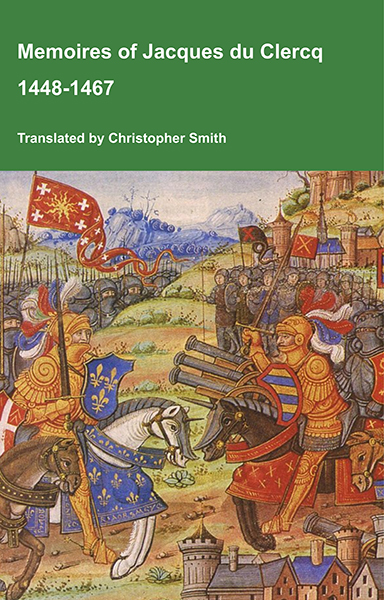
This is a translation of the 'Memoires of Jacques du Clercq', published in 1823 in two volumes, edited by Frederic, Baron de Reissenberg. In his introduction Reissenberg writes: 'Jacques du Clercq tells us that he was born in 1424, and that he was a licentiate in law and a counsellor to Philip the Good, Duke of Burgundy, in the castellany of Douai, Lille, and Orchies. It appears that he established his residence at Arras. In 1446, he married the daughter of Baldwin de la Lacherie, a gentleman who lived in Lille. We read in the fifth book of his Memoirs that his father, also named Jacques du Clercq, had married a lady of the Le Camelin family, from Compiègne. His ancestors, always attached to the counts of Flanders, had constantly served them, whether in their councils or in their armies.' The Memoires cover a period of nineteen years beginning in in 1448, ending in in 1467. It appears that the author had intended to extend the Memoirs beyond that date; no doubt illness or death prevented him from carrying out this plan. As Reissenberg writes the 'merit of this work lies in the simplicity of its narrative, in its tone of good faith, and in a certain air of frankness which naturally wins the reader’s confidence.' Du Clercq ranges from events of national and international importance, including events of the Wars of the Roses in England, to simple, everyday local events such as marriages, robberies, murders, trials and deaths, including that of his own father in Book 5; one of his last entries.
Available at Amazon in eBook and Paperback format.
In 1637 Mary Saunderson was born.
Samuel Pepys' Diary. 22nd October 1662. Hence, it raining hard, by coach home, being first trimmed here by Benier, who being acquainted with all the players, do tell me that [her future husband] Betterton [aged 27] is not married to Ianthe [aged 25], as they say; but also that he is a very sober, serious man, and studious and humble, following of his studies, and is rich already with what he gets and saves, and then to my office till late, doing great deal of business, and settling my mind in pretty good order as to my business, though at present they are very many.
Samuel Pepys' Diary. 1st December 1662. This done we broke up, and I to the Cockpitt [Map], with much crowding and waiting, where I saw "The Valiant Cidd1" acted, a play I have read with great delight, but is a most dull thing acted, which I never understood before, there being no pleasure in it, though done by [her future husband] Betterton [aged 27] and by Ianthe [aged 25], And another fine wench that is come in the room of Roxalana [aged 20] nor did the King [aged 32] or Queen [aged 24] once smile all the whole play, nor any of the company seem to take any pleasure but what was in the greatness and gallantry of the company.
After 24th December 1662 Thomas Betterton [aged 27] and Mary Saunderson [aged 25] were married. He obtained the license on 24th December 1662.
Samuel Pepys' Diary. 1st February 1664. Thence with Alderman Maynell by his coach to the 'Change [Map], and there with several people busy, and so home to dinner, and took my wife out immediately to the King's Theatre [Map], it being a new month, and once a month I may go, and there saw "The Indian Queen" acted; which indeed is a most pleasant show, and beyond my expectation; the play good, but spoiled with the ryme, which breaks the sense. But above my expectation most, the eldest Marshall did do her part most excellently well as I ever heard woman in my life; but her voice not so sweet as Ianthe's [aged 27]; but, however, we came home mightily contented. Here we met Mr. Pickering [aged 46] and his mistress, Mrs. Doll Wilde [aged 31]; he tells me that the business runs high between the Chancellor [aged 54] and my Lord Bristoll [aged 51] against the Parliament; and that my Lord Lauderdale [aged 47] and Cooper [aged 42] open high against the Chancellor; which I am sorry for.
Samuel Pepys' Diary. 28th July 1664. At the office all the morning, dined, after 'Change [Map], at home, and then abroad, and seeing "The Bondman" upon the posts, I consulted my oaths and find I may go safely this time without breaking it; I went thither, notwithstanding my great desire to have gone to Fleet Alley, God forgive me, again. There I saw it acted. It is true, for want of practice, they had many of them forgot their parts a little; but [her husband] Betterton [aged 28] and my poor Ianthe [aged 27] outdo all the world. There is nothing more taking in the world with me than that play.

Samuel Pepys' Diary. 13th August 1664. Mightly pleased with this I to the office, where all the morning. There offered by Sir W. Pen [aged 43] his coach to go to Epsum and carry my wife, I stept out and bade my wife make her ready, but being not very well and other things advising me to the contrary, I did forbear going, and so Mr. Creed dining with me I got him to give my wife and me a play this afternoon, lending him money to do it, which is a fallacy that I have found now once, to avoyde my vowe with, but never to be more practised I swear, and to the new play, at the Duke's house, of "Henry the Fifth"; a most noble play, writ by my Lord Orrery [aged 43]; wherein [her husband] Betterton [aged 29], Harris [aged 30], and Ianthe's [aged 27] parts are most incomparably wrote and done, and the whole play the most full of height and raptures of wit and sense, that ever I heard; having but one incongruity, or what did, not please me in it, that is, that King Harry promises to plead for Tudor to their Mistresse, Princesse Katherine of France, more than when it comes to it he seems to do; and Tudor refused by her with some kind of indignity, not with a difficulty and honour that it ought to have been done in to him.
Samuel Pepys' Diary. 3rd April 1665. Thence home and to dinner, and then with Creed, my wife, and Mercer to a play at the Duke's, of my Lord Orrery's [aged 43], called "Mustapha", which being not good, made [her husband] Betterton's [aged 29] part and Ianthe's [aged 28] but ordinary too, so that we were not contented with it at all.
Samuel Pepys' Diary. 29th October 1666. By and by the King [aged 36] and Queene [aged 56], Duke [aged 33] and Duchesse [aged 29], and all the great ladies of the Court; which, indeed, was a fine sight. But the play being "Love in a Tub", a silly play, and though done by the Duke's people, yet having neither [her husband] Betterton [aged 31] nor his wife [aged 29], and the whole thing done ill, and being ill also, I had no manner of pleasure in the play. Besides, the House, though very fine, yet bad for the voice, for hearing. The sight of the ladies, indeed, was exceeding noble; and above all, my Baroness Castlemayne [aged 25]. The play done by ten o'clock. I carried them all home, and then home myself, and well satisfied with the sight, but not the play, we with great content to bed.
On 28th April 1710 [her husband] Thomas Betterton [aged 74] died.
In 1712 Mary Saunderson [aged 75] died.