

Jean de Waurin's Chronicle of England Volume 6 Books 3-6: The Wars of the Roses
Jean de Waurin was a French Chronicler, from the Artois region, who was born around 1400, and died around 1474. Waurin’s Chronicle of England, Volume 6, covering the period 1450 to 1471, from which we have selected and translated Chapters relating to the Wars of the Roses, provides a vivid, original, contemporary description of key events some of which he witnessed first-hand, some of which he was told by the key people involved with whom Waurin had a personal relationship.
Available at Amazon in eBook and Paperback format.
Osbert Guy Stanhope Crawford is in Archaeologists.
On 28th October 1886 Osbert Guy Stanhope Crawford was born to [his father] Charles Edward Gordon Crawford in Breach Candy, Bombay.
Long Barrows of the Cotswolds. The Long Barrows of the Cotswolds. A Description of Long Barrows, Stone Circles and other Megalithic Remains in the area covered by Sheet 8 of the Quarter-inch Ordnance Survey comprising the Cotswolds and the Welsh Marches By O. G. S. Crawford (age 38), B.A., F.S.A. Archæology Officer, Ordnance Survey. Published by John Bellows, Gloucester, 1925.

Wessex from the Air. Wessex From The Air by O. G. S. Crawford (age 41), F.S.A. And Alexander Keiller (age 38) F.S.A., F.G.S. 1928.
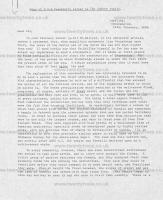
Keiller Collection Letters 14 Feb 1939. Nursling, Southampton,
14th February, 1939.
Dear Sir,
In your February number (p.10) Mr. Keiller (age 49), in his admirable article, quotes a statement that, when megalithic monuments like Stonehenge were built, the level of the Baltic and of the North Sea was 400 feet higher than now! (I need hardly say that Mr. Keiller himself is far too sane to attach any importance to such a statement). But it seems at first glance to raise certain difficulties about the construction of Stonehenge. the level of the ground on which Stonehenge stands is about 340 feet above the present level of the sea. A simple calculation shows that it must have then been about 60 feet below the sea!
The explanation of this remarkable fact was mystically revealed to me by no less a person than the chief architect himself, the patriarch Noah. With characteristic frankness he told me of a difficulty that has escaped the notice of all the Biblical critics, and of the ingenious method by which he solved it. The heavy precipitation which resulted in the well-known Flood, consisted, of course, entirely of fresh water; and the fishes who for generations had been born and bred, so to speak, in salt water came to him in great distress, asking his advice. Not being a water expert himself, Noah consulted the Authorities and was told that only strenuous work could save the fish from becoming fossilized. He accordingly devised a scheme by which they should swim across the drowned continent of Eurasia and construct a temple to Jehovah upon the submerged uplands that are now called Salisbury Plain. In order to increase their labour and save them from extinction they were to use only the largest stones, and were to fetch some of them from distant Wales. They were supplied with blue prints by a well-known firm of Sumerian architects, specially drawn on waterproof paper by highly skilled crabs, with ink provided free of charge by cuttle-fish or squids. (It is interesting to note that precisely similar paper is still used by the Ordnance Survey for its small-scale maps). The task was duly carried out, and shortly after 4000 B. C. the temple was formally declared open by a bottle-nosed whale.
In every community, however, there are some recalcitrant individuals who refuse to take good advice, and so there were amongst the fishes. A little group of passive resisters was formed, and they occupied their time swimming round the ark cursing the Authorities. They said they would be fossilized before they would consent to do such menial work, and fossilized they were. When at length the Flood receded, the slopes of Ararat and all the land of Armenia was strewn with huge stone fish. They remain there to this day and may be seen by any who care to visit that country. There is a photograph of one in the Museum at Erivan. They are called VISHAPS and a fully illustrated account of them was recently published (Les Vishaps, by N. Y. Marr & J. I. Smirnov, Leningrad, 1931, reviewed in ANTIQUITY XI, 1937, 122-3).
This explanation is a Revelation in the strict sense of the word. It entirely supersedes the old theory that Stonehenge was built by the Apalachian Indians of North America and dedicated to Apollo1; and of course puts out of court the fantastic conclusions of archaeologists which are invariably built upon the insecure basis of ascertained fact. I might add that Noah informed me that he was always at the disposal of genuine seekers after knowledge, and that his best inspiration came from Chambery No. 5 served with pigs' trotters, preferably at the Escargot d'Or.
Yours faithfully,
(signed) OGSC (age 52)
The Editor Modern Mystic 6 Bear Street, Leicester Square, W.C.2
Note 1. W. S. Blacket, Researches into the Lost Histories. of America, 1883, p. 193.

On 28th November 1957 Osbert Guy Stanhope Crawford (age 71) died.