

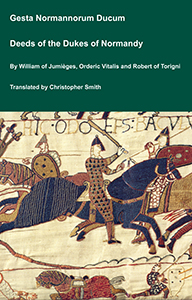
The Deeds of the Dukes of Normandy
The Gesta Normannorum Ducum [The Deeds of the Dukes of Normandy] is a landmark medieval chronicle tracing the rise and fall of the Norman dynasty from its early roots through the pivotal events surrounding the Norman Conquest of England. Originally penned in Latin by the monk William of Jumièges shortly before 1060 and later expanded at the behest of William the Conqueror, the work chronicles the deeds, politics, battles, and leadership of the Norman dukes, especially William’s own claim to the English throne. The narrative combines earlier historical sources with firsthand information and oral testimony to present an authoritative account of Normandy’s transformation from a Viking settlement into one of medieval Europe’s most powerful realms. William’s history emphasizes the legitimacy, military prowess, and governance of the Norman line, framing their expansion, including the conquest of England, as both divinely sanctioned and noble in purpose. Later chroniclers such as Orderic Vitalis and Robert of Torigni continued the history, extending the coverage into the 12th century, providing broader context on ducal rule and its impact. Today this classic work remains a foundational source for understanding Norman identity, medieval statesmanship, and the historical forces that reshaped England and Western Europe between 800AD and 1100AD.
Available at Amazon in eBook and Paperback format.
Paternal Family Tree: Clayton
In 1629 Robert Clayton was born to [his father] John Clayton and [his mother] Alice Abbott.
John Evelyn's Diary. 26th September 1672. I carried with me to dinner my Lord H. Howard [aged 44] (now to be made Earl of Norwich and Earl Marshal of England) to Sir Robert Clayton's [aged 43], now Sheriff of London, at his new house, where we had a great feast; it is built indeed for a great magistrate, at excessive cost. The cedar dining room is painted with the history of the Giants' War, incomparably done by Mr. Streeter [aged 51], but the figures are too near the eye.


John Evelyn's Diary. 18th August 1673. Taking leave of my Lord Clifford [aged 43], he wrung me by the hand, and, looking earnestly on me, bid me God-b'ye, adding, "Mr. Evelyn, I shall never see thee more". "No!" said I, "my Lord, what's the meaning of this? I hope I shall see you often, and as great a person again". "No, Mr. Evelyn, do not expect it, I will never see this place, this city, or Court again", or words of this sound. In this manner, not without almost mutual tears, I parted from him; nor was it long after, but the news was that he was dead, and I have heard from some who I believe knew, he made himself away, after an extraordinary melancholy. This is not confidently affirmed, but a servant who lived in the house, and afterward with Sir Robert Clayton [aged 44], Lord Mayor, did, as well as others, report it, and when I hinted some such thing to Mr. Prideaux, one of his trustees, he was not willing to enter into that discourse.
In 1677 Robert Clayton [aged 48] purchased the manor of Bletchingley by which he gained control of the two seats for MP Bletchingley.
John Evelyn's Diary. 3rd July 1677. I sealed the deeds of sale of the manor of Blechingley [Map] to Sir Robert Clayton [aged 48], for payment of Lord Peterborough's [aged 55] debts, according to the trust of the Act of Parliament.

John Evelyn's Diary. 19th June 1679. I dined at Sir Robert Clayton's [aged 50] with Sir Robert Viner [aged 48], the great banker.
John Evelyn's Diary. 4th November 1679. Dined at the Lord Mayor's [aged 50]; and, in the evening, went to the funeral of my pious, dear, and ancient learned friend, Dr. Jasper Needham, who was buried at St Bride's Church, Fleet Street. He was a true and holy Christian, and one who loved me with great affection. Dr. Dove preached with an eulogy due to his memory. I lost in this person one of my dearest remaining sincere friends.
John Evelyn's Diary. 18th November 1679. I dined at my Lord Mayor's [aged 50], being desired by the Countess of Sunderland [aged 33] to carry her thither on a solemn day, that she might see the pomp and ceremony of this Prince of Citizens, there never having been any, who for the stateliness of his palace, prodigious feasting, and magnificence, exceeded him. This Lord Mayor's acquaintance had been from the time of his being apprentice to one Mr. Abbot, his uncle [Note. His mother's brother], who being a scrivener, and an honest worthy man, one who was condemned to die at the beginning of the troubles forty years past, as concerned in the commission of array for King Charles I had escaped with his life; I often used his assistance in money matters. Robert Clayton, then a boy, his nephew, became, after his uncle Abbot's death, so prodigiously rich and opulent, that he was reckoned one of the wealthiest citizens. He married a free-hearted woman, who became his hospitable disposition; and having no children, with the accession of his partner and fellow apprentice, who also left him his estate, he grew excessively rich. He was a discreet magistrate, and though envied, I think without much cause. Some believed him guilty of hard dealing, especially with the Duke of Buckingham [aged 51], much of whose estate he had swallowed, but I never saw any ill by him, considering the trade he was of. The reputation and known integrity of his uncle, Abbot, brought all the royal party to him, by which he got not only great credit, but vast wealth, so as he passed this office with infinite magnificence and honor.


John Evelyn's Diary. 21st November 1679. I dined at my Lord Mayor's [aged 50], to accompany my worthiest and generous friend, the Earl of Ossory [aged 45]; it was on a Friday, a private day, but the feast and entertainment might have become a King. Such an hospitable costume and splendid magistrature does no city in the world show, as I believe.
John Evelyn's Diary. 13th July 1700. I went to Harden, which was originally a barren warren bought by Sir Robert Clayton [aged 71], who built there a pretty house, and made such alteration by planting not only an infinite store of the best fruit; but so changed the natural situation of the hill, valleys, and solitary mountains about it, that it rather represented some foreign country, which would produce spontaneously pines, firs, cypress, yew, holly, and juniper; they were come to their perfect growth, with walks, mazes, etc., among them, and were preserved with the utmost care, so that I who had seen it some years before in its naked and barren condition, was in admiration of it. The land was bought of Sir John Evelyn, of Godstone, and was thus improved for pleasure and retirement by the vast charge and industry of this opulent citizen. He and his lady received us with great civility. The tombs in the church at Croydon of Archbishops Grindal, Whitgift, and other Archbishops, are fine and venerable; but none comparable to that of the late Archbishop Sheldon, which, being all of white marble, and of a stately ordinance and carvings, far surpassed the rest, and I judge could not cost less than £700 or £800.
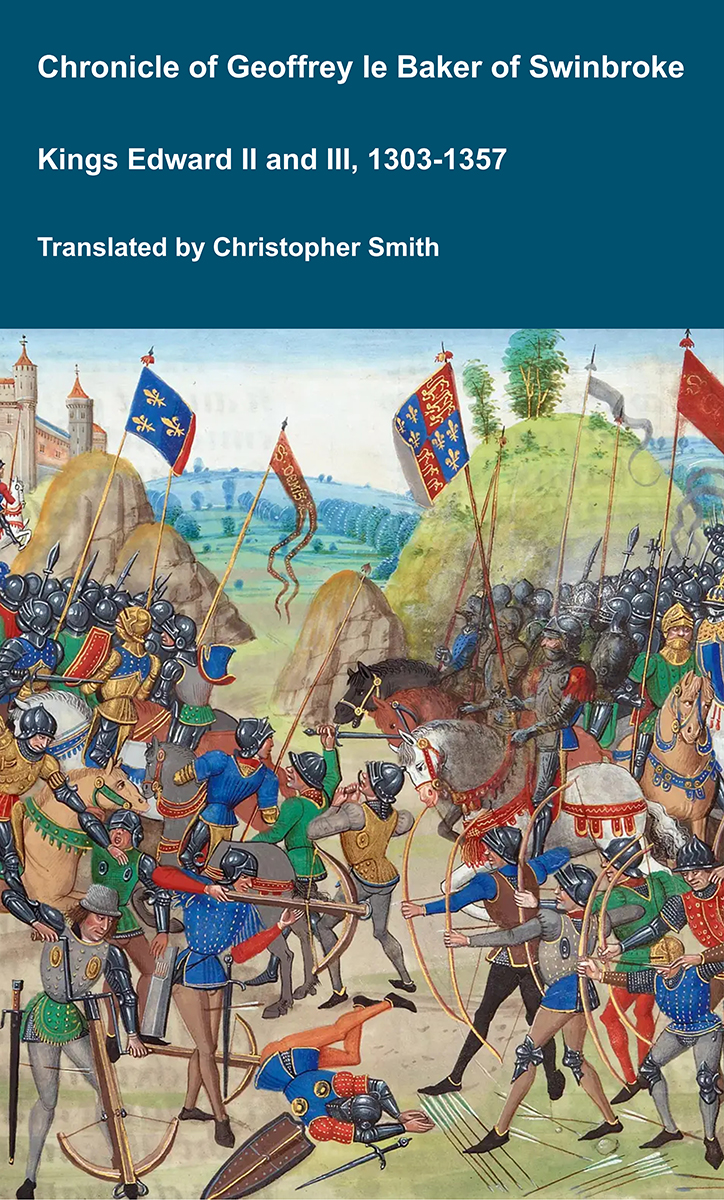
Chronicle of Geoffrey le Baker of Swinbroke
Baker was a secular clerk from Swinbroke, now Swinbrook, an Oxfordshire village two miles east of Burford. His Chronicle describes the events of the period 1303-1356: Gaveston, Bannockburn, Boroughbridge, the murder of King Edward II, the Scottish Wars, Sluys, Crécy, the Black Death, Winchelsea and Poitiers. To quote Herbert Bruce 'it possesses a vigorous and characteristic style, and its value for particular events between 1303 and 1356 has been recognised by its editor and by subsequent writers'. The book provides remarkable detail about the events it describes. Baker's text has been augmented with hundreds of notes, including extracts from other contemporary chronicles, such as the Annales Londonienses, Annales Paulini, Murimuth, Lanercost, Avesbury, Guisborough and Froissart to enrich the reader's understanding. The translation takes as its source the 'Chronicon Galfridi le Baker de Swynebroke' published in 1889, edited by Edward Maunde Thompson.
Available at Amazon in eBook and Paperback format.
In 1707 Robert Clayton [aged 78] died. His nephew William Clayton 1st Baronet was his heir.
[his father] John Clayton and [his mother] Alice Abbott were married.