

Henrici Quinti, Angliæ Regis, Gesta, is a first-hand account of the Agincourt Campaign, and subsequent events to his death in 1422. The author of the first part was a Chaplain in King Henry's retinue who was present from King Henry's departure at Southampton in 1415, at the siege of Harfleur, the battle of Agincourt, and the celebrations on King Henry's return to London. The second part, by another writer, relates the events that took place including the negotiations at Troye, Henry's marriage and his death in 1422.
Available at Amazon in eBook and Paperback format.
On 13th December 1819 Thomas Francis Dicksee was born to Richard Dicksee. Richard being described as a Gentleman on Thomas's wedding certificate in 1850.

On 25th December 1850 Thomas Francis Dicksee [aged 31] and Eliza Bernard [aged 24] were married at St James' Church, Piccadilly. His address given as 23 Howland Street, Fitzroy Square, hers as 4 Church Place.
Eliza Bernard: Around 1826 she was born to John Bernard. He, John, a Turner and Dishing Tackle Manufacturer according to her marriage certificate. In 1879 she died.
On 27th November 1853 [his son] Frank Bernard Dicksee was born to Thomas Francis Dicksee [aged 33] and [his wife] Eliza Bernard [aged 27].

1865. Thomas Francis Dicksee [aged 45]. "Ophelia".

1873. Thomas Francis Dicksee [aged 53]. "Ophelia".
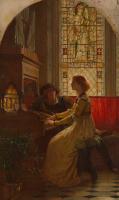
1877. Thomas Francis Dicksee [aged 57]. "Harmony".
From Painting In The Queens Reign, by A. G. Temple, 1897:
1877 was the year in which Frank Dicksee's work first made a distinct impression on the public mind. Harmony was a very appropriate title which this medieval organ, its fair player, and its handsome ardent listener bore. Through a high narrow-stained glass window the evening light poured its rich effect, but there was nothing meretricious about the work. The painter was scarcely twenty-four, but the result of sound training was perceived; good drawing and skillful arrangement, and a becoming modesty of theme, set in early Florentine times, entitled it to conspicuous notice, and it was promptly purchased by the Chantrey Bequest Trustees; a replica being painted afterwards, I believe, for the Duke of Connaught, who had desired to purchase the original. His scholarly drawing and sound management of colour, united to a marked instinct for grace of composition and completeness of design, have fitted the painter for the achievement of work of a high order; and one of the elements of beauty in his pictures, to the artistic sense at least, is the evidence of the unhesitating hand, and of the self-reliance which only thoroughly good training, and experience can give.
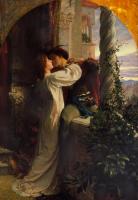
1877. Thomas Francis Dicksee [aged 57]. "Romeo and Juliet".
From Painting In The Queens Reign, by A. G. Temple, 1897:
1884 saw one of the loveliest of his works, Romeo and Juliet belonging now to Mr Charles Churchill. I believe the first thought of this design was a black and white drawing for Cassells. Its development afterwards in colour, with considerable variations, resulted in one of the most attractive renderings, and certainly one of the most skilled designs, of this oft-painted subject. Far behind it came Gabriel Max's, Ford Madox Brown's, and, one might safely say any other, in the pure and refined beauty of the slender Juliet's form, and the absence in the work of exaggeration in any particular. The position is a perfectly feasible one: no perilous rope-ladder sways from a dizzy height, no arm is stretched meaninglessly out into the air; the depiction of passion is undisturbed by any of these things, and the beauteous embracing figures, conscious as the painter has made us also, of the growing light, the awakening morn upon the distant hills, are as naturally placed as can be.
In 1879 [his wife] Eliza Bernard [aged 53] died.
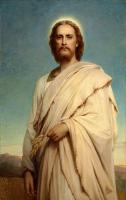
1883. Thomas Francis Dicksee [aged 63]. "Christ of the Cornfield".

1888. Thomas Francis Dicksee [aged 68]. "Amy Robsart".

Before 1895. Thomas Francis Dicksee [aged 75]. Self-portrait.
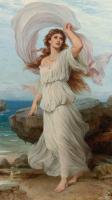
1895. Thomas Francis Dicksee [aged 75]. "Miranda".
Miranda: he was born to Duke Prospero.
On 6th November 1895 Thomas Francis Dicksee [aged 75] died.
The Times. 19th October 1928. With the consent of the Dean of Westminster, the Council of the Royal Academy have arranged for the first part of the funeral of the late President, Sir Frank Dicksee, to be held in Westminster Abbey, on Tuesday October 23rd at 2:00 p m. Those wishing to attend will be admitted without ticket by the North Door, or the Poets Corner Door in the south Transept. The burial will take place afterwards at the Hampstead Cemetery, Fortune-green, NW.
The Times. 24th October 1928. The King was represented by Sir Harry Verney, and the Prince of Wales by the Hon Bruce Ogilvy, and Princess Louise, Duchess of Argyll by Col B. W. L. MacMahon at the service for Sir Frank Dicksee which took place yesterday in Westminster Abbey. The Dean of Westminster officiated, assisted by Canon Storr, and the Reverend H. L. Nixon. A procession was formed at the West Door, and proceeded through the nave headed by the full choir and clergy.
The Pall Bearers were all titled with the exception of J. W. MacKail the distinguished academic and son-in-law of Sir Edward Burne-Jones. Amongst the mourners were many members of the Dicksee family, including Miss Mary Dicksee (sister), and Mr Herbert Thomas Dicksee. Official representatives included The French Ambassador, the Belgian Ambassador. The Brazilian Ambassador, the Swedish Minister, the High Commissioners for Australia and New Zealand, and (the 2nd) Lord Leverhume. Also present were many Academicians including W. Ouless, Sir John Lavery [aged 72], W. Goscombe-John [aged 68]. Mrs Blair Leighton, widow of Edmund, and Lady East [aged 83], widow of Sir Alfred were also among the mourners. The list of mourners in The Times includes many of the most distinguished people of the day.

The Times. The Death of Sir Frank Dicksee. Miss Winifred Holliday writes:
It must be rare for a man whose career is described as "a run of unbroken success" to remain to the end so beautifully unspoiled as was the late Sir Frank Dicksee, but in the memory of his friends his unaffected simplicity and unvarying kindliness were the finest part of that success. Perhaps, as there have been some allusions to his early work with my father, whose junior he was by some 15 years, I may be allowed to mention a recent and touching expression of his goodness. On my father's death last year, I had the difficult task of dealing with the immense variety of objects that an artist accumulates in the course of a long career, and amongst these was his life-size statue Sleep. Though not professionally a sculptor, my father considered her one of his best pieces of work of any kind whatsoever, yet when the house and studio were empty of all else Sleep still remained. What was I to do with her? In my difficulty I sought Sir Frank, and the difficulty vanished; in a few days she was transferred to one of his own studios. Nor was this all. My father, following what he considered to be the example of the great Greeks, had tinted the statue. This tinting, purely conventional in character, Sir Frank greatly admired; but the statue was in need of a thorough cleaning, which was done under his directions. The sequel is best given in his own words. Writing to me early this year he said:
"When you last saw Sleep you must have been disappointed; she was not looking her best. The man who cleaned her did his work well, but in the doing removed the colour from some parts of her figure, which troubled him, but I told him I would restore it. Two days ago I was able to go all over it, and she looks really beautiful. I should like you to see her now."
I went, and I shall never forget his smiling expression of pride and delight as he removed her coverings and turned to look at me. In the midst of all his incessant work, artistic and official, he had indeed found time to restore her from head to foot, and as I looked at her I felt that faithful though the colouring was to the original, he had in some charming way added a living and loving touch to the work of his old friend.