

Abbot John Whethamstede’s Chronicle of the Abbey of St Albans
Abbot John Whethamstede's Register aka Chronicle of his second term at the Abbey of St Albans, 1451-1461, is a remarkable text that describes his first-hand experience of the beginning of the Wars of the Roses including the First and Second Battles of St Albans, 1455 and 1461, respectively, their cause, and their consequences, not least on the Abbey itself. His text also includes Loveday, Blore Heath, Northampton, the Act of Accord, Wakefield, and Towton, and ends with the Coronation of King Edward IV. In addition to the events of the Wars of the Roses, Abbot John, or his scribes who wrote the Chronicle, include details in the life of the Abbey such as charters, letters, land exchanges, visits by legates, and disputes, which provide a rich insight into the day-to-day life of the Abbey, and the challenges faced by its Abbot.
Available at Amazon in eBook and Paperback format.
Around 1507 Thomas Pope was born at Deddington, Oxfordshire. He was educated at Banbury School, Oxfordshire and Eton College [Map].
Around 1534 Thomas Pope (age 27) was appointed Clerk of the Star Chamber.
In 1534 Thomas Pope (age 27) was appointed Warden of the Mint.
In 1536 Thomas Pope (age 29) was elected MP Buckingham.
Before 11th July 1536 Thomas Pope (age 29) and Elizabeth Gunston were married. They were divorced on 11 Jul 1536.
On 17th July 1536 Thomas Pope (age 29) and Margaret widow of Ralph Dodmer were married.
After 1538 Thomas Pope (age 31) and Elizabeth Blount (age 23) were married.
In 1539 Thomas Pope (age 32) was elected MP Berkshire.
In 1552 Thomas Pope (age 45) was appointed High Sheriff of Essex.
On 8th March 1556 Thomas Pope (age 49) received a royal charter for the establishment and endowment of a college of the "Holy and Undivided Trinity"
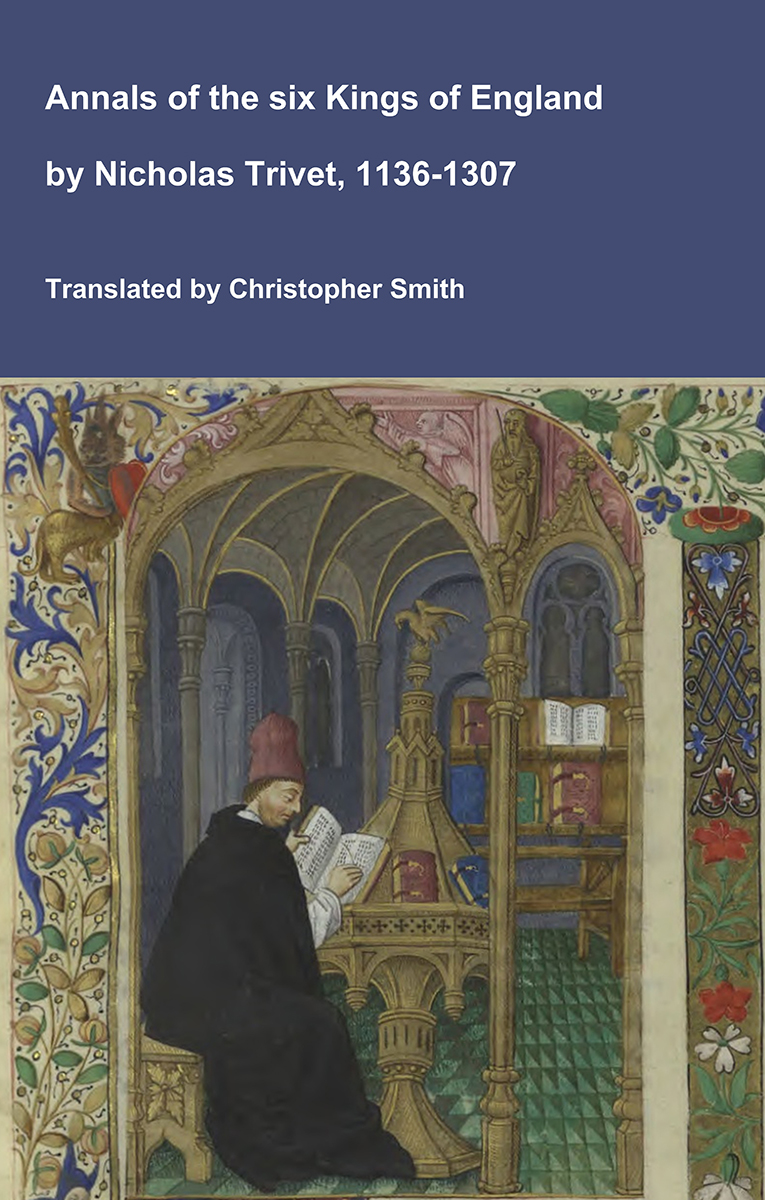
Annals of the six Kings of England by Nicholas Trivet
Translation of the Annals of the Six Kings of England by that traces the rise and rule of the Angevin aka Plantagenet dynasty from the mid-12th to early 14th century. Written by the Dominican scholar Nicholas Trivet, the work offers a vivid account of English history from the reign of King Stephen through to the death of King Edward I, blending political narrative with moral reflection. Covering the reigns of six monarchs—from Stephen to Edward I—the chronicle explores royal authority, rebellion, war, and the shifting balance between crown, church, and nobility. Trivet provides detailed insight into defining moments such as baronial conflicts, Anglo-French rivalry, and the consolidation of royal power under Edward I, whose reign he describes with particular immediacy. The Annals combines careful year-by-year reporting with thoughtful interpretation, presenting history not merely as a sequence of events but as a moral and political lesson. Ideal for readers interested in medieval history, kingship, and the origins of the English state, this chronicle remains a valuable and accessible window into the turbulent world of the Plantagenet kings.
Available at Amazon in eBook and Paperback format.
In 1557 Thomas Pope (age 50) was appointed High Sheriff of Hertfordshire.
On 29th January 1559 Thomas Pope (age 52) died at Clerkenwell [Map]. He was buried at St Stephen's Church, Walbrook.
After 29th January 1559 Hugh Paulett (age 50) and [his former wife] Elizabeth Blount (age 44) were married.
Henry Machyn's Diary. 6th February 1559. The vj day of Feybruary went to the chyrche to be bered at Clarkenwell [Map] ser Thomas Pope (deceased) knyght, with a standard and cott, pennon of armes, a targett, elmett and sword, and a ij dosen of armes, and xij for the branchys and vj for the .... of bokeram; and ij haroldes of armes, master Clarenshus and master Yorke; master Clarenshus bare the cott, and master Yorke bare the helmett and crest. And he gayff xl mantyll frys gownes, xx men and xx women; and xx men bare torchys; and the vomen ij and ij to-gether, with torchys; and ij grett whyt branchys, and iiij branchys tapurs of wax garnysshed with armes, and with iiij dosen pensels. And ser Recherd Sowthwell knyght and ser Thomas Stradlyng, and dyver odur morners in blake, to the nomber of lx and mo in blake, and all the howsse and the chyrche with blake and armes; and after to the plasse to drynke, with spyssebred and wyne; and the morow masse, iij songe, .... with ij pryke songe, and the iij of requiem, with the clarkes of London; and after he was bered; and, that done, to the plasse to dener, for ther was a grett dener, and plente of all thynges, and a grett dolle of money.
Note. P. 188. Funeral of sir Thomas Pope. This was the founder of Trinity college, Oxford. The original place of his interment is a matter of question (see the Biogr. Brit. 1760, p. 3404), which our diary does not determine. In his will he directed his executors to bury him in the church of that parish in which he should chance to die. This would be Clerkenwell. Stowe has preserved an inscription formerly in St. Stephen's, Walbrook: "Hic jacet Thomas Pope primus Thesaurarius Augmentationum, et Dna Margaretta uxor ejus, quæ quidem Margaretta obiit 16 Jan. 1538." Margaret, who was his second wife, was no doubt interred there; but the remains of both, it seems, were afterwards removed to the college chapel, according to the inscription round the verge of the tomb—"corpora Thome Pope . . et duarum Elizabethe et Margarete uxorum ejus." Elizabeth had been the name of his first as well as his third wife, but from the former he was divorced. It is to be presumed, therefore, the third was intended by the name [his former wife] Elizabeth (age 44); and she, after remarrying sir Hugh Poulet (age 50), of Hinton St. George, was brought to rest in the chapel in 1593. There is however only one female effigy lying by the founder's side: see an engraving in Skelton's Pietas Oxoniensis, 4to. 1830.
On 27th October 1593 [his former wife] Elizabeth Blount (age 78) died. She was buried at the Chapel of Trinity College, Oxford University which her first husband Thomas Pope had founded.
In 1638 [his former wife] Margaret widow of Ralph Dodmer died.