


The True Chronicles of Jean le Bel Volume 1 Chapters 1-60 1307-1342
The True Chronicles of Jean le Bel offer one of the most vivid and immediate accounts of 14th-century Europe, written by a knight who lived through the events he describes, and experienced some of them first hand. Covering the early decades of the Hundred Years’ War, this remarkable chronicle follows the campaigns of Edward III of England, the politics of France and the Low Countries, and the shifting alliances that shaped medieval warfare. Unlike later historians, Jean le Bel writes with a strong sense of eyewitness authenticity, drawing on personal experience and the testimony of fellow soldiers. His narrative captures not only battles and sieges, but also the realities of military life, diplomacy, and the ideals of chivalry that governed noble society. A key source for Jean Froissart, Le Bel’s chronicle stands on its own as a compelling and insightful work, at once historical record and literary achievement. This translation builds on the 1905 edition published in French by Jules Viard, adding extensive translations from other sources Rymer's Fœdera, the Chronicles of Adam Murimuth, William Nangis, Walter of Guisborough, a Bourgeois of Valenciennes, Geoffrey le Baker of Swinbroke and Richard Lescot to enrich the original text and Viard's notes.
Available at Amazon in eBook and Paperback format.
Paternal Family Tree: Borlase
Around 1564 William Borlase of Little Marlow was born to John Borlase of Buckinghamshire [aged 37].
On 17th November 1581 William Borlase of Little Marlow [aged 17] matriculated Magdalen College, Oxford University.
In 1584 William Borlase of Little Marlow [aged 20] was a student at Gray's Inn.
In 1589 [his son] William Borlase was born to William Borlase of Little Marlow [aged 25]. He married before 21st August 1619 Jane Popham and had issue.
Around 1590 [his son] Henry Borlase was born to William Borlase of Little Marlow [aged 26].
On 6th May 1593 [his father] John Borlase of Buckinghamshire [aged 66] died.
In 1601 William Borlase of Little Marlow [aged 37] was appointed High Sheriff of Buckinghamshire.
On 28th June 1603 William Borlase of Little Marlow [aged 39] was knighted at Beddington, Surrey.
In 1604 William Borlase of Little Marlow [aged 40] was elected MP Aylesbury.
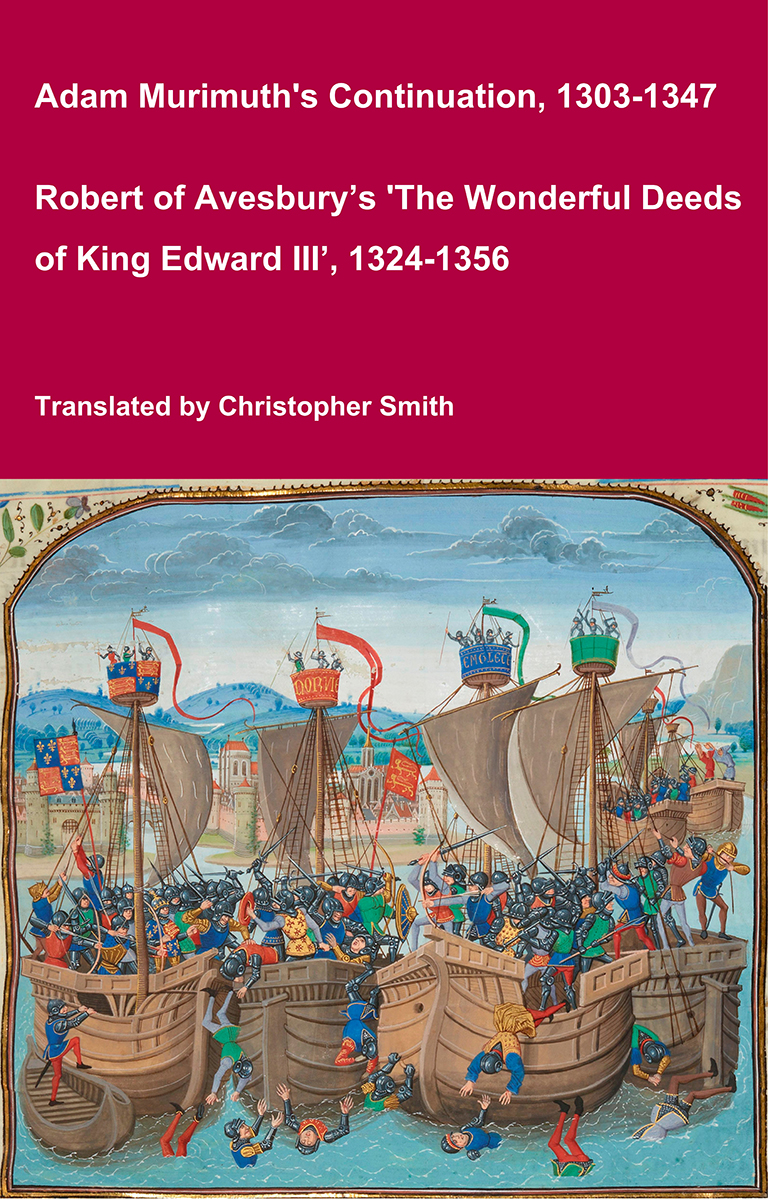
Adam Murimuth's Continuation and Robert of Avesbury’s 'The Wonderful Deeds of King Edward III'
This volume brings together two of the most important contemporary chronicles for the reign of Edward III and the opening phases of the Hundred Years’ War. Written in Latin by English clerical observers, these texts provide a vivid and authoritative window into the political, diplomatic, and military history of fourteenth-century England and its continental ambitions. Adam Murimuth Continuatio's Chronicarum continues an earlier chronicle into the mid-fourteenth century, offering concise but valuable notices on royal policy, foreign relations, and ecclesiastical affairs. Its annalistic structure makes it especially useful for establishing chronology and tracing the development of events year by year. Complementing it, Robert of Avesbury’s De gestis mirabilibus regis Edwardi tertii is a rich documentary chronicle preserving letters, treaties, and official records alongside narrative passages. It is an indispensable source for understanding Edward III’s claim to the French crown, the conduct of war, and the mechanisms of medieval diplomacy. Together, these works offer scholars, students, and enthusiasts a reliable and unembellished account of a transformative period in English and European history. Essential for anyone interested in medieval chronicles, the Hundred Years’ War, or the reign of Edward III.
Available at Amazon in eBook and Paperback format.
In 1614 William Borlase of Little Marlow [aged 50] was elected MP Buckinghamshire.
Before 21st August 1619 [his son] William Borlase [aged 30] and [his daughter-in-law] Jane Popham were married.
In 1624 [his son] Henry Borlase [aged 34] died.
In 1624 William Borlase of Little Marlow [aged 60] founded Sir William Borlase's Grammar School in memory of his son Henry Borlase [aged 34] who had died that year.
On 4th September 1629 William Borlase of Little Marlow [aged 65] died. He was buried on 10th September 1629.