

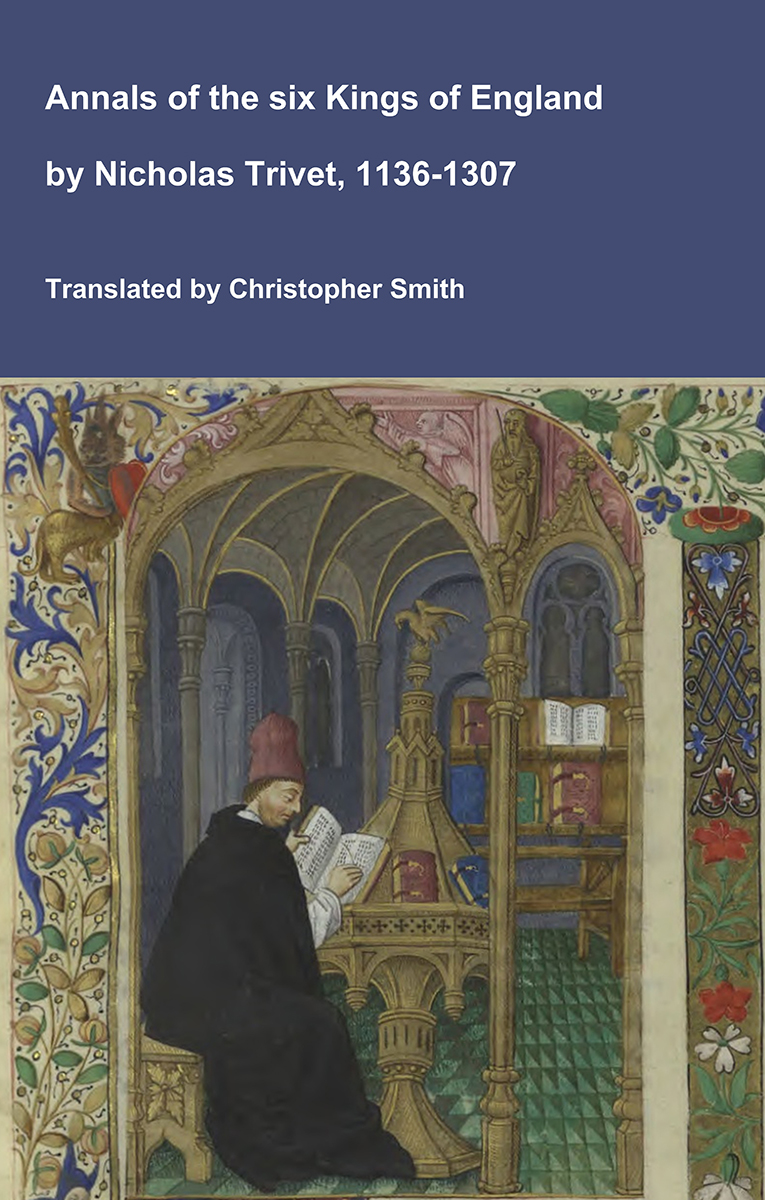
Annals of the six Kings of England by Nicholas Trivet
Translation of the Annals of the Six Kings of England by that traces the rise and rule of the Angevin aka Plantagenet dynasty from the mid-12th to early 14th century. Written by the Dominican scholar Nicholas Trivet, the work offers a vivid account of English history from the reign of King Stephen through to the death of King Edward I, blending political narrative with moral reflection. Covering the reigns of six monarchs—from Stephen to Edward I—the chronicle explores royal authority, rebellion, war, and the shifting balance between crown, church, and nobility. Trivet provides detailed insight into defining moments such as baronial conflicts, Anglo-French rivalry, and the consolidation of royal power under Edward I, whose reign he describes with particular immediacy. The Annals combines careful year-by-year reporting with thoughtful interpretation, presenting history not merely as a sequence of events but as a moral and political lesson. Ideal for readers interested in medieval history, kingship, and the origins of the English state, this chronicle remains a valuable and accessible window into the turbulent world of the Plantagenet kings.
Available at Amazon in eBook and Paperback format.
In 1584 William Button 1st Baronet was born to William Button of Alton and Tockenham Court in Lyneham in Wiltshire and Jane Lamb.
On 13th February 1601 William Button 1st Baronet [aged 17] matriculated Queen's College, Oxford University.
On 15th July 1605 William Button 1st Baronet [aged 21] was knighted at Whitehall Palace [Map].
In 1611 William Button 1st Baronet [aged 27] was appointed High Sheriff of Wiltshire.
Before 1614 William Button 1st Baronet [aged 29] and Ruth Dunch were married.
In 1622 [his son] William Button 2nd Baronet was born to William Button 1st Baronet [aged 38] and [his wife] Ruth Dunch. He married 6th April 1640 Anne Rolle.
In 1622 [his son] Robert Button 3rd Baronet was born to William Button 1st Baronet [aged 38] and [his wife] Ruth Dunch.
In 1622 [his son] John Button 4th Baronet was born to William Button 1st Baronet [aged 38] and [his wife] Ruth Dunch.
On 18th March 1622 William Button 1st Baronet [aged 38] was created 1st Baronet Button of Alton in Wiltshire.
On 6th April 1640 [his son] William Button 2nd Baronet [aged 18] and [his daughter-in-law] Anne Rolle [aged 24] were married at St Petroc's Church, Petrockstowe [Map].
On 2nd January 1647 William Button 1st Baronet [aged 63] was fined £2380 for having supported the King during the Civil War.
Chronicle of Walter of Guisborough
A canon regular of the Augustinian Guisborough Priory, Yorkshire, formerly known as The Chronicle of Walter of Hemingburgh, describes the period from 1066 to 1346. Before 1274 the Chronicle is based on other works. Thereafter, the Chronicle is original, and a remarkable source for the events of the time. This book provides a translation of the Chronicle from that date. The Latin source for our translation is the 1849 work edited by Hans Claude Hamilton. Hamilton, in his preface, says: 'In the present work we behold perhaps one of the finest samples of our early chronicles, both as regards the value of the events recorded, and the correctness with which they are detailed; Nor will the pleasing style of composition be lightly passed over by those capable of seeing reflected from it the tokens of a vigorous and cultivated mind, and a favourable specimen of the learning and taste of the age in which it was framed.'
Available at Amazon in eBook and Paperback format.
On 16th January 1655 William Button 1st Baronet [aged 71] died. He was buried at St James the Great Church, North Wraxall. His son William [aged 33] succeeded 2nd Baronet Button of Alton in Wiltshire.
Wiltshire Archaeological Magazine 1857 V4 Pages 307-363. "The morrow after Twelfday, Mr. Charles Seymour and Sir William Button3, mett with their packs of Hounds at the Grey-Weathers. These downes looke as if they were sowen with great Stones, very thick, and in a dusky evening, they looke like a flock of Sheep: from whence it takes its name: one might fancy it to have been the scene, where the giants fought with huge stones against the Gods. "Twas here that our game began, and the chase led us (at length) thorough the village of Aubury, into the closes there: where I was wonderfully surprized at the sight of those vast stones, of which I had never heard before: as also at the mighty Bank and graffe4" about it: I observed in the inclosure some segments of rude circles, made with these stones, whence I concluded, they had been in the old time complete. I left my company a while, entertaining myselfe with a more delightfull indagation: and then (steered by the cry of the Hounds) overtooke the company, and went with them to Kynnet, where was a good hunting dinner provided.
"Our repast was cheerfull, which being ended, we remounted, and beat over the downes with our greyhounds. In this afternoon's diversion I happened to see Wensditch (sic), and an old camp and two or three sepulchres. The evening put a period to our sport, and we returned to the Castle at Marleborough, where we were nobly entertained; juvat hec meminisse5. I thinke I am the only surviving gentleman of that company.
Note 1. It is here printed from a transcript from the original MS. taken for the purpose of the present paper, and the accompanying illustrations have been reduced from very accurate facsimiles of Aubrey's sketches, which the writer has presented to the Society's Library and Museum at Devizes.
Note 2. Then of Allingham neer Chippenham: since Ld Seymour.
Note 3. Of Tottenham, Baronet. Tockenham.
Note 4. Ditch.
Note 5. it helps to remember this.
Father: William Button of Alton and Tockenham Court in Lyneham in Wiltshire
GrandFather: John Lamb
Mother: Jane Lamb