

William of Worcester's Chronicle of England
William of Worcester, born around 1415, and died around 1482 was secretary to John Fastolf, the renowned soldier of the Hundred Years War, during which time he collected documents, letters, and wrote a record of events. Following their return to England in 1440 William was witness to major events. Twice in his chronicle he uses the first person: 1. when writing about the murder of Thomas, 7th Baron Scales, in 1460, he writes '… and I saw him lying naked in the cemetery near the porch of the church of St. Mary Overie in Southwark …' and 2. describing King Edward IV's entry into London in 1461 he writes '… proclaimed that all the people themselves were to recognize and acknowledge Edward as king. I was present and heard this, and immediately went down with them into the city'. William’s Chronicle is rich in detail. It is the source of much information about the Wars of the Roses, including the term 'Diabolical Marriage' to describe the marriage of Queen Elizabeth Woodville’s brother John’s marriage to Katherine, Dowager Duchess of Norfolk, he aged twenty, she sixty-five or more, and the story about a paper crown being placed in mockery on the severed head of Richard, 3rd Duke of York.
Available at Amazon in eBook and Paperback format.
Paternal Family Tree: Craven
Maternal Family Tree: Anne Bond 1615
Around 1605 [his father] William Craven [aged 57] and [his mother] Elizabeth Whitmore [aged 20] were married. The difference in their ages was 37 years.
In June 1608 William Craven 1st Earl Craven was born to [his father] William Craven [aged 60] and [his mother] Elizabeth Whitmore [aged 23] at Appletreewick North Yorkshire.
In 1610 [his father] William Craven [aged 62] was appointed Lord Mayor of London.
On 18th July 1618 [his father] William Craven [aged 70] died. He was buried at St Andrew Undershaft Church, Aldgate Ward [Map].
In 1624 [his mother] Elizabeth Whitmore [aged 39] died.
Before 1626 [his brother-in-law] Percy Herbert 2nd Baron Powis [aged 27] and [his sister] Elizabeth Craven Baroness Herbert [aged 25] were married. She by marriage Lady Powis of Red Castle in Montgomeryshire.

On 12th March 1627 William Craven 1st Earl Craven [aged 18] was created 1st Baron Craven of Hamstead Marshall in Berkshire with a special remainder to his brothers John [aged 16], who was later created Baron Craven of Ryton, and Thomas, both of whom predeceased William, rendering the remainder ineffective.

Between 1634 and 1643 [his brother] John Craven 1st Baron Craven [aged 23] and [his sister-in-law] Elizabeth Spencer Baroness Craven [aged 17] were married.
On 21st March 1643 [his brother] John Craven 1st Baron Craven [aged 32] was created 1st Baron Craven of Ryton in Shropshire. [his sister-in-law] Elizabeth Spencer Baroness Craven [aged 26] by marriage Baroness Craven of Ryton in Shropshire.
In 1648 [his brother] John Craven 1st Baron Craven [aged 37] died. Baron Craven of Ryton in Shropshire extinct.
John Evelyn's Diary. 8th June 1654.. my wife [aged 19] and I set out in a coach and four horses, in our way to visit relations of hers in Wiltshire, and other parts, where we resolved to spend some months. We dined at Windsor [Map], saw the Castle and Chapel of St. George, where they have laid our blessed Martyr, King Charles, in the vault just before the alter. The church and workmanship in stone is admirable. The Castle itself is large in circumference; but the rooms melancholy, and of ancient magnificence. The keep, or mount, hath, besides its incomparable prospect, a very profound well; and the terrace toward Eton, with the park, meandering Thames, and sweet meadows, yield one of the most delightful prospects. That night, we lay at Reading. Saw my Lord Craven's [aged 46] house at Causam [Caversham], now in ruins, his goodly woods felling by the Rebels.
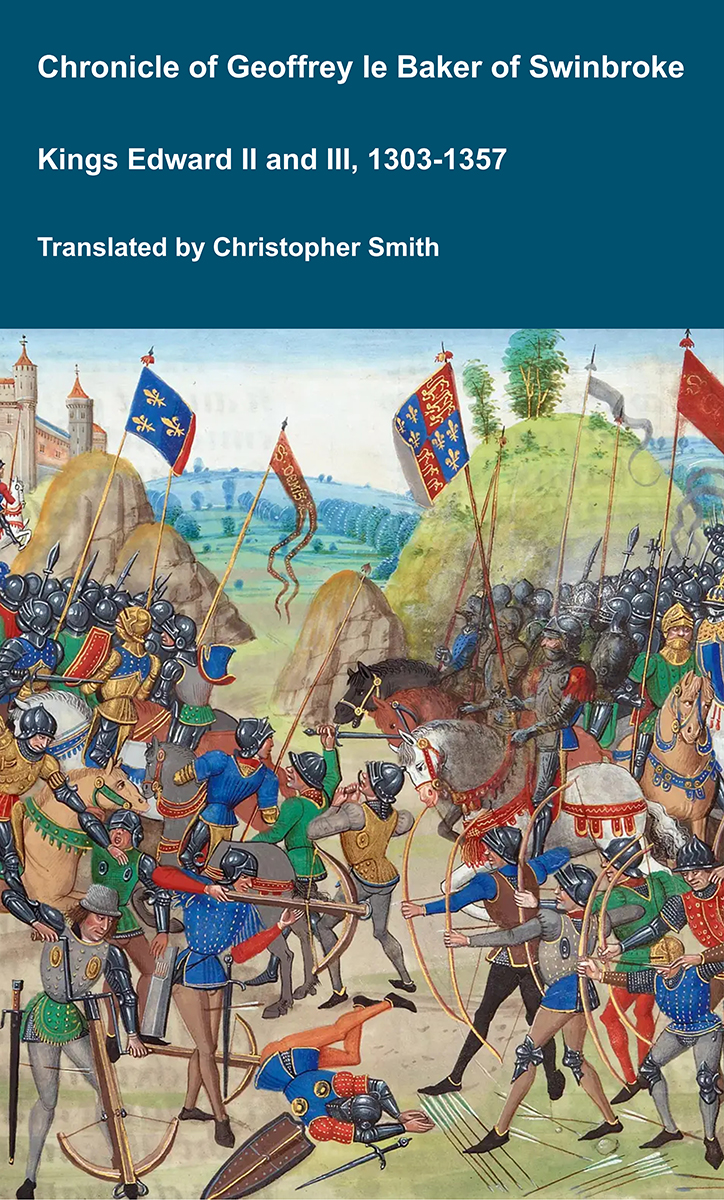
Chronicle of Geoffrey le Baker of Swinbroke
Baker was a secular clerk from Swinbroke, now Swinbrook, an Oxfordshire village two miles east of Burford. His Chronicle describes the events of the period 1303-1356: Gaveston, Bannockburn, Boroughbridge, the murder of King Edward II, the Scottish Wars, Sluys, Crécy, the Black Death, Winchelsea and Poitiers. To quote Herbert Bruce 'it possesses a vigorous and characteristic style, and its value for particular events between 1303 and 1356 has been recognised by its editor and by subsequent writers'. The book provides remarkable detail about the events it describes. Baker's text has been augmented with hundreds of notes, including extracts from other contemporary chronicles, such as the Annales Londonienses, Annales Paulini, Murimuth, Lanercost, Avesbury, Guisborough and Froissart to enrich the reader's understanding. The translation takes as its source the 'Chronicon Galfridi le Baker de Swynebroke' published in 1889, edited by Edward Maunde Thompson.
Available at Amazon in eBook and Paperback format.
On 7th March 1655 William Herbert 1st Baron Powis [aged 82] died. He was buried at St Mary and Christ Church, Hendon Barnet. His son [his brother-in-law] Percy [aged 57] succeeded 2nd Baron Powis of Powis Castle in Powys. [his sister] Elizabeth Craven Baroness Herbert [aged 55] by marriage Baroness Powis of Powis Castle in Powys.

Before 1656 Gerrit van Honthorst [aged 63]. Portrait of William Craven 1st Earl Craven [aged 47].
Samuel Pepys' Diary. 17th August 1661. So he and I to the Wardrobe to dinner, and after dinner Captain Ferrers and I to the Opera, and saw "The Witts" again, which I like exceedingly. The Queen of Bohemia [aged 64] was here, brought by my Lord Craven [aged 53].


In 1662 [his sister] Elizabeth Craven Baroness Herbert [aged 62] died.
Samuel Pepys' Diary. 15th June 1663. Thence to church, where Dr. Britton preached a sermon full of words against the Nonconformists, but no great matter in it, nor proper for the day at all. His text was, "With one mind and one mouth give glory to God, the Father of our Lord Jesus Christ". That done, by water, I in the barge with the Maister, to the Trinity House, Deptford [Map] at London; where, among others, I found my Lords Sandwich and Craven [aged 55], and my cousin Roger Pepys [aged 46], and Sir Wm. Wheeler [aged 52]. Anon we sat down to dinner, which was very great, as they always have. Great variety of talk. Mr. Prin [aged 63], among many, had a pretty tale of one that brought in a bill in parliament for the empowering him to dispose his land to such children as he should have that should bear the name of his wife. It was in Queen Elizabeth's time. One replied that there are many species of creatures where the male gives the denomination to both sexes, swan and woodcock, but not above one where the female do, and that is a goose.
In 1664 William Craven 1st Earl Craven [aged 55] was created 1st Earl Craven in Yorkshire, 1st Viscount Craven of Uffington in Berkshire with a special remainder to his kinsmen Sir William Craven and Sir Anthony Craven.
Samuel Pepys' Diary. 6th June 1664. Then by barge with Sir W. Batten [aged 63] to Trinity House, Deptford [Map]. It seems they have with much ado carried it for Sir G. Carteret [aged 54] against Captain Harrison, poor man, who by succession ought to have been it, and most hands were for him, but only they were forced to fright the younger Brethren by requiring them to set their hands (which is an ill course) and then Sir G. Carteret carryed it. Here was at dinner my Lord Sandwich [aged 38], Mr. Coventry [aged 36], my Lord Craven [aged 56], and others. A great dinner, and good company. Mr. Prin [aged 64] also, who would not drink any health, no, not the King's, but sat down with his hat on all the while1 but nobody took notice of it to him at all; but in discourse with the Doctor he did declare himself that he ever was, and has expressed himself in all his books for mixt communion against the Presbyterian examination.
Note 1. William Prynne had published in 1628 a small book against the drinking of healths, entitled, "Healthes, Sicknesse; or a compendious and briefe Discourse, prouing, the Drinking and Pledging of Healthes to be sinfull and utterly unlawfull unto Christians ... wherein all those ordinary objections, excuses or pretences, which are made to justifie, extenuate, or excuse the drinking or pledging of Healthes are likewise cleared and answered". The pamphlet was dedicated to Charles I as "more interessed in the theame and subject of this compendious discourse then any other that I know", and "because your Majestie of all other persons within your owne dominions, are most dishonoured, prejudiced, and abused by these Healthes"..


Samuel Pepys' Diary. 24th August 1664. So after 'Change [Map] home and a good dinner, and then to White Hall to a Committee of the Fishery, where my Lord Craven [aged 56] and Mr. Gray mightily against Mr. Creed's being joined in the warrant for Secretary with Mr. Duke. However I did get it put off till the Duke of Yorke [aged 30] was there, and so broke up doing nothing.
Samuel Pepys' Diary. 18th October 1664. At noon dined at home. In the afternoon to the Fishery, where, very confused and very ridiculous, my Lord Craven's [aged 56] proceedings, especially his finding fault with Sir J. Collaton and Colonell Griffin's' report in the accounts of the lottery-men.
Samuel Pepys' Diary. 18th November 1664. Up and to the office, and thence to the Committee of the Fishery at White Hall, where so poor simple doings about the business of the Lottery, that I was ashamed to see it, that a thing so low and base should have any thing to do with so noble an undertaking. But I had the advantage this day to hear Mr. Williamson [aged 31] discourse, who come to be a contractor with others for the Lotterys, and indeed I find he is a very logicall man and a good speaker. But it was so pleasant to see my Lord Craven [aged 56], the chaireman, before many persons of worth and grave, use this comparison in saying that certainly these that would contract for all the lotteries would not suffer us to set up the Virginia lottery for plate before them, "For", says he, "if I occupy a wench first, you may occupy her again your heart out you can never have her maidenhead after I have once had it", which he did more loosely, and yet as if he had fetched a most grave and worthy instance. They made mirth, but I and others were ashamed of it.

In 1665 William Craven 1st Earl Craven [aged 56] was created 1st Baron Craven of Hamstead Marshall in Berkshire with a special remainder to his cousin William Craven [aged 26].
Samuel Pepys' Diary. 19th August 1665. Our fleete is come home to our great grief with not above five weeks' dry, and six days' wet provisions: however, must out again; and the Duke [aged 31] hath ordered the Soveraigne, and all other ships ready, to go out to the fleete to strengthen them. This news troubles us all, but cannot be helped. Having read all this news, and received commands of the Duke with great content, he giving me the words which to my great joy he hath several times said to me, that his greatest reliance is upon me. And my Lord Craven [aged 57] also did come out to talk with me, and told me that I am in mighty esteem with the Duke, for which I bless God.
Chronicle of Geoffrey le Baker of Swinbroke
Baker was a secular clerk from Swinbroke, now Swinbrook, an Oxfordshire village two miles east of Burford. His Chronicle describes the events of the period 1303-1356: Gaveston, Bannockburn, Boroughbridge, the murder of King Edward II, the Scottish Wars, Sluys, Crécy, the Black Death, Winchelsea and Poitiers. To quote Herbert Bruce 'it possesses a vigorous and characteristic style, and its value for particular events between 1303 and 1356 has been recognised by its editor and by subsequent writers'. The book provides remarkable detail about the events it describes. Baker's text has been augmented with hundreds of notes, including extracts from other contemporary chronicles, such as the Annales Londonienses, Annales Paulini, Murimuth, Lanercost, Avesbury, Guisborough and Froissart to enrich the reader's understanding. The translation takes as its source the 'Chronicon Galfridi le Baker de Swynebroke' published in 1889, edited by Edward Maunde Thompson.
Available at Amazon in eBook and Paperback format.
Samuel Pepys' Diary. 23rd September 1665. Here we dined, and I did hear my Lord Craven [aged 57] whisper, as he is mightily possessed with a good opinion of me, much to my advantage, which my good Lord did second, and anon my Lord Craven did speak publiquely of me to the Duke [aged 31], in the hearing of all the rest; and the Duke did say something of the like advantage to me; I believe, not much to the satisfaction of my brethren; but I was mightily joyed at it.
Samuel Pepys' Diary. 9th October 1665. Up, my head full of business, and called upon also by Sir John Shaw, to whom I did give a civil answer about our prize goods, that all his dues as one of the Farmers of the Customes are paid, and showed him our Transire; with which he was satisfied, and parted, ordering his servants to see the weight of them. I to the office, and there found an order for my coming presently to the Duke of Albemarle [aged 56], and what should it be, but to tell me, that, if my Lord Sandwich [aged 40] do not come to towne, he do resolve to go with the fleete to sea himself, the Dutch, as he thinks, being in the Downes, and so desired me to get a pleasure boat for to take him in to-morrow morning, and do many other things, and with a great liking of me, and my management especially, as that coxcombe my Lord Craven [aged 57] do tell me, and I perceive it, and I am sure take pains enough to deserve it.


Samuel Pepys' Diary. 13th October 1665. So to the office, and there very busy till about noon comes Sir W. Warren, and he goes and gets a bit of meat ready at the King's Head [Map] for us, and I by and by thither, and we dined together, and I am not pleased with him about a little business of Tangier that I put to him to do for me, but however, the hurt is not much, and his other matters of profit to me continue very likely to be good. Here we spent till 2 o'clock, and so I set him on shore, and I by water to the Duke of Albemarle [aged 56], where I find him with Lord Craven [aged 57] and Lieutenant of the Tower [aged 50] about him; among other things, talking of ships to get of the King [aged 35] to fetch coles for the poore of the city, which is a good worke.

Samuel Pepys' Diary. 13th October 1665. But, Lord! to hear the silly talke between these three great people! Yet I have no reason to find fault, the Duke [aged 56] and Lord Craven [aged 57] being my very great friends. Here did the business I come about, and so back home by water, and there Cocke [aged 48] comes to me and tells me that he is come to an understanding with Fisher, and that he must give him £100, and that he shall have his goods in possession to-morrow, they being all weighed to-day, which pleases me very well.
Samuel Pepys' Diary. 14th November 1665. Called up by break of day by Captain Cocke [aged 48], by agreement, and he and I in his coach through Kent-streete (a sad place through the plague, people sitting sicke and with plaisters about them in the street begging) to Viner's [aged 34] and Colvill's about money business, and so to my house, and there I took £300 in order to the carrying it down to my Lord Sandwich [aged 40] in part of the money I am to pay for Captain Cocke by our agreement. So I took it down, and down I went to Greenwich, Kent [Map] to my office, and there sat busy till noon, and so home to dinner, and thence to the office again, and by and by to the Duke of Albemarle's [aged 56] by water late, where I find he had remembered that I had appointed to come to him this day about money, which I excused not doing sooner; but I see, a dull fellow, as he is, do sometimes remember what another thinks he mindeth not. My business was about getting money of the East India Company; but, Lord! to see how the Duke himself magnifies himself in what he had done with the Company; and my Lord Craven [aged 57] what the King [aged 35] could have done without my Lord Duke, and a deale of stir, but most mightily what a brave fellow I am.

Samuel Pepys' Diary. 13th January 1666. Home with his Lordship to Mrs. Williams's, in Covent-Garden [Map], to dinner (the first time I ever was there), and there met Captain Cocke [aged 49]; and pretty merry, though not perfectly so, because of the fear that there is of a great encrease again of the plague this week. And again my Lord Bruncker [aged 46] do tell us, that he hath it from Sir John Baber; who is related to my Lord Craven [aged 57], that my Lord Craven do look after Sir G. Carteret's [aged 56] place, and do reckon himself sure of it.
Samuel Pepys' Diary. 22nd November 1665. Up, and by water to the Duke of Albemarle [aged 56], and there did some little business, but most to shew myself, and mightily I am yet in his and Lord Craven's [aged 57] books, and thence to the Swan [Map] and there drank and so down to the bridge, and so to the 'Change [Map], where spoke with many people, and about a great deale of business, which kept me late.
Samuel Pepys' Diary. 7th January 1666. Lord's Day. Up, and being trimmed I was invited by Captain Cocke [aged 49], so I left my wife, having a mind to some discourse with him, and dined with him. He tells me of new difficulties about his goods which troubles me and I fear they will be great. He tells me too what I hear everywhere how the towne talks of my Lord Craven [aged 57] being to come into Sir G. Carteret's [aged 56] place; but sure it cannot be true. But I do fear those two families, his and my Lord Sandwich's [aged 40], are quite broken. And I must now stand upon my own legs.
Samuel Pepys' Diary. 19th June 1667. While we were discoursing over our publique misfortunes, I am called in to a large Committee of the Council: present the Duke of Albemarle [aged 58], Anglesey [aged 52], Arlington [aged 49], Ashly [aged 45], Carteret [aged 57], Duncomb [aged 44], Coventry [aged 39], Ingram [aged 52], Clifford [aged 36], Lauderdale [aged 51], Morrice [aged 64], Manchester [aged 65], Craven [aged 59], Carlisle [aged 38], Bridgewater [aged 44].
Samuel Pepys' Diary. 24th March 1668. Thence up and down Westminster by Mrs. Burroughes her mother's shop, thinking to have seen her, but could not, and therefore back to White Hall, where great talk of the tumult at the other end of the town, about Moore-fields [Map], among the 'prentices, taking the liberty of these holydays to pull down bawdy-houses1. And, Lord! to see the apprehensions which this did give to all people at Court, that presently order was given for all the soldiers, horse and foot, to be in armes! and forthwith alarmes were beat by drum and Trumpet through Westminster, and all to their colours, and to horse, as if the French were coming into the town! So Creed, whom I met here, and I to Lincolne's Inn-fields, thinking to have gone into the fields to have seen the 'prentices; but here we found these fields full of soldiers all in a body, and my Lord Craven [aged 59] commanding of them, and riding up and down to give orders, like a madman. And some young men we saw brought by soldiers to the Guard at White Hall, and overheard others that stood by say, that it was only for pulling down the bawdy-houses; and none of the bystanders finding fault with them, but rather of the soldiers for hindering them. And we heard a justice of the Peace this morning say to the King [aged 37], that he had been endeavouring to suppress this tumult, but could not; and that, imprisoning some [of them] in the new prison at Clerkenwell, the rest did come and break open the prison and release them; and that they do give out that they are for pulling down the bawdy-houses, which is one of the greatest grievances of the nation. To which the King made a very poor, cold, insipid answer: "Why, why do they go to them, then?" and that was all, and had no mind to go on with the discourse. Mr. Creed and I to dinner to my Lord Crew [aged 70], where little discourse, there being none but us at the table, and my Lord and my Lady Jemimah, and so after dinner away, Creed and I to White Hall, expecting a Committee of Tangier, but come too late. So I to attend the Council, and by and by were called in with Lord Brouncker [aged 48] and Sir W. Pen [aged 46] to advise how to pay away a little money to most advantage to the men of the yards, to make them dispatch the ships going out, and there did make a little speech, which was well liked, and after all it was found most satisfactory to the men, and best for the King's dispatch, that what money we had should be paid weekly to the men for their week's work until a greater sum could be got to pay them their arrears and then discharge them. But, Lord! to see what shifts and what cares and thoughts there was employed in this matter how to do the King's work and please the men and stop clamours would make a man think the King should not eat a bit of good meat till he has got money to pay the men, but I do not see the least print of care or thoughts in him about it at all. Having done here, I out and there met Sir Fr. Hollis [aged 25], who do still tell me that, above all things in the world, he wishes he had my tongue in his mouth, meaning since my speech in Parliament. He took Lord Brouncker and me down to the guards, he and his company being upon the guards to-day; and there he did, in a handsome room to that purpose, make us drink, and did call for his bagpipes, which, with pipes of ebony, tipt with silver, he did play beyond anything of that kind that ever I heard in my life; and with great pains he must have obtained it, but with pains that the instrument do not deserve at all; for, at the best, it is mighty barbarous musick.
Note 1. It was customary for the apprentices of the metropolis to avail themselves of their holidays, especially on Shrove Tuesday, to search after women of ill fame, and to confine them during the season of Lent. See a "Satyre against Separatists", 1642. "Stand forth, Shrove Tuesday, one a' the silenc'st bricklayers; 'Tis in your charge to pull down bawdy-houses". Middleton's Inner Temple Masque, 1619, Works, ed. Bullen, vii., 209.


Samuel Pepys' Diary. 16th June 1668. Tuesday. So paying the reckoning, 14s. 4d., and servants, 2s., poor 1s., set out; and overtook one coach and kept a while company with it, till one of our horses losing a shoe, we stopped and drank and spent 1s. So on, and passing through a good part of this county of Wiltshire, saw a good house of Alexander Popham's [aged 63], and another of my Lord Craven's [aged 60], I think in Barkeshire. Come to Newbery [Map], and there dined, which cost me, and musick, which a song of the old courtier of Queen Elizabeth's, and how he was changed upon the coming in of the King [aged 38], did please me mightily, and I did cause W. Hewer [aged 26] to write it out, 3s. 6d. Then comes the reckoning, forced to change gold, 8s. 7d.; servants and poor, 1s. 6d. So out, and lost our way, which made me vexed, but come into it again; and in the evening betimes come to Reading [Map], and there heard my wife read more of "Mustapha", and then to supper, and then I to walk about the town, which is a very great one, I think bigger than Salsbury: a river runs through it, in seven branches, and unite in one, in one part of the town, and runs into the Thames half-a-mile off one odd sign of the Broad Face. W. Hewer troubled with the headake we had none of his company last night, nor all this day nor night to talk. Then to my inn, and so to bed.
John Evelyn's Diary. 19th June 1671. To a splendid dinner at the great room in Deptford Trinity House [Map], Sir Thomas Allen [Note. Possibly Thomas Allen 1st Baronet [aged 38], Thomas Allen [aged 68].] chosen Master, and succeeding the Earl of Craven [aged 63].
The History of William Marshal was commissioned by his son shortly after William’s death in 1219 to celebrate the Marshal’s remarkable life; it is an authentic, contemporary voice. The manuscript was discovered in 1861 by French historian Paul Meyer. Meyer published the manuscript in its original Anglo-French in 1891 in two books. This book is a line by line translation of the first of Meyer’s books; lines 1-10152. Book 1 of the History begins in 1139 and ends in 1194. It describes the events of the Anarchy, the role of William’s father John, John’s marriages, William’s childhood, his role as a hostage at the siege of Newbury, his injury and imprisonment in Poitou where he met Eleanor of Aquitaine and his life as a knight errant. It continues with the accusation against him of an improper relationship with Margaret, wife of Henry the Young King, his exile, and return, the death of Henry the Young King, the rebellion of Richard, the future King Richard I, war with France, the death of King Henry II, and the capture of King Richard, and the rebellion of John, the future King John. It ends with the release of King Richard and the death of John Marshal.
Available at Amazon in eBook and Paperback format.
On 9th April 1697 William Craven 1st Earl Craven [aged 88] died. Earl Craven in Yorkshire, Viscount Craven of Uffington in Berkshire and Baron Craven of Hamstead Marshall in Berkshire extinct. His half first cousin three times removed William [aged 28] succeeded 2nd Baron Craven of Hamstead Marshall in Berkshire.
GrandFather: William Craven 
Father: William Craven
William Craven 1st Earl Craven
GrandFather: William Whitmore of Balmes Manor in Hackney
Mother: Elizabeth Whitmore
GrandMother: Anne Bond