

Chronicle of a Bourgeois of Valenciennes
Récits d’un bourgeois de Valenciennes aka The Chronicle of a Bourgeois of Valenciennes is a vivid 14th-century vernacular chronicle written by an anonymous urban chronicler from Valenciennes in the County of Hainaut. It survives in a manuscript that describes local and regional history from about 1253 to 1366, blending chronology, narrative episodes, and eyewitness-style accounts of political, military, and social events in medieval France, Flanders, and the Low Countries. The work begins with a chronological framework of events affecting Valenciennes and its region under rulers such as King Philip VI of France and the shifting allegiances of local nobility. It includes accounts of conflicts, sieges, diplomatic manoeuvres, and the impact of broader struggles like the Hundred Years’ War on urban life in Hainaut. Written from the perspective of a burgher (bourgeois) rather than a monastery or royal court, the chronicle offers a rare lay viewpoint on high politics and warfare, reflecting how merchants, townspeople, and civic institutions experienced the turbulence of the 13th and 14th centuries. Its narrative style combines straightforward reporting of events with moral and civic observations, making it a valuable source for readers interested in medieval urban society, regional politics, and the lived experience of war and governance in pre-modern Europe.
Available at Amazon in eBook and Paperback format.
In or before 1827 [his father] William Morris [aged 29] and [his mother] Emma Shelton [aged 22] were married.
On 24th March 1834 William Morris was born to William Morris [aged 36] and Emma Shelton [aged 30] at Elm House, Clay Hill.
Life of William Morris. William Morris, the eldest son and third child of [his father] William Morris [aged 36] and Emma Shelton, was born at Elm House, Clay Hill, Walthamstow, on the 24th of March, 1834. His ancestry was on neither side in any way remarkable, and family records in the undistinguished middle class, whether commercial or professional, to which both his parents belonged, are generally scanty in amount and do not go far back. Such fact's as have been preserved may be briefly set down, without laying any stress on what is known or what is unknown in the history of the family.
From 1844 Edward Coley Burne-Jones 1st Baronet [aged 10] attended King Edward VI Grammar School. From 1848 to 1852 Edward Coley Burne-Jones 1st Baronet attended Birmingham School of Art after which he studied theology at Exeter College, Oxford University where he became a friend of William Morris [aged 9], where, together with a group of friends they became known as the Birmingham Set who formed a society "The Brotherhood".


On 8th September 1847 [his father] William Morris [aged 50] died. He was buried in the churchyard at St George's Church, Kelmscott [Map] where his monument has the insciption: "Sacred to the memory of William Morris, Esqr., of Woodford Hall, who departed this life 8th September 1847 aged 50 years, also of [his mother] Emma [aged 43], his widow, who fell asleep in Jesus on the 8th day of December 1894 in the 90th year of her age, and was buried in Much Hadham churchyard. Also Eliza Stanley, second daughter of Thomas Morris Eqr. PE (?) and Agnes Robina, his wife of Abbotsfield, County of Devon, and niece to the late William Morris Esqre. of Woodford Hall, who departed this life at Leyton House on the 12th. July 1858, aged 11 years".
Life of William Morris. June 1852. At the beginning of June, 1852, Morris [aged 18] went up to Oxford, and passed the matriculation examination at Exeter. This was with the view of going into residence after the Long Vacation. But the college was then so full that his entry had to be deferred till the Lent term of 1853. He returned to Mr. Guy's meanwhile, and read with him for six months more, going with him for the Long Vacation to Alphington, in Devonshire, and returning to Walthamstow for the remainder of the year. At the examination in the Hall of Exeter there had sat next him another boy who had come up for the same purpose from King Edward's Grammar School, Birmingham, and was destined to be his most intimate and lifelong friend, Edward Burne-Jones [aged 18].
Life of William Morris. In the early part of the Long Vacation of 1857, Rossetti [aged 28] went down to Oxford to see his friend Benjamin Woodward, the architect. Morris, always delighted to take a day at Oxford, went with him. The long battle between the Palladian and Gothic styles for the new University Museum had been at last decided by the Oxford authorities in favour of the latter. Woodward's plans, in a style of mixed Rhenish and Venetian Gothic, had been accepted, and the museum was now in progress. Besides his principal work at the museum, he was engaged in building a debating hall for the Union Society. That hall, now the principal library, was just roofed in. In formi, the hall was a long building with apsidal ends. A narrow gallery fitted with bookshelves ran completely round it, and above the shelves was a broad belt of wall divided into ten bays, pierced by twenty six-foil circular windows, and surmounted by an open timber roof. Rossetti was at once fired with the idea of painting the space thus given. In his notions of the application of painting to architedural surfaces, Woodward, an ardent admirer and a skilled imitator of the Venetian builders, cordially concurred ; and it was at once settled that the ten bays and the whole of the ceiling should be covered with painting in tempera. The Building Committee of the Union, who had a general discretion as regards the work to be done during the Long Vacation, were induced to authorize the work without waiting to refer the matter to a general meeting of the Society. It was arranged that the paintings should forthwith be designed and carried out under Rossetti's superintendence. He himself, and other artists whom he should invite to join him, were to be the executants. The Union was to defray the expense of scaffolding and materials, and the travelling and lodging expenses of the artists, who, beyond this, were to give their services for nothing. No sooner was this settled, than Rossetti went straight back to London and issued his orders: Burne-Jones [aged 23] and Morris [aged 22] were to lay aside all other work and start on the new scheme at once. He had it all planned in his mind. The ten paintings on the walls were to be a series of scenes from the "Morte d' Arthur," and the roof above them was to be covered with a floriated design. For the pidures, ten men had to be found, each of whom should execute one bay, and the work, in the first enthusiasm, was estimated as a matter of six weeks or so. Arthur Hughes [aged 24], Spencer Stanhope [aged 27], Val Prinsep [aged 18], and Hungerford Pollen [aged 36], were drawn into the scheme and agreed to take a picture each; Madox Brown [aged 35] was also asked to execute one, but declined. Rossetti undertook to do two, or if possible three, himself, and Morris and Burne-Jones were each to do one under his eye and with his guidance : eight or nine of the ten bays were thus accounted for, and the remainder of the space was for the moment left to chance.


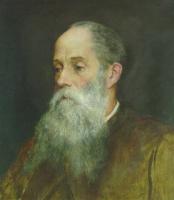


1857. Unknown Photographer. Photograph of William Morris [aged 22].
In 1857 John Roddam Spencer-Stanhope [aged 27], Dante Gabriel Rossetti [aged 28], Edward Burne-Jones [aged 23] and William Morris [aged 22] decorated the Oxford Union Debating Hall with murals on Arthurian themes.
Letters of Dante Gabriel Rossetti 1857. In February 1857 Dante Gabriel Rossetti [aged 28] wrote to William Bell Scott [aged 46]:
Two young men, projectors of the "Oxford and Cambridge Magazine," have recently come up to town from Oxford, and are now very intimate friends of mine. Their names are Morris [aged 22] and Jones [aged 23]. They have turned artists instead of taking up any other career to which the university generally leads, and both are men of real genius. Jones's designs are marvels of finish and imaginative detail, unequalled by anything unless perhaps Albert Durer's finest works' (W. B. Scott, Memoirs, ii. 37).

The Diary of George Price Boyce 1855-1857. 29th June 1857. Rossetti [aged 29] and his friend Morris [aged 23] (of 17 Red Lion Square), called on me in Buckingham St. and had tea. R. told me he was sure it was a man of the name of Sandys [aged 28] who had done the caricature.
Chronicle of Walter of Guisborough
A canon regular of the Augustinian Guisborough Priory, Yorkshire, formerly known as The Chronicle of Walter of Hemingburgh, describes the period from 1066 to 1346. Before 1274 the Chronicle is based on other works. Thereafter, the Chronicle is original, and a remarkable source for the events of the time. This book provides a translation of the Chronicle from that date. The Latin source for our translation is the 1849 work edited by Hans Claude Hamilton. Hamilton, in his preface, says: 'In the present work we behold perhaps one of the finest samples of our early chronicles, both as regards the value of the events recorded, and the correctness with which they are detailed; Nor will the pleasing style of composition be lightly passed over by those capable of seeing reflected from it the tokens of a vigorous and cultivated mind, and a favourable specimen of the learning and taste of the age in which it was framed.'
Available at Amazon in eBook and Paperback format.

1858. William Morris [aged 23]. "La Belle Iseult", sometimes referred to as "Queen Guinevere", is Morris' only surviving easel painting, now in the Tate Gallery. The model Jane Morris nee Burden [aged 18], his future wife.
On 26th April 1859 William Morris [aged 25] and Jane Morris nee Burden [aged 19] were married at St Michael at the Northgate Church, Oxford after which they moved to the Red House.
Memorials of Edward Burne-Jones 1860. A few days before this we had been telling each other riddles, and one of us asked, "Who killed his brother Cain?" Morris [aged 26] instantly fell into the trap and shouted, "Abel, of course!" amidst a peal of laughter from us all. Afterwards he thought it very funny himself, so on his return from the wedding we were not surprised to learn that he had amused the company at breakfast by trying the trick on some one else. "I asked the parson" - he told us triumphantly - "I asked him 'Who killed his brother Abel?' and when of course he said 'Cain,' I said 'Hah! I knew you'd say that - every one says it.'" And we laughed again, more than before.
Memorials of Edward Burne-Jones 1860. Charles Faulkner [aged 27] came down a couple of days after we did, and helped to paint patterns on walls and ceilings, and played bowls in the alley, and in intervals between work joined in triangular bear-fights in the drawing-room. Once, in the middle of a scrimmage that had surged up the steps into the "Minstrels' Gallery" he suddenly leapt clear over the parapet into the middle of the floor with an astounding noise; another time he stored windfallen apples in the gallery and defended himself with them against all comers until a too well-delivered apple gave Morris [aged 26] a black eye; and then, remembering that Morris had promised to give away one of his sisters at her marriage a day or two afterwards, Edward and Faulkner left him no peace from their anticipations of the discredit his appearance would bring upon the ceremony.

Memorials of Edward Burne-Jones 1860. A little later and we were with the Morrises [aged 26] in their new house at Upton, and the time we spent together there was one to swear by, if human happiness were doubted.
First was the arrival at Abbey Wood Station, a country place in those days, where a thin fresh air full of sweet smells met us as we walked down the platform, and outside was the wagonette sent from Red House to meet us; then a pull up the hill and a swinging drive of three miles of winding road on the higher land until, passing "Hog's Hole" on the left, we stopped at our friends' gate. I think Morris must have brought us down from town himself, for I can see the tall figure of a girl standing alone in the porch to receive us.
It was not a large house, as I have said, but purpose and proportion had been so skilfully observed in its design as to arrange for all reasonable demands and leave an impression of ample space everywhere. It stood facing a little west of north, but the longest line of the building had a sunny frontage of west by south, and beneath its windows stretched a green bowling alley where the men used to play when work was over. For it was by no means on a holiday that Edward had come down, nor only to enjoy the company of his friend again, but that they might consult together about the decoration of the house, of which much is said in the Notes from which I have so often quoted.
The house was strongly built of red brick, and red tiled: the porches were deep and the plan of the house was two sides of a quadrangle. In the angle was a covered well. As we talked of decorating it plans grew apace. We fixed upon a romance for the drawing-room, a great favourite of ours called Sir Degrevaunt. I designed seven pictures from that poem, of which I painted three that summer and autumn in tempera. We schemed also subjects from Troy for the hall, and a great ship carrying Greek heroes for a larger space in the hall, but these remained only as schemes, none were designed except the ship. The great settle from Red lion Square, with the three painted shutters above the scat, was put up at the end of the drawing-room, and there was a ladder to its top and a parapet round it, and a little door above, in the wall behind it, that led into the roof. There at Christmas time it was intended that minstrels should play and sing. I began a picture from the Niebelungen Lied on the inside of one of the shutters of this settle, and Morris painted in tempera a hanging below the Degrevaunt pictures, of bushy trees and parrots and labels on which he wrote the motto he adopted for his life, 'If I can.' He worked hard at this and the room began to look very beautiful."
On one of his visits to Red House Rossetti [aged 32] found many of these labels still blank, waiting for the words "If I can," and in his reckless way instantly filled them with another motto, "As I can't." When Morris saw this pleasantry, Edward said, "it would have puzzled the discriminator of words to know which of those two was most eloquent in violent English."
1861. The Census records William Morris [aged 26], [his wife] Jane Morris nee Burden [aged 21], Algernon Charles Swinburne [aged 23], Visitor, four servants and [his daughter] Jane Alicia Morris at Red House.


On 17th January 1861 [his daughter] Jane Alicia Morris was born to William Morris [aged 26] and [his wife] Jane Morris nee Burden [aged 21] at the Red House.
On 25th March 1862 [his daughter] Mary "May" Morris was born to William Morris [aged 28] and [his wife] Jane Morris nee Burden [aged 22] at the Red House. She was baptised 30th May 1862 at Christ Church, Bexleyheath. She married (1) 14th June 1890 Henry Halliday Sparling.


1870. George Frederick Watts [aged 52]. Portrait of William Morris [aged 35].
In 1871 William Morris [aged 36], and Dante Gabriel Rossetti [aged 42] took out a joint tenancy on Kelmscott Manor, Oxfordshire. Moris went to Iceland leaving Dante Gabriel Rossetti and [his wife] Jane Morris nee Burden [aged 31] to furnish the house. A relationship between Rossetti and Jane is believed to have begun some years before.
1871. The census records William Morris [aged 36], [his wife] Jane Morris nee Burden [aged 31], Elizabeth Burden, sister-in-law, [his daughter] Jane Alicia Morris [aged 9], Mary "May" Morris [aged 8] and three servants living at 21 Queen Square, Bloomsbury.
The Deeds of the Dukes of Normandy
The Gesta Normannorum Ducum [The Deeds of the Dukes of Normandy] is a landmark medieval chronicle tracing the rise and fall of the Norman dynasty from its early roots through the pivotal events surrounding the Norman Conquest of England. Originally penned in Latin by the monk William of Jumièges shortly before 1060 and later expanded at the behest of William the Conqueror, the work chronicles the deeds, politics, battles, and leadership of the Norman dukes, especially William’s own claim to the English throne. The narrative combines earlier historical sources with firsthand information and oral testimony to present an authoritative account of Normandy’s transformation from a Viking settlement into one of medieval Europe’s most powerful realms. William’s history emphasizes the legitimacy, military prowess, and governance of the Norman line, framing their expansion, including the conquest of England, as both divinely sanctioned and noble in purpose. Later chroniclers such as Orderic Vitalis and Robert of Torigni continued the history, extending the coverage into the 12th century, providing broader context on ducal rule and its impact. Today this classic work remains a foundational source for understanding Norman identity, medieval statesmanship, and the historical forces that reshaped England and Western Europe between 800AD and 1100AD.
Available at Amazon in eBook and Paperback format.
1874. Frederick Hollyer [aged 35]. Photograph of Edward Coley Burne-Jones 1st Baronet [aged 40] and William Morris [aged 39].
1874. Frederick Hollyer [aged 35]. Photograph of the Burne-Jones and Morris families including William Morris [aged 39], [his wife] Jane Morris nee Burden [aged 34], Edward Coley Burne-Jones 1st Baronet [aged 40] and Georgiana Macdonald Lady Burne-Jones [aged 33].

Around 1885. William Blake Richmond [aged 42]. Portrait of William Morris [aged 50].

Around 1887. Frederick Hollyer [aged 48]. Photograph of William Morris [aged 52].
On 14th June 1890 [his son-in-law] Henry Halliday Sparling [aged 30] and Mary "May" Morris [aged 28] were married at Fulham Register Office. She the daughter of William Morris [aged 56] and Jane Morris nee Burden [aged 50].
On 8th December 1894 [his mother] Emma Shelton [aged 90] died. She was buried in the churchyard at St Andrew's Church, Much Hadham.
St Germans Priory [Map]. South Chapel and East Window by William Morris [aged 61] and Reredos. To the glory of God this window is dedicated by the donor Alfred Burton in the year 1896. This enormous five-light window is one of the largest in Cornwall. All of the ten main figures and angels in the tracery were designed in 1895 for the South transept window of Albion Congregational church, Ashton-under-Lyne. They were repeated at St Germans the following year in this window donated by Alfred Burton. The angel tracery for St Germans, however, is far superior to the tracery at Ashton-under-Lyne. Burne-Jones [aged 62] was paid £300 for his Ashton designs, and it was common practice for all the major Victorian studios subsequently to reuse the design cartoons for future commissions.


On 3rd October 1896 William Morris [aged 62] died after several months of "general organic degeneration", at Kelmscott House, Hammersmith. He died, Mackail says, 'quietly and without visible suffering' (II, 335)'
On 6th October 1896 William Morris [deceased] was buried at St George's Church, Kelmscott [Map]. His gravestone was designed by his friend Philip Webb. His wife Jane Morris nee Burden [aged 56] and daughter Mary "May" Morris [aged 34] attended. The funeral is described by William Fredeman here.
On 26th January 1914 [his former wife] Jane Morris nee Burden [aged 74] died at 5 Brock Street, Bath. On 29th January 1914 she was buried at St George's Church, Kelmscott [Map] in the same grave as her husband William Morris. Her body was driven in a 'motor' from Bath to the manor house just before the service. Her coffin was 17th century style and in oak with brass furniture and a simple inscription of her name and date of death, and was carried into the church by six village men. The church was well attended by the villagers as well as familiar names from the world of art and literature including Marie Stillman [aged 69] whose wreath was noted in the papers. The hymn 'Now the labourer's task is o'er' was sung and the organist played the Dead March as the coffin was carried out to where William was already buried.


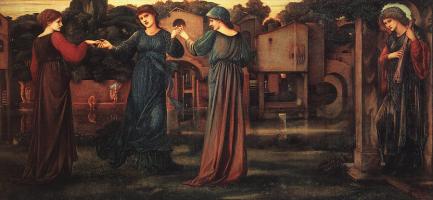


Life of William Morris. Some time before his death Mr. Morris had bought a nomination to Marlborough College for his son [William Morris]. The school had been recently founded "in a healthy and central position," to quote the terms of its prospectus," and conveniently accessible from all parts of England, being only twelve miles from Swindon, which is to be the great point of junction of the chief lines of railway in the kingdom." It was at all events in the centre of one of the most beautiful and romantic parts of England, in a neighbourhood full of history, and still fuller of prehistoric records. A childhood on the skirts of Epping Forest was fitly followed by a boyhood on the edge of Savernake. It is not easy to over-estimate the influence of these surroundings on the development of a sensitive and romantic nature, or their share in fostering that passionate love of earth and her beauty which remained a controlling and sustaining force throughout his life.
William Morris' Funeral. Tuesday, October 6, 1896, was a storm day throughout England, and in the region of Lechlade, in the Thames valley, the winds and rain were unseasonably violent. For at least two observers1, the storm, confirming Ruskin's principle of the pathetic fallacy, was nature's boisterous and saga-like accompaniment to William Morris' departure from this 'Earthly Paradise'.
As we never associated William Morris with fine weather, rather taking him to be a pilot poet lent by the Vikings to steer us from the Doldrums in which we now lie all becalmed in smoke to some ValhaUa of his own creation beyond the world's end, it seemed appropriate thac on his burial-day the rain descended and the wind blew half a gale from the north-west. (p. 389)2
Note 1. R. B. Cunninghame-Graham. 'With the North-West Wind', Saturday Review, LXXXII, No. 2137 (10 October 1896), 389-90- the other articles are by G. B. Shaw on 'Morris as Actor and Dramatist', and by Arthur Symons on 'Morris as Poet'; J. W. Mackail, The Life of Wi/liam Morris (London: Longmans, 1899), Vol. lI, 347-349. Quotations from these two sources are documented internally.
Note 2. It is an amusing inconsistency that Mackail, describing the storm, says that it 'raged with great violence over the whole country, with furious south-westerly gales ...'
GrandFather: Unamed Morris
Father: William Morris
Great x 1 Grandfather: Charles Stanley
GrandMother: Elizabeth Stanley
Great x 1 Grandfather: John Shelton
GrandFather: Joseph Shelton
Mother: Emma Shelton