

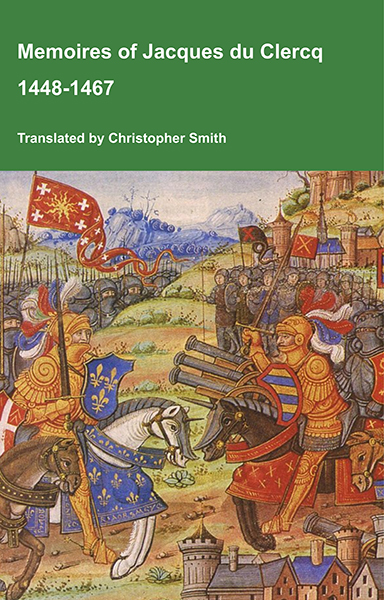
This is a translation of the 'Memoires of Jacques du Clercq', published in 1823 in two volumes, edited by Frederic, Baron de Reissenberg. In his introduction Reissenberg writes: 'Jacques du Clercq tells us that he was born in 1424, and that he was a licentiate in law and a counsellor to Philip the Good, Duke of Burgundy, in the castellany of Douai, Lille, and Orchies. It appears that he established his residence at Arras. In 1446, he married the daughter of Baldwin de la Lacherie, a gentleman who lived in Lille. We read in the fifth book of his Memoirs that his father, also named Jacques du Clercq, had married a lady of the Le Camelin family, from Compiègne. His ancestors, always attached to the counts of Flanders, had constantly served them, whether in their councils or in their armies.' The Memoires cover a period of nineteen years beginning in in 1448, ending in in 1467. It appears that the author had intended to extend the Memoirs beyond that date; no doubt illness or death prevented him from carrying out this plan. As Reissenberg writes the 'merit of this work lies in the simplicity of its narrative, in its tone of good faith, and in a certain air of frankness which naturally wins the reader’s confidence.' Du Clercq ranges from events of national and international importance, including events of the Wars of the Roses in England, to simple, everyday local events such as marriages, robberies, murders, trials and deaths, including that of his own father in Book 5; one of his last entries.
Available at Amazon in eBook and Paperback format.
All Saints' Church, Strelley is in Strelley, Nottinghamshire, Churches in Nottinghamshire.
In 1390 Sampson Strelley was buried at All Saints' Church, Strelley [Map]. Monument to Sampson and Elizabeth Hercy. Early Plate Bascinet and Gorget Period. Finely made in Chellaston alabaster. The detail of the mail incomplete. Bascinet, no orle, moustache. Great helm with Saracen's Head Crest, strangled as denoted by the tongue out. Extended mantling. She wearing an early form of Crespine Headress. Holding Hands. Chest with Angels with Rounded Wings holding Shields. Angels Supporting Pillow. Bedesmen. Dogs chewing at her dress with Studded Collar.
Sampson Strelley: Sampson Strelley and Elizabeth Hercy were married. he was born to Robert Strelley. In 1390 Sampson Strelley died.
Elizabeth Hercy: In 1405 she died. She was buried at All Saints' Church, Strelley [Map].


In 1405 Elizabeth Hercy died. She was buried at All Saints' Church, Strelley [Map].
After 22nd January 1502 John Strelley (deceased) was buried at All Saints' Church, Strelley [Map]. Monument to John Strelley and Sanchia Willoughby (age 50). Fluted Period. Described as the finest alabaster monument in the country. Chellaston alabaster. Bobbed hair to the shoulder. Feet resting on a Lion, two fine Bedesmen, one male, one female;possibly Harpur and Moorecock of Burton on Trent. Great helm with Saracen's Head Crest, strangled as denoted by the tongue out. Extended mantling. Four arms above the effigies represent, from left to right: Strelley impaled Kempe - his father Robert Strelley and his mother Isabel Kempe, Strelley Arms impaled Willoughby - John and his wife, Strelley impaled Pierrepoint - John's paternal great-grandfather Nicholas Strelley and great-grandmother Elizabeth Pierrepoint.


Around May 1533 Sanchia Willoughby (age 81) died at Strelley, Nottinghamshire. She was buried at All Saints' Church, Strelley [Map].
Around 1734 Reverend William Goodday (age 25) was appointed Rector of All Saints' Church, Strelley [Map].
On 15th July 1766 Ruth Unknown died. She was buried at All Saints' Church, Strelley [Map].
On 21st May 1788 Reverend William Goodday (age 79) died. He was buried at All Saints' Church, Strelley [Map].