


The Deeds of the Dukes of Normandy
The Gesta Normannorum Ducum [The Deeds of the Dukes of Normandy] is a landmark medieval chronicle tracing the rise and fall of the Norman dynasty from its early roots through the pivotal events surrounding the Norman Conquest of England. Originally penned in Latin by the monk William of Jumièges shortly before 1060 and later expanded at the behest of William the Conqueror, the work chronicles the deeds, politics, battles, and leadership of the Norman dukes, especially William’s own claim to the English throne. The narrative combines earlier historical sources with firsthand information and oral testimony to present an authoritative account of Normandy’s transformation from a Viking settlement into one of medieval Europe’s most powerful realms. William’s history emphasizes the legitimacy, military prowess, and governance of the Norman line, framing their expansion, including the conquest of England, as both divinely sanctioned and noble in purpose. Later chroniclers such as Orderic Vitalis and Robert of Torigni continued the history, extending the coverage into the 12th century, providing broader context on ducal rule and its impact. Today this classic work remains a foundational source for understanding Norman identity, medieval statesmanship, and the historical forces that reshaped England and Western Europe between 800AD and 1100AD.
Available at Amazon in eBook and Paperback format.
Calwich Abbey, Staffordshire is in Calwich, Staffordshire, Abbeys in England.
In 1130 Calwich Abbey, Staffordshire [Map] was founded as satellite cell of Kenilworth Priory and was dedicated to St Margaret.
In 1349 Calwich Abbey, Staffordshire [Map] became independent from Kenilworth with the right to elect its own prior. It was always a small and relatively poor establishment. After the death of the prior in 1530 only one canon remained in residence and in 1532 the house was suppressed and handed over to Rocester Abbey for disposal.
Around 1543 John Fleetwood (age 26) purchased Calwich Abbey, Staffordshire [Map] following its dissolution. The resulting transformation was described by the contemporary historian Erdeswick: "the chancel had been made into a parlour, the church into a hall and the steeple into a kitchen".
In 1586 the tower at St Peter's Church, Ellastone was constructed with the inscription "Know Thyself" placed above the north door from Calwich Abbey, Staffordshire [Map].
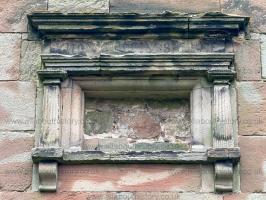
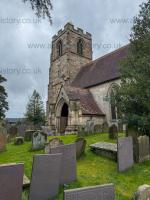
Before 1775 Bernard Granville (age 75) purchased Calwich Abbey, Staffordshire [Map] from Thomas Fleetwood 6th Baronet. He demolished the priory house and built a new house nearer the stream which he turned into a lake.
On 2nd July 1775 Bernard Granville (age 76) died without issue at Calwich, Staffordshire. He was buried at St Peter's Church, Ellastone. His nephew Reverend John D'Ewes aka Granville (age 31) inherited Calwich Abbey, Staffordshire [Map] and changed his surname from D'Ewes to Granville.
Bernard Granville: On or before 25th April 1699, the date he was baptised, he was born to Bernard Granvile. Before 1775 Bernard Granville purchased Calwich Abbey, Staffordshire [Map] from Thomas Fleetwood 6th Baronet. He demolished the priory house and built a new house nearer the stream which he turned into a lake.
Reverend John D'Ewes aka Granville: In 1744 he was born to John D'Ewes and Anne Granville. In 1779 Reverend John D'Ewes aka Granville and Harriet de la Bere were married.
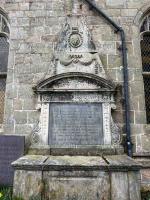
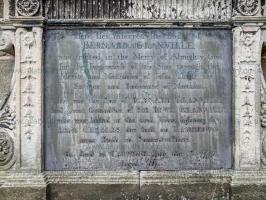
On 7th July 1800 Captain John Granville (age 21) died of rapid consumption at Hot Wells, Bristol. He was buried at St Peter's Church, Ellastone on 19th July 1800. His nephew Court D'Ewes aka Granville (age 21) inherited Calwich Abbey, Staffordshire [Map] and changed his surname from D'Ewes to Granville.
Underneath this Stone In the Family Vault Lies Interred the Body of John Granville, only son of John and Harriett Granville of Calwich and late Captain in the Staffordshire Regiment of Militia who was suddenly cut off in the Prime of his Life, to the inexpressible Grief of his Parents and Sorrow of All who knew him July the 7th 1800 in the 21st Year of his Age. In the same vault are deposited the remains of their infant daughter. Also the remains of the above named Harriet Joan Granville Died at Calwich 25th March 1825, aged 71.
Captain John Granville: Around 1779 he was born to Reverend John D'Ewes aka Granville and Harriet de la Bere.
Court D'Ewes aka Granville: In 1779 he was born to Bernard D'Ewes. In 1848 Court D'Ewes aka Granville died.


Chronicle of a Bourgeois of Valenciennes
Récits d’un bourgeois de Valenciennes aka The Chronicle of a Bourgeois of Valenciennes is a vivid 14th-century vernacular chronicle written by an anonymous urban chronicler from Valenciennes in the County of Hainaut. It survives in a manuscript that describes local and regional history from about 1253 to 1366, blending chronology, narrative episodes, and eyewitness-style accounts of political, military, and social events in medieval France, Flanders, and the Low Countries. The work begins with a chronological framework of events affecting Valenciennes and its region under rulers such as King Philip VI of France and the shifting allegiances of local nobility. It includes accounts of conflicts, sieges, diplomatic manoeuvres, and the impact of broader struggles like the Hundred Years’ War on urban life in Hainaut. Written from the perspective of a burgher (bourgeois) rather than a monastery or royal court, the chronicle offers a rare lay viewpoint on high politics and warfare, reflecting how merchants, townspeople, and civic institutions experienced the turbulence of the 13th and 14th centuries. Its narrative style combines straightforward reporting of events with moral and civic observations, making it a valuable source for readers interested in medieval urban society, regional politics, and the lived experience of war and governance in pre-modern Europe.
Available at Amazon in eBook and Paperback format.
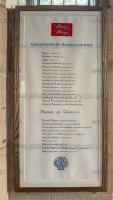
St Peter's Church, Ellastone. Keepers of Kenilworth Priory. Keepers of Calwich [Map]. Priors of Calwich.
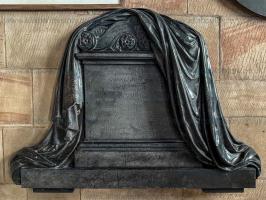
On 3rd November 1822 Abel John Ram of Clonattin, County Wexford (age 46) died at Calwich Hall [Map]. Memorial at St Peter's Church, Ellastone.
Abel John Ram of Clonattin, County Wexford: Around 1776 he was born to Abel Ram. On 11th August 1803 Abel John Ram of Clonattin, County Wexford and Frances Anne Port were married.
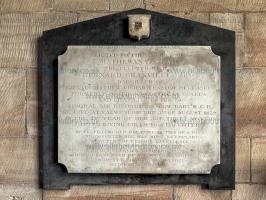
On 3rd August 1829 Mathewana Onslow (age 21) died from childbirth at Calwich Hall [Map] three months after giving birth to a daughter. Memorial at St Peter's Church, Ellastone.
Mathewana Onslow: Around 1808 she was born to Matthew Richard Onslow. On 28th June 1828 Bernard Granville and she were married.
Around 1840 Calwich Abbey, Staffordshire [Map] was purchased by the Duncombe family.
In 1927 Calwich Abbey, Staffordshire [Map] was demolished except for the stables and some small buildings.A fishing temple, built next to the river, survives.