


Anne Boleyn. Her Life as told by Lancelot de Carle's 1536 Letter.
In 1536, two weeks after the execution of Anne Boleyn, her brother George and four others, Lancelot du Carle, wrote an extraordinary letter that described Anne's life, and her trial and execution, to which he was a witness. This book presents a new translation of that letter, with additional material from other contemporary sources such as Letters, Hall's and Wriothesley's Chronicles, the pamphlets of Wynkyn the Worde, the Memorial of George Constantyne, the Portuguese Letter and the Baga de Secrets, all of which are provided in Appendices.
Available at Amazon in eBook and Paperback format.
Around 1536 Gregory Cromwell 1st Baron Cromwell Oakham [aged 16] educated at Cambridge University.
In August 1564 Queen Elizabeth I of England and Ireland [aged 30] visited Cambridge University accompanied by William Howard 1st Baron Howard [aged 54] and William Cecil 1st Baron Burghley [aged 43]. William Cecil 1st Baron Burghley was created Master of Arts: Cambridge University.
John Astley [aged 57] was created Master of Arts: Cambridge University.
On 10th August 1564 Edward Manners 3rd Earl of Rutland [aged 15] was created Master of Arts: Cambridge University.
In 1607 Henry Carey 1st Earl Dover [aged 27] educated at Cambridge University.
In 1640 Bishop John Cosins [aged 45] was appointed Vice-Chancellor of Cambridge University of Cambridge University.
In 1648 Alexander Burnett was awarded Doctor of Medicine at Cambridge University.
In 1652 John Temple [aged 19] was awarded Master of Arts: Cambridge University at Cambridge University.
William Howard educated at Cambridge University.

Around 1564 William Drury [aged 13] educated at Caius College, Cambridge University.
Around 1573 Thomas Hinson [aged 22] was tutor to William Bourchier 3rd Earl Bath [aged 15] at Caius College, Cambridge University.
In 1590 Thomas Fairfax 1st Viscount Fairfax [aged 16] entered Caius College, Cambridge University.
Henrici Quinti, Angliæ Regis, Gesta, is a first-hand account of the Agincourt Campaign, and subsequent events to his death in 1422. The author of the first part was a Chaplain in King Henry's retinue who was present from King Henry's departure at Southampton in 1415, at the siege of Harfleur, the battle of Agincourt, and the celebrations on King Henry's return to London. The second part, by another writer, relates the events that took place including the negotiations at Troye, Henry's marriage and his death in 1422.
Available at Amazon in eBook and Paperback format.
On 23rd March 1610 Francis Prujean [aged 17] entered Caius College, Cambridge University as a sizar.
On 30th April 1629 William Gawdy 1st Baronet [aged 16] was admitted to Caius College, Cambridge University. He was awarded BA in 1632.
John Evelyn's Diary. 31st August 1654. Thence to Caius, and afterward to King's College [Map], where I found the chapel [Map] altogether answered expectation, especially the roof, all of stone, which for the flatness of its laying and carving may, I conceive, vie with any in Christendom. The contignation of the roof (which I went upon), weight, and artificial joining of the stones is admirable. The lights are also very fair. In one aisle lies the famous Dr. Collins, so celebrated for his fluency in the Latin tongue. From this roof we could descry Ely [Map], and the encampment of Sturbridge fair now beginning to set up their tents and booths; also Royston [Map], Newmarket, Suffolk, etc., houses belonging to the King. The library is too narrow.
On 9th May 1694 Harbord Cropley aka Harbord [aged 19] was educated at Caius College, Cambridge University.
In 1699 Thomas Palmer 4th Baronet [aged 16] admitted at Caius College, Cambridge University.
On 4th February 1713 William Morden aka Harbord 1st Baronet [aged 17] was educated at Caius College, Cambridge University.
In 1454 Thomas Boleyn [aged 54] was appointed Master of Gonville College, Cambridge University which position he held until 1472.
Around 1484 Nicholas Hare was born to John Hare of Homersfield in Suffolk. He was educated at Gonville College, Cambridge University and admitted to the Inner Temple in 1515. He married 1528 Katherine Bassingbourne.
In May 1500 Thomas Wendy was born to John Wendy of Clare in Suffolk. He was educated at Gonville College, Cambridge University receiving a BA in 1519, MA in 1522 and MD in 1527. He married 13th June 1552 Margaret Porter.
Around 1541 William Drury [aged 13] educated at Gonville College, Cambridge University.
The History of William Marshal was commissioned by his son shortly after William’s death in 1219 to celebrate the Marshal’s remarkable life; it is an authentic, contemporary voice. The manuscript was discovered in 1861 by French historian Paul Meyer. Meyer published the manuscript in its original Anglo-French in 1891 in two books. This book is a line by line translation of the first of Meyer’s books; lines 1-10152. Book 1 of the History begins in 1139 and ends in 1194. It describes the events of the Anarchy, the role of William’s father John, John’s marriages, William’s childhood, his role as a hostage at the siege of Newbury, his injury and imprisonment in Poitou where he met Eleanor of Aquitaine and his life as a knight errant. It continues with the accusation against him of an improper relationship with Margaret, wife of Henry the Young King, his exile, and return, the death of Henry the Young King, the rebellion of Richard, the future King Richard I, war with France, the death of King Henry II, and the capture of King Richard, and the rebellion of John, the future King John. It ends with the release of King Richard and the death of John Marshal.
Available at Amazon in eBook and Paperback format.
Before 1559 Thomas Wendy [aged 58] was elected President of Gonville College, Cambridge University.
On 27th May 1559 Thomas Paget 3rd Baron Paget Beaudasert [aged 15] was educated at Gonville College, Cambridge University.
In 1667 Titus Oates [aged 17] entered Gonville College, Cambridge University.
On 13th November 1550 Paulus Fagius [aged 46] died. He was buried at St Michael's Church, Cambridge.
Henry Machyn's Diary. 26th January 1557. [The xxvj day of January went to Cambridge, Watson [aged 42] bishop elect of Lincoln, Scot bishop of Chester, and Christopherson bishop elect of Chichester,] comyssyoners to the [lord cardinal, to the] chyrche of sant Mares [Map], and thay toke up on Martin [Bucer] that was bered ther, and Paulus Phagius [was] taken up at Sant Myghelle cherche that was [buried there,] and after brentt [burned] boyth.
In 1600 George Goring 1st Earl Norwich [aged 14] matriculated Sidney Sussex College, Cambridge University.

Around 1612 Edward Montagu 2nd Earl Manchester [aged 10] educated at Sidney Sussex College, Cambridge University.
In 1640 Edward Dering 2nd Baronet [aged 14] was admitted as as a fellow-commoner to Sidney Sussex College, Cambridge University.
John Evelyn's Diary. 31st August 1654. Peter-House [Map], formerly under the government of my worthy friend, Dr. Joseph Cosin [aged 59] [Note. Joseph appears to be a mistake for John?], Dean of Peterborough; a pretty neat college, having a delicate chapel. Next to Sidney, a fine college.

Around 1677 William Brownlow 4th Baronet [aged 11] educated at Sidney Sussex College, Cambridge University.
In 1569 John Ballard was educated at St Catharine's College, Cambridge University.
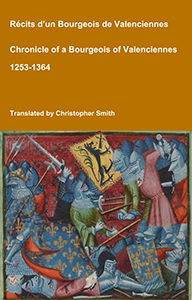
Chronicle of a Bourgeois of Valenciennes
Récits d’un bourgeois de Valenciennes aka The Chronicle of a Bourgeois of Valenciennes is a vivid 14th-century vernacular chronicle written by an anonymous urban chronicler from Valenciennes in the County of Hainaut. It survives in a manuscript that describes local and regional history from about 1253 to 1366, blending chronology, narrative episodes, and eyewitness-style accounts of political, military, and social events in medieval France, Flanders, and the Low Countries. The work begins with a chronological framework of events affecting Valenciennes and its region under rulers such as King Philip VI of France and the shifting allegiances of local nobility. It includes accounts of conflicts, sieges, diplomatic manoeuvres, and the impact of broader struggles like the Hundred Years’ War on urban life in Hainaut. Written from the perspective of a burgher (bourgeois) rather than a monastery or royal court, the chronicle offers a rare lay viewpoint on high politics and warfare, reflecting how merchants, townspeople, and civic institutions experienced the turbulence of the 13th and 14th centuries. Its narrative style combines straightforward reporting of events with moral and civic observations, making it a valuable source for readers interested in medieval urban society, regional politics, and the lived experience of war and governance in pre-modern Europe.
Available at Amazon in eBook and Paperback format.
John Evelyn's Diary. 31st August 1654. Catherine-Hall, though a mean structure, is yet famous for the learned Bishop Andrews, once Master. Emanuel College, that zealous house, where to the hall they have a parlor for the Fellows. The chapel is reformed, ab origine, built north and south, and meanly erected, as is the library.
On 23rd May 1685 Robert Kemp 3rd Baronet [aged 17] was admitted to St Catharine's College, Cambridge University.
Around 1686 Thomas Willoughby 1st Baron Middleton [aged 13] educated at St Catharine's College, Cambridge University.
On or before 21st December 1691 Dean John Addenbroke was born to Reverend John Addenbrooke [aged 39]. He was educated at St Catharine's College, Cambridge University. He married 1735 Dorothea Wedgwood.
In 1708 Francis Whichcote 3rd Baronet [aged 16] was admitted to St Catharine's College, Cambridge University.
From 1960 to 1963 Martin Henig [aged 17] was educated at St Catharine's College, Cambridge University where he was awarded BA and MA.