

Abbot John Whethamstede’s Chronicle of the Abbey of St Albans
Abbot John Whethamstede's Register aka Chronicle of his second term at the Abbey of St Albans, 1451-1461, is a remarkable text that describes his first-hand experience of the beginning of the Wars of the Roses including the First and Second Battles of St Albans, 1455 and 1461, respectively, their cause, and their consequences, not least on the Abbey itself. His text also includes Loveday, Blore Heath, Northampton, the Act of Accord, Wakefield, and Towton, and ends with the Coronation of King Edward IV. In addition to the events of the Wars of the Roses, Abbot John, or his scribes who wrote the Chronicle, include details in the life of the Abbey such as charters, letters, land exchanges, visits by legates, and disputes, which provide a rich insight into the day-to-day life of the Abbey, and the challenges faced by its Abbot.
Available at Amazon in eBook and Paperback format.
Cobden Edge is in Mellor, Cheshire [Map].

30th March 1851. 1851 Census Derbyshire Mellor Page 21. Cobden Edge [Map].
Charles Hadfield (age 32). Head. 33. Farmer 38 Acres.
Ann Hadfield. Wife. 32.
Anne Hadfield (age 5). Daughter. 4. Cotton Factory Worker.
William Hadfield (age 2). Son. 2.
Jane Goodwin. Niece. 13. Servant.
William Goodwin. Nephew. 2.
Anne Hadfield: Around 1846 she was born to Charles Hadfield and Ann Goodwin.
William Hadfield: Around 1849 he was born to Charles Hadfield and Ann Goodwin. He must have died young since he doesn't appear on the 1861 census.

1861. 1861 Census Derbyshire Mellor Cobden Edge Page 10. Cobden Edge [Map].
Charles Hadfield (age 42). Head. 43. Farmer 38 Acres.
Ann Hadfield. Wife. 42.
Anne Hadfield (age 15). Daughter. 14. Cotton Factory Worker.
John Hadfield (age 1). Son. 1
Thomas Hadfield (age 4). Son. 4.

1871. 1871 Census Derbyshire Mellor Page 10. Cobden Edge [Map].
Charles Hadfield (age 52). Head. 53. Farmer of 38 Acres.
Ann Hadfield. Wife. 56. Farmer's wife.
Thomas Hadfield (age 14). 13. Calico Print Worker.
John Hadfield (age 11). 11. Scholar.

1881. 1881 Census Derbyshire Mellor Page 3. Cobden Edge [Map].
Charles Hadfield (age 62). Head. 62. Farmer of 38 Acres.
Ann Goodwin (age 61). Wife. 61. Farmer's wife.
Thomas Hadfield (age 24). 23. Slurry? Cotton Print Works.
John Hadfield (age 21). 21. Carter Cotton Print Works.

On 18th December 1882 Charles Hadfield (age 64) died at Cobden Edge [Map]. His will was probated 31st January 1882.
1891. 1891 Census Derbyshire Mellor 28 Cobden Edge. Cobden [Map].
Thomas Hadfield (age 34). Head. 34. Farmer and General Labourer.
1901. 1901 Census Derbyshire 37 Cobden Edge. Cobden Edge [Map].
Thomas Hadfield (age 44). Head. 45. Railway Labourer.
Elizabeth Oakes (age 49). Wife. 49.
Charles Hadfield (age 14). Son. 14. Calico Printer Works Labourer.
William Hadfield. Son. 12.
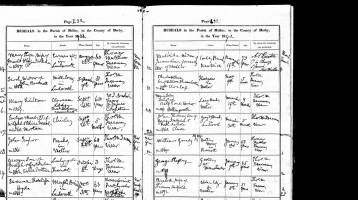
Before 8th January 1903 Elizabeth Oakes (age 51) died. She was living at Cobden Edge [Map]. She was buried on 8th January 1890 at Mellor, Cheshire [Map].