

William of Worcester's Chronicle of England
William of Worcester, born around 1415, and died around 1482 was secretary to John Fastolf, the renowned soldier of the Hundred Years War, during which time he collected documents, letters, and wrote a record of events. Following their return to England in 1440 William was witness to major events. Twice in his chronicle he uses the first person: 1. when writing about the murder of Thomas, 7th Baron Scales, in 1460, he writes '… and I saw him lying naked in the cemetery near the porch of the church of St. Mary Overie in Southwark …' and 2. describing King Edward IV's entry into London in 1461 he writes '… proclaimed that all the people themselves were to recognize and acknowledge Edward as king. I was present and heard this, and immediately went down with them into the city'. William’s Chronicle is rich in detail. It is the source of much information about the Wars of the Roses, including the term 'Diabolical Marriage' to describe the marriage of Queen Elizabeth Woodville’s brother John’s marriage to Katherine, Dowager Duchess of Norfolk, he aged twenty, she sixty-five or more, and the story about a paper crown being placed in mockery on the severed head of Richard, 3rd Duke of York.
Available at Amazon in eBook and Paperback format.
Compton Verney Chapel is in Compton Verney House, Warwickshire.
On 26th March 1631 or 26th March 1632 Margaret Greville 14th Baroness Latimer 6th Baroness Willoughby of Broke [aged 70] died. She was buried at Compton Verney Chapel [Map]. Her son Greville [aged 45] succeeded 15th Baron Latimer of Corby, 7th Baron Willoughby Broke. Catherine Southwell Baroness Latimer and Willoughby Broke [aged 38] by marriage Baroness Latimer of Corby, Baroness Willoughby Broke.
On 9th December 1648 Greville Verney 16th Baron Latimer 8th Baron Willoughby [aged 28] died. He was buried at Compton Verney Chapel [Map]. His son Greville succeeded 17th Baron Latimer of Corby, 9th Baron Willoughby Broke.
In February 1649 Elizabeth Wenman Baroness Latimer and Willoughby Broke died from childbirth. Her husband had died a month before. Their son Greville Verney 17th Baron Latimer 9th Baron Willoughby was born posthumously on 26 Jan 1649. She was buried at Compton Verney Chapel [Map].
On 23rd July 1668 Greville Verney 17th Baron Latimer 9th Baron Willoughby [aged 19] died. He was buried at Compton Verney Chapel [Map]. His son William succeeded 18th Baron Latimer of Corby, 10th Baron Willoughby Broke.
On 23rd August 1683 William Verney 18th Baron Latimer 10th Baron Willoughby [aged 15] died. He was buried at Compton Verney Chapel [Map]. His great uncle Richard [aged 62] succeeded 19th Baron Latimer of Corby, 11th Baron Willoughby Broke.
On 18th July 1711 Richard Verney 19th Baron Latimer 11th Baron Willoughby [aged 90] died. He was buried at Compton Verney Chapel [Map]. His son George [aged 51] succeeded 20th Baron Latimer of Corby, 12th Baron Willoughby Broke. Margaret Heath Baroness Latimer and Willoughby by marriage Baroness Latimer of Corby, Baroness Willoughby Broke.
On 26th December 1728 George Verney 20th Baron Latimer 12th Baron Willoughby [aged 69] died. He was buried at Compton Verney Chapel [Map]. His son Richard [aged 35] succeeded 21st Baron Latimer of Corby, 13th Baron Willoughby Broke.
In 1772 the old medieval church of Compton Murdak which stood a short way to the South East of Compton Verney House, Warwickshire near the lake was demolished to open up views from the house. An obelisk now marks the site of the original church and crypt.
Brown replaced it with a new chapel [Map] located on the slope to the north of the house, which was begun in 1776 and completed in 1780. It is a plain, Palladian-style Chapel built in 1776-9 to Brown's design to the north of the house, for a total cost of £981 10s 4d. The tombs of earlier Verneys were moved to the new chapel, along with a mixture of English heraldic and German Renaissance glass panels which had either decorated the old chapel or were collected by a stained-glass dealer during the 1770s. Today, it stands as a rare example of a building designed by Brown.
On 16th December 1852 Henry Peyto Verney 24th Baron Latimer 16th Baron Willoughby [aged 79] died. He was buried at Compton Verney Chapel [Map]. His nephew Robert [aged 43] succeeded 25th Baron Latimer of Corby, 17th Baron Willoughby Broke. He changed his surname from Barnard to Verney at this time as part of the settlement.
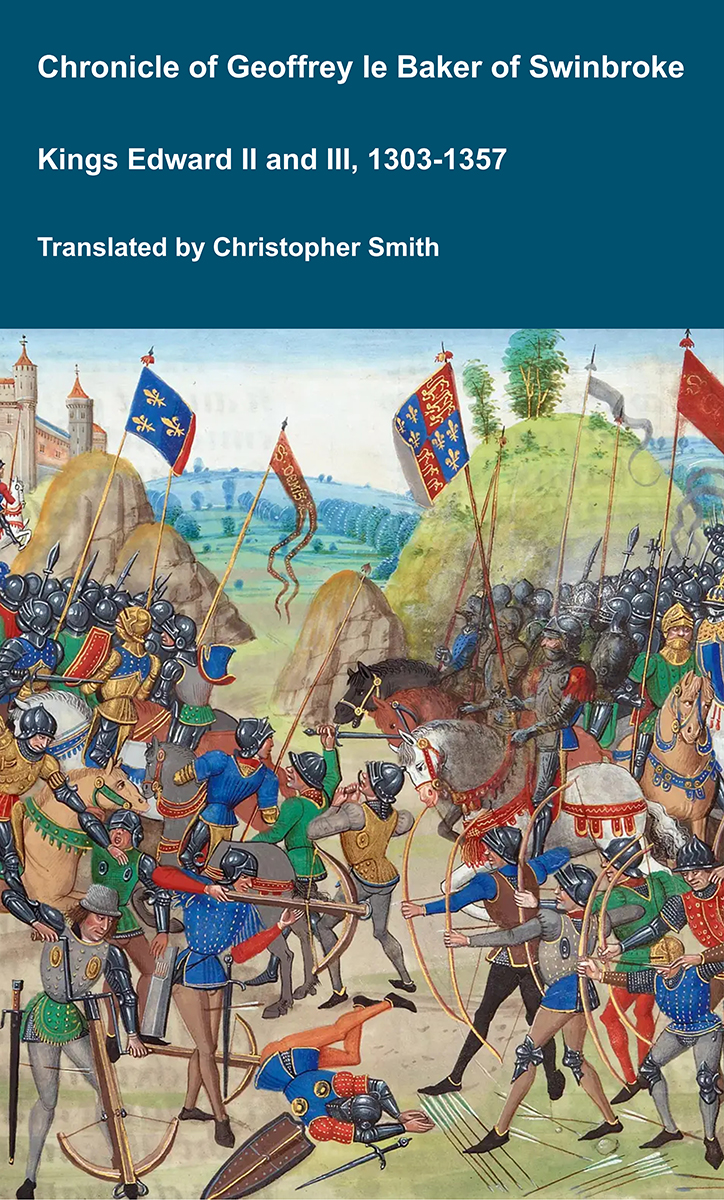
Chronicle of Geoffrey le Baker of Swinbroke
Baker was a secular clerk from Swinbroke, now Swinbrook, an Oxfordshire village two miles east of Burford. His Chronicle describes the events of the period 1303-1356: Gaveston, Bannockburn, Boroughbridge, the murder of King Edward II, the Scottish Wars, Sluys, Crécy, the Black Death, Winchelsea and Poitiers. To quote Herbert Bruce 'it possesses a vigorous and characteristic style, and its value for particular events between 1303 and 1356 has been recognised by its editor and by subsequent writers'. The book provides remarkable detail about the events it describes. Baker's text has been augmented with hundreds of notes, including extracts from other contemporary chronicles, such as the Annales Londonienses, Annales Paulini, Murimuth, Lanercost, Avesbury, Guisborough and Froissart to enrich the reader's understanding. The translation takes as its source the 'Chronicon Galfridi le Baker de Swynebroke' published in 1889, edited by Edward Maunde Thompson.
Available at Amazon in eBook and Paperback format.
On 16th December 1923 Richard Verney 27th Baron Latimer 19th Baron Willoughby de Broke [aged 54] died. He was buried at Compton Verney Chapel [Map]. His son John [aged 27] succeeded 28th Baron Latimer of Corby, 20th Baron Willoughby Broke.