


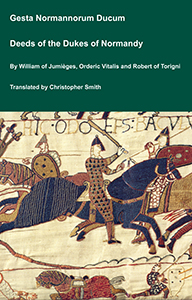
The Deeds of the Dukes of Normandy
The Gesta Normannorum Ducum [The Deeds of the Dukes of Normandy] is a landmark medieval chronicle tracing the rise and fall of the Norman dynasty from its early roots through the pivotal events surrounding the Norman Conquest of England. Originally penned in Latin by the monk William of Jumièges shortly before 1060 and later expanded at the behest of William the Conqueror, the work chronicles the deeds, politics, battles, and leadership of the Norman dukes, especially William’s own claim to the English throne. The narrative combines earlier historical sources with firsthand information and oral testimony to present an authoritative account of Normandy’s transformation from a Viking settlement into one of medieval Europe’s most powerful realms. William’s history emphasizes the legitimacy, military prowess, and governance of the Norman line, framing their expansion, including the conquest of England, as both divinely sanctioned and noble in purpose. Later chroniclers such as Orderic Vitalis and Robert of Torigni continued the history, extending the coverage into the 12th century, providing broader context on ducal rule and its impact. Today this classic work remains a foundational source for understanding Norman identity, medieval statesmanship, and the historical forces that reshaped England and Western Europe between 800AD and 1100AD.
Available at Amazon in eBook and Paperback format.
Glastonbury Abbey is in Glastonbury, Somerset, Abbeys in England.
Anglo-Saxon Chronicle. 688. This year Ceadwall (age 29) went to Rome, and received baptism at the hands of Sergius the pope, who gave him the name of Peter; but in the course of seven nights afterwards, on the twelfth day before the calends of May, he died in his crisom-cloths, and was buried in the church of St. Peter. To him succeeded Ina (age 18) in the kingdom of Wessex, and reigned thirty-seven winters. He founded the monastery of Glastonbury [Map]; after which he went to Rome, and continued there to the end of his life. Ina was the son of Cenred, Cenred of Ceolwald; Ceolwald was the brother of Cynegils; and both were the sons of Cuthwin, who was the son of Ceawlin; Ceawlin was the son of Cynric, and Cynric of Cerdic.
On 26th May 946 King Edmund I of England (age 25) was murdered by Leofa, an exiled thief, whilst attending mass at Pucklechurch, Gloucestershire. He was buried at Glastonbury Abbey [Map]. His brother Eadred succeeded I King of England.
On 8th July 975 King Edgar I of England (age 32) died at Winchester, Hampshire [Map]. He was buried in Glastonbury Abbey [Map]. His son Edward (age 13) succeeded I King of England.
On 30th November 1016 King Edmund "Ironside" I of England (age 26) died. He was buried near his grandfather King Edgar I of England in Glastonbury Abbey [Map].
Anglo-Saxon Chronicle. On the feast of St. Andrew [30th November 1016] died King Edmund (age 26); and he is buried with his grandfather Edgar at Glastonbury [Map]. In the same year died Wulfgar, Abbot of Abingdon; and Ethelsy took to the abbacy.
Anglo-Saxon Chronicle. 1033. This year died Bishop Merewhite in Somersetshire, who is buried at Glastonbury Abbey [Map]; and Bishop Leofsy, whose body resteth at Worcester, and to whose see Brihteh was promoted.
On 22nd April 1045 Bishop Bertwald of Ramsbury died. He was buried at Glastonbury Abbey [Map].
In 1053 Abbot Æthelnoth of Glastonbury was appointed Abbot of Glastonbury.
Anglo-Saxon Chronicle. 1083. This year arose the tumult at Glastonbury [Map] betwixt the Abbot Thurstan and his monks. It proceeded first from the abbot's want of wisdom, that he misgoverned his monks in many things. But the monks meant well to him; and told him that he should govern them rightly, and love them, and they would be faithful and obedient to him. The abbot, however, would hear nothing of this; but evil entreated them, and threatened them worse. One day the abbot went into the chapter-house, and spoke against the monks, and attempted to mislead them;101 and sent after some laymen, and they came full-armed into the chapter-house upon the monks. Then were the monks very much afraid102 of them, and wist not what they were to do, but they shot forward, and some ran into the church, and locked the doors after them. But they followed them into the minster, and resolved to drag them out, so that they durst not go out. A rueful thing happened on that day. The Frenchmen broke into the choir, and hurled their weapons toward the altar, where the monks were; and some of the knights went upon the upper floor103, and shot their arrows downward incessantly toward the sanctuary; so that on the crucifix that stood above the altar they stuck many arrows. And the wretched monks lay about the altar, and some crept under, and earnestly called upon God, imploring his mercy, since they could not obtain any at the hands of men. What can we say, but that they continued to shoot their arrows; whilst the others broke down the doors, and came in, and slew104 some of the monks to death, and wounded many therein; so that the blood came from the altar upon the steps, and from the steps on the floor. Three there were slain to death, and eighteen wounded.
Note 101. i.e. In the service; by teaching them a new-fangled chant, brought from Feschamp in Normandy, instead of that to which they had been accustomed, and which is called the Gregorian chant.
Note 102. Literally, "afeared of them"-i.e. terrified by them.
Note 103. Probably along the open galleries in the upper story of the choir.
Note 104. "Slaegan", in its first sense, signifies "to strike violently"; whence the term "sledge-hammer". This consideration will remove the supposed pleonasm in the Saxon phrase, which is here literally translated.
 Become a Member via our Buy Me a Coffee page to read more.
On 17th August 1469 Humphrey Stafford 1st Earl Devon (age 30), having escaped after the Battle of Edgecote Moor, was captured and executed by a mob at Bridgwater, Somerset [Map]. He was buried at Glastonbury Abbey [Map]. Earl Devon, Baron Stafford of Southwick forfeit.

Before 1852. Samuel Prout (age 68). Water-colour of The Chapel of St Joseph of Arimathea Glastonbury Abbey [Map] from the south-east.
Bishop Henry of Blois was appointed Abbot of Glastonbury.
Jean de Waurin's Chronicle of England Volume 6 Books 3-6: The Wars of the Roses
Jean de Waurin was a French Chronicler, from the Artois region, who was born around 1400, and died around 1474. Waurin’s Chronicle of England, Volume 6, covering the period 1450 to 1471, from which we have selected and translated Chapters relating to the Wars of the Roses, provides a vivid, original, contemporary description of key events some of which he witnessed first-hand, some of which he was told by the key people involved with whom Waurin had a personal relationship.
Available at Amazon in eBook and Paperback format.

1825. John Buckler (age 54). Abbots Kitchen, Glastonbury Abbey.