

William of Worcester's Chronicle of England
William of Worcester, born around 1415, and died around 1482 was secretary to John Fastolf, the renowned soldier of the Hundred Years War, during which time he collected documents, letters, and wrote a record of events. Following their return to England in 1440 William was witness to major events. Twice in his chronicle he uses the first person: 1. when writing about the murder of Thomas, 7th Baron Scales, in 1460, he writes '… and I saw him lying naked in the cemetery near the porch of the church of St. Mary Overie in Southwark …' and 2. describing King Edward IV's entry into London in 1461 he writes '… proclaimed that all the people themselves were to recognize and acknowledge Edward as king. I was present and heard this, and immediately went down with them into the city'. William’s Chronicle is rich in detail. It is the source of much information about the Wars of the Roses, including the term 'Diabolical Marriage' to describe the marriage of Queen Elizabeth Woodville’s brother John’s marriage to Katherine, Dowager Duchess of Norfolk, he aged twenty, she sixty-five or more, and the story about a paper crown being placed in mockery on the severed head of Richard, 3rd Duke of York.
Available at Amazon in eBook and Paperback format.
 Birch Vale, Derbyshire
 Buxton, Derbyshire
 Chapel en le Frith, Derbyshire
 Chinley, Buxworth and Brownside
 Dove Holes, Derbyshire
 Edale, Derbyshire
 Glossop, Derbyshire
 Hayfield, Derbyshire
 Hope Valley
 Kinder, Derbyshire
 Little Hayfield, Derbyshire
 New Mills, Derbyshire
 Peak Forest, Derbyshire
 Whaley Bridge, Derbyshire
High Peak, Derbyshire is in Derbyshire.
In 1328 Basingwerk Abbey [Map] gained a market charter for Charlesworth, Derbyshire.
In 1535 William Slack of Chapel en le Frith was born at Brownside, Derbyshire [Map].
Godfrey SLACKE Glossop (Brownsyde [Map]): 17th May 1592.
In the name of god Amen the xixth daye of Aprill in the yeare of o[ur] Lorde god 1591 I Godfrey SLACKE of the preshe of Glossopp and countie derbe Weke in bodie but sounde in myned & of good and pfecte Remembrance prayse be to god almeightie make Herin my last will and testamt in man and fforme followinge:
ffirst I bequeth my soule to god almeigthie my maker savior and Redemr and my bodie to be buried in the church yarde of chapell le fryth,
Itm I do geve and bequeth unto my brother Thomas SLACKE xx sheepe in whethers sheepe so many as I have and to ffell & make ffourth the score in other sheepe at the dyscretion of my syster Elizabeth SLACKE. Itm I do bequeth to lytell Henry SLACKE an ewe lambe. Itm my will ys that after my ffunerall expenses, my dower and legacies beinge payed and dyscharged of my whole goods, my syster Elizabeth shall have the Restidew of my goods!Itm my will ys that my said syster shall have all my Houses lands & grounds wth my Reights tythe terme and interest in the Harbage [Map] of Chynley wth all and syngle ther apprtence to have and to holde occupie and [quyetley] to injoye ffor and duringe her naturall lyfe In as large beneficall and ample in an as I have now the same.
And after the decease of my said syster Eliz: my will ys that all my said Houses lands & grounds wth all my Reight tytle terme and Interest of the said Harbage of Chynley wth all and everie comoditie or [ fytt] belonging or in any wyse appertaninge unto the premysses or to any pte ther of I do geve and bequeth them and eberie pte and pcell therof to my said brother Thomas SLACKE his heires & assignes for ever in as large benificall and ample in an as I now injoye & occupie the same. Itm I do apointe my welbeloved syster Elizabeth SLACKE to be myne executor to execute pforme and ffulfill this my last will and testamt accordinge to the true meaning ther of as my ffull trust ys in her. And to be supervisor hereof I desyre my welbeloved cosen Richard BLYTHE
Sealed Read and published before these wytnesses Richard SLACK; Charles ASHETON; Robert SLACK and John BOLLER
Detts wch the said Godfre SLACK owethe.
Impri John WILDE viiid
Itm to Jannes FFRITH iiid
Itm to Peter SHORE gz
Itm to George YEVELEY ffor bes[ ] [ ]esses abouv vis viiid
Itm to Robert SLACK [ ]
Itm to CHESWELL ixd
Itm to Richard [ ] xii£
Itm to Thomas MELLOR of Cloughe head
On 30th October 1753 Robert Slack (age 34) and Ann Pickford were married at Peak Forest, Derbyshire [Map].
In 1770 Edward Fletcher was born at Peak Forest, Derbyshire [Map].
In 1830 Joseph Fletcher was born to John Fletcher (age 35) at Peak Forest, Derbyshire [Map].
Eldon Hill Barrow 1 is also in Peak District Bronze Age Barrows.
Ten Years' Digging. The first mound [Eldon Hill Barrow 1 [Map]], placed east of the highest point of the hill, measures not more than 5 yards in diameter, by about 2 feet in height, and is composed of small stones and earth. It yielded rats' bones, the root of a stag's horn, and the lower jaw of a small dog or fox, but produced no human remains, very probably fxom having been reduced in size.
Eldon Hill Barrow 2 is also in Peak District Bronze Age Barrows.
Ten Years' Digging. The other tumulus [Eldon Hill Barrow 2 [Map]] on the highest point of the mountain, measures 16 yards across, by about 4 feet in height, and is composed of large stones and earth. We found that the centre had been previously disturbed; nevertheless we there met with an immense quantity of rats' bones, a few portions of the skeleton of a child, a few bones from the extremities of a full grown person, and a rhomboidal article of bone, 2¼ inches long, with a hole through the middle, most likely intended to attach it to the dress as a button or fastening of some kind. In the undisturbed part, immediately south of the centre, were eight tines or points from the antlers of stags, some showing marks of tooling, also where they had been partially sawn through before they were broken off; accompanied by the lower jaw and bones of a cow, and other splintered animal bones, all lying about 18 inches from the top. Further south was a scattered deposit of calcined human bones, accompanied by the unburnt skeleton of an infant, a fine spear head of flint much burnt, 2 inches long, and a small vase of the usual imperfectly baked clay, 4¾ inches high, very nicely ornamented, but partly disintegrated. The interments lay about 18 inches above the natural surface, among some large stones which were not arranged so as to guard the deposits, indeed the latter appeared to have been carelessly interred at a period subsequent to the formation of the tumulus.
The River Goyt rises from the Errwood [Map] and Fernilee [Map] reservoirs from which it flows through Whaley Bridge, Derbyshire [Map], Furness Vale, Derbyshire [Map], New Mills, Derbyshire [Map], Marple, Cheshire [Map] before joining the River Tame at Stockport, Cheshire [Map] to form the River Mersey.
On 16th July 1883 Ada Louise Moorcroft was born to George Henry Moorcroft (age 26) and Caroline Wood at Fernilee, Derbyshire [Map]. She married 1904 Richard Waterhouse and had issue.
Around 1887 Arthur Moorcroft was born to George Henry Moorcroft (age 30) and Caroline Wood at Fernilee, Derbyshire [Map].
Around 1890 Caroline Moorcroft was born to George Henry Moorcroft (age 33) and Caroline Wood at Fernilee, Derbyshire [Map].
Around 1892 George Henry Moorcroft was born to George Henry Moorcroft (age 35) and Caroline Wood at Fernilee, Derbyshire [Map].
Around 1896 Thomas Willam Moorcroft was born to George Henry Moorcroft (age 39) and Caroline Wood at Fernilee, Derbyshire [Map].
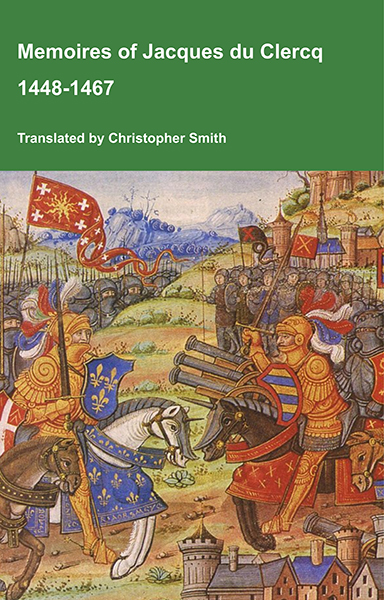
This is a translation of the 'Memoires of Jacques du Clercq', published in 1823 in two volumes, edited by Frederic, Baron de Reissenberg. In his introduction Reissenberg writes: 'Jacques du Clercq tells us that he was born in 1424, and that he was a licentiate in law and a counsellor to Philip the Good, Duke of Burgundy, in the castellany of Douai, Lille, and Orchies. It appears that he established his residence at Arras. In 1446, he married the daughter of Baldwin de la Lacherie, a gentleman who lived in Lille. We read in the fifth book of his Memoirs that his father, also named Jacques du Clercq, had married a lady of the Le Camelin family, from Compiègne. His ancestors, always attached to the counts of Flanders, had constantly served them, whether in their councils or in their armies.' The Memoires cover a period of nineteen years beginning in in 1448, ending in in 1467. It appears that the author had intended to extend the Memoirs beyond that date; no doubt illness or death prevented him from carrying out this plan. As Reissenberg writes the 'merit of this work lies in the simplicity of its narrative, in its tone of good faith, and in a certain air of frankness which naturally wins the reader’s confidence.' Du Clercq ranges from events of national and international importance, including events of the Wars of the Roses in England, to simple, everyday local events such as marriages, robberies, murders, trials and deaths, including that of his own father in Book 5; one of his last entries.
Available at Amazon in eBook and Paperback format.
The River Goyt rises from the Errwood [Map] and Fernilee [Map] reservoirs from which it flows through Whaley Bridge, Derbyshire [Map], Furness Vale, Derbyshire [Map], New Mills, Derbyshire [Map], Marple, Cheshire [Map] before joining the River Tame at Stockport, Cheshire [Map] to form the River Mersey.
The River Goyt rises from the Errwood [Map] and Fernilee [Map] reservoirs from which it flows through Whaley Bridge, Derbyshire [Map], Furness Vale, Derbyshire [Map], New Mills, Derbyshire [Map], Marple, Cheshire [Map] before joining the River Tame at Stockport, Cheshire [Map] to form the River Mersey.
The River Goyt rises from the Errwood [Map] and Fernilee [Map] reservoirs from which it flows through Whaley Bridge, Derbyshire [Map], Furness Vale, Derbyshire [Map], New Mills, Derbyshire [Map], Marple, Cheshire [Map] before joining the River Tame at Stockport, Cheshire [Map] to form the River Mersey.