

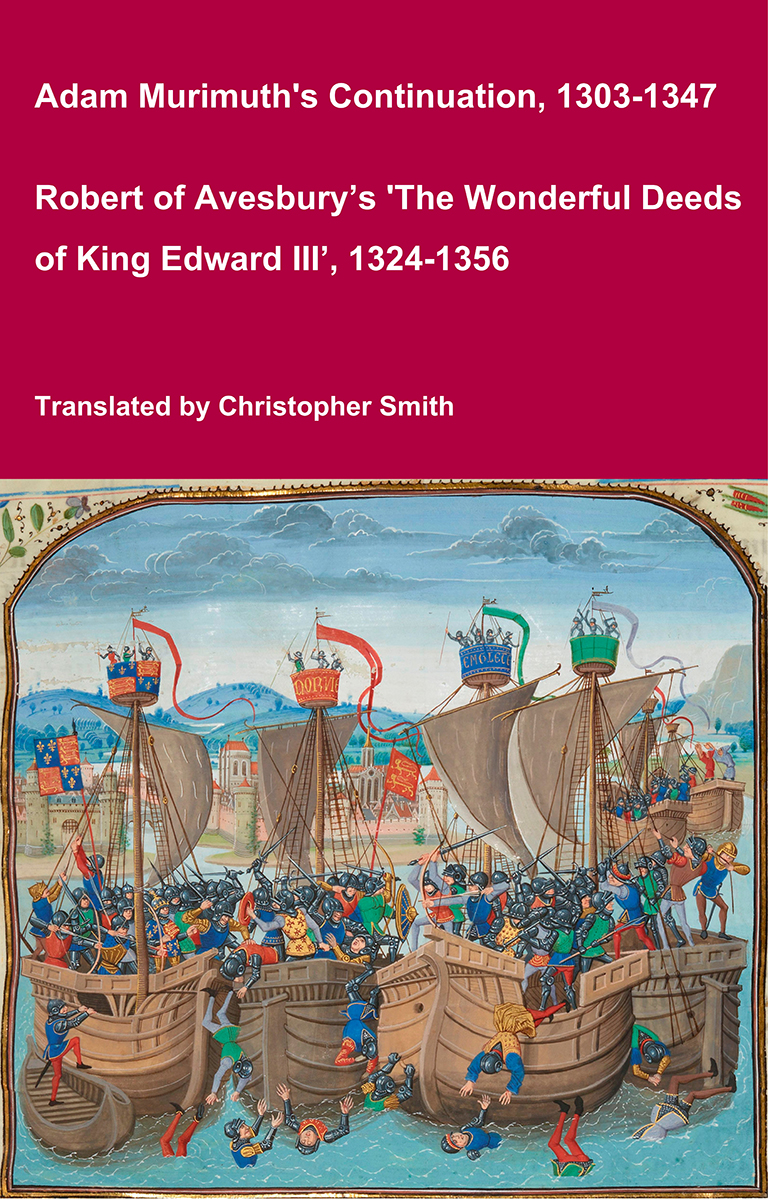
Adam Murimuth's Continuation and Robert of Avesbury’s 'The Wonderful Deeds of King Edward III'
This volume brings together two of the most important contemporary chronicles for the reign of Edward III and the opening phases of the Hundred Years’ War. Written in Latin by English clerical observers, these texts provide a vivid and authoritative window into the political, diplomatic, and military history of fourteenth-century England and its continental ambitions. Adam Murimuth Continuatio's Chronicarum continues an earlier chronicle into the mid-fourteenth century, offering concise but valuable notices on royal policy, foreign relations, and ecclesiastical affairs. Its annalistic structure makes it especially useful for establishing chronology and tracing the development of events year by year. Complementing it, Robert of Avesbury’s De gestis mirabilibus regis Edwardi tertii is a rich documentary chronicle preserving letters, treaties, and official records alongside narrative passages. It is an indispensable source for understanding Edward III’s claim to the French crown, the conduct of war, and the mechanisms of medieval diplomacy. Together, these works offer scholars, students, and enthusiasts a reliable and unembellished account of a transformative period in English and European history. Essential for anyone interested in medieval chronicles, the Hundred Years’ War, or the reign of Edward III.
Available at Amazon in eBook and Paperback format.
Lambeth, Surrey is in Surrey.
Chronicon ex Chronicis by Florence and John of Worcester. 1042. Hardicanute [aged 24], king of England, while he was present at a joyous feast given at a place called Lambeth, Surrey [Map], by Osgod Clapa, a man of great wealth, on occasion of his giving the hand of his daughter Githa in marriage to Tovi, surnamed Prudan, a noble and powerful Dane,—and carousing, full of health and merriment, with the bride and some others, fell down, by a sad mischance, while in the act of drinking, and continued speechless until Tuesday the sixth of the ides [the 8th] of June, when he expired. He was carried to Winchester and buried near his father Canute. His brother Edward [aged 39] was proclaimed king at London, chiefly by the exertions of earl Godwin [aged 41], and Living, bishop of Worcester. Edward was the son of Ethelred, who was the son of Edgar, who was the son of Edmund, who was the son of Edward the Elder, who was the son of Alfred.
In 1390 Geoffrey Culpepper [aged 73] died at Lambeth, Surrey [Map].
In 1479 Ralph Leigh was born to John Leigh [aged 32] in Lambeth, Surrey [Map]. He married before 1492 Joyce Culpepper and had issue.
On 28th January 1501 John Dynham 1st Baron Dynham [aged 68] died at Lambeth, Surrey [Map]. He was buried at Greyfriars Church Farringdon Within [Map]. Baron Dinham extinct.
Around 1523 Catherine Howard was born to Edmund Howard [aged 45] and Joyce Culpepper [aged 43] at Lambeth, Surrey [Map]. She married 28th July 1540 her fifth cousin once removed King Henry VIII of England and Ireland, son of King Henry VII of England and Ireland and Elizabeth York Queen Consort England.
John Evelyn's Diary. 17th September 1657. To see Sir Robert Needham, at Lambeth, Surrey [Map], a relation of mine; and thence to John Tradescant's museum, in which the chiefest rarities were, in my opinion, the ancient Roman, Indian, and other nations' armour, shields, and weapons; some habits of curiously-colored and wrought feathers, one from the phœnix wing, as tradition goes. Other innumerable things there were printed in his catalogue by Mr. Ashmole [aged 40], to whom after the death of the widow they are bequeathed, and by him designed as a gift to Oxford [Map].


Samuel Pepys' Diary. 20th September 1665. So I up, and after being trimmed, the first time I have been touched by a barber these twelvemonths, I think, and more, went to Sir J. Minnes's [aged 66], where I find all out of order still, they having not seen one another till by and by Sir J. Minnes and Sir W. Batten [aged 64] met, to go into my Lord Bruncker's [aged 45] coach, and so we four to Lambeth, Surrey [Map], and thence to the Duke of Albemarle [aged 56], to inform him what we have done as to the fleete, which is very little, and to receive his direction.


Samuel Pepys' Diary. 23rd September 1665. Thence by coach to Lambeth, Surrey [Map], his Lordship, and all our office, and Mr. Evelyn [aged 44], to the Duke of Albemarle [aged 56], where, after the compliment with my Lord very kind, we sat down to consult of the disposing and supporting of the fleete with victuals and money, and for the sicke men and prisoners; and I did propose the taking out some goods out of the prizes, to the value of £10,000, which was accorded to, and an order, drawn up and signed by the Duke [aged 31] and my Lord, done in the best manner I can, and referred to my Lord Bruncker [aged 45] and Sir J. Minnes [aged 66], but what inconveniences may arise from it I do not yet see, but fear there may be many.


Samuel Pepys' Diary. 10th October 1665. So that being done, I left the goods to be watched by men on their part and ours, and so to the office by noon, whither by and by comes Captain Cocke [aged 48], whom I had with great care sent for by expresse the last night, and so I with him to his house and there eat a bit, and so by coach to Lambeth, Surrey [Map], and I took occasion first to go to the Duke of Albemarle [aged 56] to acquaint him with some thing of what had been done this morning in behalf of a friend absent, which did give a good entrance and prevented their possessing the Duke with anything of evil of me by their report, and by and by in comes. Captain Cocke and tells his whole story.
Samuel Pepys' Diary. 22nd October 1665. Lord's Day. Up, and after ready and going to Captain Cocke's [aged 48], where I find we are a little further safe in some part of our goods, I to Church, in my way was meeting with some letters, which made me resolve to go after church to my Duke of Albemarle's [aged 56] so, after sermon, I took Cocke's chariott, and to Lambeth, Surrey [Map]; but, in going and getting over the water, and through White Hall, I spent so much time, the Duke had almost dined. However, fresh meat was brought for me to his table, and there I dined, and full of discourse and very kind. Here they are again talking of the prizes, and my Lord Duke did speake very broad that my Lord Sandwich [aged 40] and Pen [aged 44] should do what they would, and answer for themselves. For his part, he would lay all before the King [aged 35]. Here he tells me the Dutch Embassador at Oxford is clapped up, but since I hear it is not true.


Samuel Pepys' Diary. 5th November 1665. To dinner, where a great deale of silly discourse, but the worst is I hear that the plague increases much at Lambeth, Surrey [Map], St. Martin's [Map] and Westminster, and fear it will all over the city.
Chronicle of a Bourgeois of Valenciennes
Récits d’un bourgeois de Valenciennes aka The Chronicle of a Bourgeois of Valenciennes is a vivid 14th-century vernacular chronicle written by an anonymous urban chronicler from Valenciennes in the County of Hainaut. It survives in a manuscript that describes local and regional history from about 1253 to 1366, blending chronology, narrative episodes, and eyewitness-style accounts of political, military, and social events in medieval France, Flanders, and the Low Countries. The work begins with a chronological framework of events affecting Valenciennes and its region under rulers such as King Philip VI of France and the shifting allegiances of local nobility. It includes accounts of conflicts, sieges, diplomatic manoeuvres, and the impact of broader struggles like the Hundred Years’ War on urban life in Hainaut. Written from the perspective of a burgher (bourgeois) rather than a monastery or royal court, the chronicle offers a rare lay viewpoint on high politics and warfare, reflecting how merchants, townspeople, and civic institutions experienced the turbulence of the 13th and 14th centuries. Its narrative style combines straightforward reporting of events with moral and civic observations, making it a valuable source for readers interested in medieval urban society, regional politics, and the lived experience of war and governance in pre-modern Europe.
Available at Amazon in eBook and Paperback format.
Samuel Pepys' Diary. 6th November 1665. At last, however, to Lambeth, Surrey [Map] and thence the Cockpitt [Map], where we found Sir G. Carteret [aged 55] come, and in with the Duke [aged 32] and the East India Company about settling the business of the prizes, and they have gone through with it.
Samuel Pepys' Diary. 20th December 1665. Up, and was trimmed, but not time enough to save my Lord Bruncker's [aged 45] coach or Sir J. Minnes's [aged 66], and so was fain to walk to Lambeth, Surrey [Map] on foot, but it was a very fine frosty walke, and great pleasure in it, but troublesome getting over the River for ice. I to the Duke of Albemarle [aged 57], whither my brethren were all come, but I was not too late. There we sat in discourse upon our Navy business an houre, and thence in my Lord Bruncker's coach alone, he walking before (while I staid awhile talking with Sir G. Downing [aged 40] about the Act, in which he is horrid troublesome) to the Old Exchange [Map].
John Evelyn's Diary. 19th September 1676. To Lambeth, Surrey [Map], to that rare magazine of marble, to take order for chimney-pieces, etc., for Mr. Godolphin's [aged 31] house. The owner of the works had built for himself a pretty dwelling house; this Dutchman had contracted with the Genoese for all their marble. We also saw the Duke of Buckingham's [aged 48] glasswork, where they made huge vases of metal as clear, ponderous, and thick as crystal; also looking-glasses far larger and better than any that come from Venice [Map].


John Evelyn's Diary. 25th May 1682. I was desired by Sir Stephen Fox [aged 55] and Sir Christopher Wren [aged 58] to accompany them to Lambeth, Surrey [Map], with the plot and design of the college to be built at Chelsea, to have the Archbishop's approbation. It was a quadrangle of 200 feet square, after the dimensions of the larger quadrangle at Christ church, Oxford, for the accommodation of 440 persons, with Governor of and officers. This was agreed on.


John Evelyn's Diary. 5th February 1684. It began to thaw, but froze againe. My coach crossed from Lambeth [Map] to the Horseferry at Millbank, Westminster. The booths were almost all taken downe, but there was first a Map or Landskip cut in copper representing all the manner of the camp, and the several actions, sports, and pastimes thereon, in memory of so signal a frost.
In 24th March 1767 Christian Fredericke Zincke [aged 84] died at Lambeth, Surrey [Map].
On 30th May 1785 Frederick Augustus Berkeley 5th Earl Berkeley [aged 40] and Mary Cole were married at St Mary's Church, Berkeley by the Vicar. The marriage was kept secret until the couple were married again at Lambeth, Surrey [Map] on 16th May 1796. The absence of evidence led to subsequent issues with inheritance with the couple's fist six children effectively being illegitimate and the couple's children after the Lambeth marriage being legitimate and eligible to inherit.
In 1769 John "The Elder" Bacon [aged 28] was working at Coade's Artificial Stone Works [Map]. In 1771, Ms Coade appointed John "The Elder" Bacon works supervisor at her manufactory [Map]: he directed both model-making and design there until his death.
Cansisk's Monumental Inscriptions Volume 1 Whitefield's Chapel. Whitfield Chapel, Tottenham Court Road [Map]. Near this Place lies John Bacon [deceased], R.A.1, Sculptor; Who Died Aug. 7th 1799; aged 59 years; and left The Following Inscription For this Tablet: "What I was as an Artist seemed to me of some Importance While I lived; But What I really was, as a Believer in Christ Jesus, is the Only Thing of Importance to me now!"
Note 1. Bacon was born in Southwark, November 24, 1740, he was apprenticed to Mr. Crispe, a manufacturer of china, at Lambeth [Map], where he was employed in painting on porcelain. While here he had an opportunity of seeing the models sent by different sculptors to be burnt, and by them was inspired with a strong desire for his future profession. He was unremitting in his diligence, and his progress was so rapid that he obtained nine of the first premiums of the Society for the Encouragement of the Arts. The first of these was for a figure of Peace, in 1758, when he was only eighteen years of age. He was the first person to bring to perfection statues in artificial stone and cement, which has since been brought to great perfection. In 1769 he began to work in marble; and having invented an instrument for transfering the form of the model to marble, he saved a great deal of his time, and brought his instrument to be adopted by other sculptors. In 1769, he obtained from the Royal Academy the first gold medal given by that society, and the year following he was chosen an associate. While modelling the bust of George III. for the hall of Christ Church, Oxford, the King asked him if he had ever been out of the kingdom; and on being answered in the negative, "I'm glad of it," said his Majesty, "you will be the greater honour to it." His execution of this bust gained him the royal patronage, and he was employed in forming another for the university of Gottingen. Among his many works were the statue of Mars, Lord Chatham's monument in Guildhall, a beautiful monument in Bristol Cathedral, to Mrs. Draper, Lord Chatham, in Westminster Abbey, Howard, and Dr. Johnson's in St. Paul's Cathedral, besides a large number of others..
On 17th November 1887 Field-Marshal Bernard Law Montgomery 1st Viscount Montgomery was born to Bishop Henry Montgomery [aged 40] and Maud Friar [aged 22] at Kennington, Lambeth. He married 1927 Elizabeth Hobart and had issue.
Watling Street. From Durobrivae [Map] the road continues through Park Pale, Kent [Map], Vagniacis [Map], Dartford, Kent [Map], Noviomagus [Map], Bexley, Kent [Map], down Shooter's Hill, Greenwich [Map] past Eltham Common, Kent [Map] to Greenwich Park [Map] where the road either (or both):
1. went along the Old Kent Road [Map] and crossed the River Thames at either the London Bridge [Map] or a ford near Westminster Bridge [Map] after which it continued north past St Mary-le-Bow Church, Cheapside [Map], Newgate Gate [Map], Ludgate Hill [Map] and over the River Fleet at Fleet Bridge [Map] to Marble Arch [Map].
2. continued north-west through Camberwell, Surrey [Map] crossing the River Thames near Vauxhall Bridge [Map] after which it continued north to Marble Arch [Map].
Chronicle of a Bourgeois of Valenciennes
Récits d’un bourgeois de Valenciennes aka The Chronicle of a Bourgeois of Valenciennes is a vivid 14th-century vernacular chronicle written by an anonymous urban chronicler from Valenciennes in the County of Hainaut. It survives in a manuscript that describes local and regional history from about 1253 to 1366, blending chronology, narrative episodes, and eyewitness-style accounts of political, military, and social events in medieval France, Flanders, and the Low Countries. The work begins with a chronological framework of events affecting Valenciennes and its region under rulers such as King Philip VI of France and the shifting allegiances of local nobility. It includes accounts of conflicts, sieges, diplomatic manoeuvres, and the impact of broader struggles like the Hundred Years’ War on urban life in Hainaut. Written from the perspective of a burgher (bourgeois) rather than a monastery or royal court, the chronicle offers a rare lay viewpoint on high politics and warfare, reflecting how merchants, townspeople, and civic institutions experienced the turbulence of the 13th and 14th centuries. Its narrative style combines straightforward reporting of events with moral and civic observations, making it a valuable source for readers interested in medieval urban society, regional politics, and the lived experience of war and governance in pre-modern Europe.
Available at Amazon in eBook and Paperback format.
Samuel Pepys' Diary. 5th August 1663. So to the Exchange [Map], and thence home to dinner with my brother, and in the afternoon to Westminster Hall [Map], and there found Mrs. Lane, and by and by agreement we met at the Parliament stairs (in my way down to the boat who should meet us but my lady Jemimah, who saw me lead her but said nothing to me of her, though I ought to speak to her to see whether she would take notice of it or no) and off to Stangate and so to the King's Head at Lambeth marsh, and had variety of meats and drinks, but I did so towse her and handled her, but could get nothing more from her though I was very near it; but as wanton and bucksome as she is she dares not adventure upon the business, in which I very much commend and like her. Staid pretty late, and so over with her by water, and being in a great sweat with my towsing of her durst not go home by water, but took coach, and at home my brother and I fell upon Des Cartes, and I perceive he has studied him well, and I cannot find but he has minded his book, and do love it.
Samuel Pepys' Diary. 20th April 1666. Up, and after an houre or two's talke with my poor wife, who gives me more and more content every day than other, I abroad by coach to Westminster, and there met with Mrs. Martin, and she and I over the water to Stangold, and after a walke in the fields to the King's Head, and there spent an houre or two with pleasure with her, and eat a tansy and so parted, and I to the New Exchange, there to get a list of all the modern plays which I intend to collect and to have them bound up together.
On 22nd June 1610 William Seymour 2nd Duke of Somerset [aged 22] and Arabella Stewart [aged 35] were married in secret at Palace of Placentia, Greenwich [Map]. For having married without permission King James I of England and Ireland and VI of Scotland [aged 44] had Arabella Stewart imprisoned in Sir Thomas Perry's House, Lambeth and he in the Tower of London [Map]. She the daughter of Charles Stewart 5th Earl Lennox and Elizabeth Cavendish Countess Lennox. They were third cousin once removed. He a great x 3 grandson of King Henry VII of England and Ireland. She a great x 2 granddaughter of King Henry VII of England and Ireland.


Samuel Pepys' Diary. 5th August 1663. So to the Exchange [Map], and thence home to dinner with my brother, and in the afternoon to Westminster Hall [Map], and there found Mrs. Lane, and by and by agreement we met at the Parliament stairs (in my way down to the boat who should meet us but my lady Jemimah, who saw me lead her but said nothing to me of her, though I ought to speak to her to see whether she would take notice of it or no) and off to Stangate and so to the King's Head at Lambeth marsh, and had variety of meats and drinks, but I did so towse her and handled her, but could get nothing more from her though I was very near it; but as wanton and bucksome as she is she dares not adventure upon the business, in which I very much commend and like her. Staid pretty late, and so over with her by water, and being in a great sweat with my towsing of her durst not go home by water, but took coach, and at home my brother and I fell upon Des Cartes, and I perceive he has studied him well, and I cannot find but he has minded his book, and do love it.
Samuel Pepys' Diary. 20th April 1666. Up, and after an houre or two's talke with my poor wife, who gives me more and more content every day than other, I abroad by coach to Westminster, and there met with Mrs. Martin, and she and I over the water to Stangold, and after a walke in the fields to the King's Head, and there spent an houre or two with pleasure with her, and eat a tansy and so parted, and I to the New Exchange, there to get a list of all the modern plays which I intend to collect and to have them bound up together.
Samuel Pepys' Diary. 21st March 1669. Lord's Day. Up, and by water over to Southwarke [Map]; and then, not getting a boat, I forced to walk to Stangate; and so over to White Hall, in a scull; where up to the Duke of York's [aged 35] dressing-room, and there met Harry Saville [aged 27], and understand that Sir W. Coventry [aged 41] is come to his house last night. I understand by Mr. Wren [aged 40] that his friends having, by Secretary Trevor [aged 45] and my Lord Keeper [aged 63], applied to the King [aged 38] upon his first coming home, and a promise made that he should be discharged this day, my Lord Arlington [aged 51] did anticipate them, by sending a warrant presently for his discharge which looks a little like kindness, or a desire of it; which God send! though I fear the contrary: however, my heart is glad that he is out.


Time Team Series 2 Episode 4: The Archbishop's Back Garden was filmed between 8th July 1994 and 10th July 1994. It was originally shown on 29th January 1995.
Location: Lambeth Palace [Map], London.
Tony Robinson [aged 48], Presenter
Mick Aston [aged 48], Bristol University Landscape Archaeologist
Carenza Lewis [aged 31], Field Archaeologist
Phil Harding [aged 45], Wessex Archaeological Trust Field Archaeologist
Robin Bush [aged 51], Archivist
Victor Ambrus [aged 59], Historical Illustrator
John Gator, Chris Gaffney, Geophysics
Jane Sidell, Museum of London Archaeologist
Stewart Ainsworth [aged 43], Landscape Archaeologist
Harvey Sheldon, Authority on Roman London
Gustav Milne, Institue of Archaeology
Hedley Swain, Field Archaeologist
London Fire Brigade Boat
Sources: Excavations of Bernard Davis in the 1930s, Cassius Dio Book 60 Sections 20 and 21, 1562 Map of London showing Horseferry Stairs and Stangate Stairs, Registers of the Archbishops of Canterbury at Lambeth Palace Library, 1746 Map of Lambeth Palace Gardens, John Rokes 18th Century Map of London
Techniques: Core Samples, Excavation, a string with a brick to determine rievr depth
Outcomes: Piece of a Mortarium, Reconstructed Roman Road, Garden features in the Palace, Roman River Level was lower by a couple of feet, Causeway on lower side of Westminster Bridge, Peer walked across 1950s1, location of Stangate Stairs.
Note 1. The New York Times 26th March 2002. Lord Noel-Buxton waded about half-way across the river and had to swim the rest.
On 15th April 1880 Eleanor Thornton was born to Frederick Thornton Telegraph Engineer at 18 Cottage Grove Stockwell.
On 1st June 1857 Delves Louis Broughton 10th Baronet was born to Henry Delves Broughton 9th Baronet [aged 48] at Tillotson Place Waterloo Road Lambeth, Surrey. He married (1) 26th April 1881 Rosamond Broughton and had issue (2) 21st December 1887 Mary Evelyn Cotton Lady Broughton.