

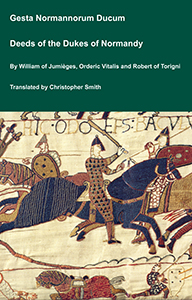
The Deeds of the Dukes of Normandy
The Gesta Normannorum Ducum [The Deeds of the Dukes of Normandy] is a landmark medieval chronicle tracing the rise and fall of the Norman dynasty from its early roots through the pivotal events surrounding the Norman Conquest of England. Originally penned in Latin by the monk William of Jumièges shortly before 1060 and later expanded at the behest of William the Conqueror, the work chronicles the deeds, politics, battles, and leadership of the Norman dukes, especially William’s own claim to the English throne. The narrative combines earlier historical sources with firsthand information and oral testimony to present an authoritative account of Normandy’s transformation from a Viking settlement into one of medieval Europe’s most powerful realms. William’s history emphasizes the legitimacy, military prowess, and governance of the Norman line, framing their expansion, including the conquest of England, as both divinely sanctioned and noble in purpose. Later chroniclers such as Orderic Vitalis and Robert of Torigni continued the history, extending the coverage into the 12th century, providing broader context on ducal rule and its impact. Today this classic work remains a foundational source for understanding Norman identity, medieval statesmanship, and the historical forces that reshaped England and Western Europe between 800AD and 1100AD.
Available at Amazon in eBook and Paperback format.
Merton College, Oxford University is in Oxford University.
Around 1394 Cardinal John Kempe (age 14) educated at Merton College, Oxford University.
Before 1499 George Owen was born. He was educated at Merton College, Oxford University.
On 20th December 1577 Henry Neville of Billingbear (age 13) was educated at Merton College, Oxford University.
In 1579 Henry Savile 1st Baronet was born to John Savile (age 34) and Jane Garth. He was educated at Merton College, Oxford University and in 1593 he entered the Middle Temple. He married before 23rd June 1632 Mary Dent.
Around 1607 Robert Devereux 3rd Earl Essex (age 15) educated at Merton College, Oxford University.
On 10th July 1607 Henry Poole (age 15) was educated at Merton College, Oxford University.
On 23rd October 1607 John Trelawny 1st Baronet (age 15) matriculated Merton College, Oxford University.
In 1624 Richard Browne 1st Baronet (age 19) became a Fellow of Merton College, Oxford University and received his MA on 29th July 1628.
On 8th September 1665 Charles Dormer (age 13) graduated Master of Arts at Merton College, Oxford University.
On 28th December 1665 George Fitzroy 1st Duke Northumberland was born illegitimately to King Charles II of England Scotland and Ireland (age 35) and Barbara Villiers 1st Duchess of Cleveland (age 25) at Merton College, Oxford University.
On 3rd February 1671 Walter Clarges 1st Baronet (age 17) was educated at Merton College, Oxford University.
On 16th July 1672 Barbara Fitzroy was born illegitimately to John Churchill (age 22) and Barbara Villiers 1st Duchess of Cleveland (age 31) at Merton College, Oxford University. She claimed the child was the King's (age 42) but most consider her father to be John Churchill, subsequently Duke of Marlborough.


Around 1728 Thomas Drury 1st Baronet (age 15) educated at Merton College, Oxford University.
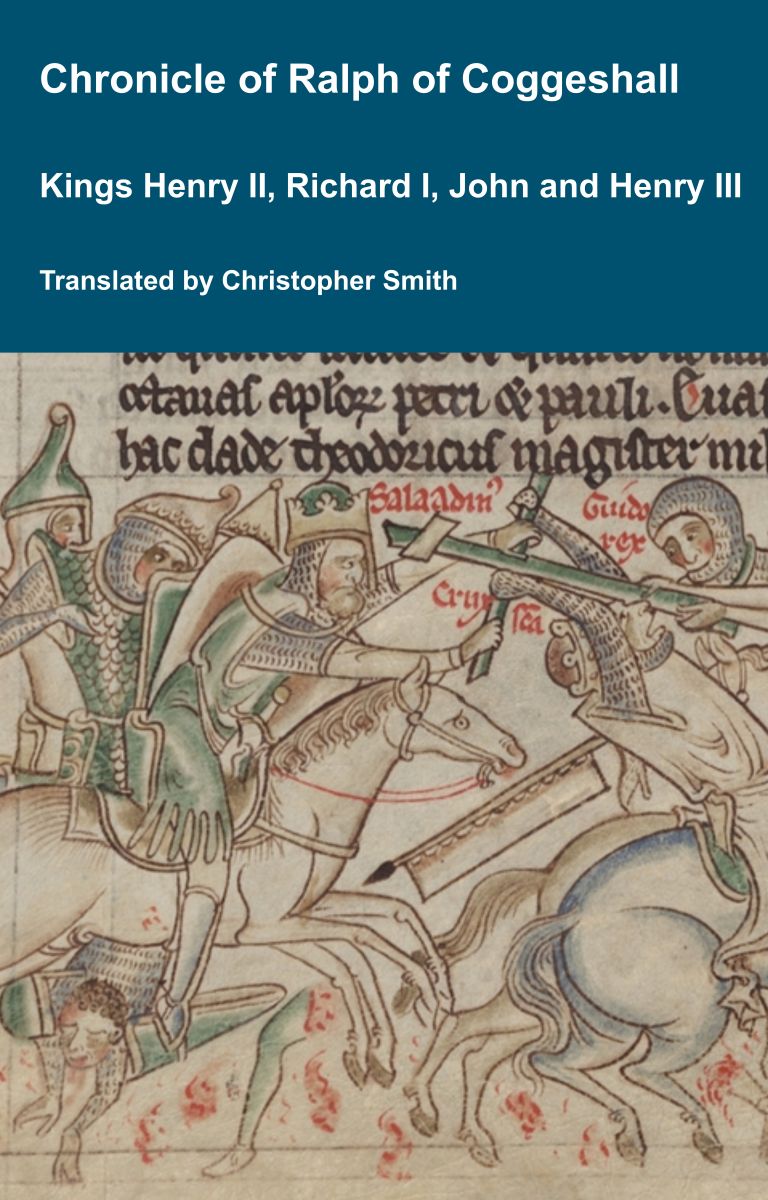
Chronicle of Abbot Ralph of Coggeshall
The Chronicle of Abbot Ralph of Coggeshall (Chronicon Anglicanum) is an indispensable medieval history that brings to life centuries of English and European affairs through the eyes of a learned Cistercian monk. Ralph of Coggeshall, abbot of the Abbey of Coggeshall in Essex in the early 13th century, continued and expanded his community’s chronicle, documenting events from the Norman Conquest of 1066 into the tumultuous reign of King Henry III. Blending eyewitness testimony, careful compilation, and the monastic commitment to record-keeping, this chronicle offers a rare narrative of political intrigue, royal power struggles, and social upheaval in England and beyond. Ralph’s work captures the reigns of pivotal figures such as Richard I and King John, providing invaluable insights into their characters, decisions, and the forces that shaped medieval rule. More than a simple annal, Chronicon Anglicanum conveys the texture of medieval life and governance, making it a rich source for scholars and readers fascinated by English history, monastic authorship, and the shaping of the medieval world.
Available at Amazon in eBook and Paperback format.
In 1750 Reverend Newton Ogle (age 24) was awarded BA by Merton College, Oxford University.
In June 1768 Thomas Frankland 6th Baronet (age 17) was educated at Merton College, Oxford University.
In July 1771 Thomas Frankland 6th Baronet (age 20) was awarded Master of Arts: Oxford University at Merton College, Oxford University.
On 13th May 1829 Reverend Brabazon Lowther (age 17) was admitted to Merton College, Oxford University receiving his BA in 1834.
In 1832 Bishop Walter Kerr Hamilton (age 23) was elected to a Fellowship of Merton College, Oxford University.
On 1st November 1833 Richard Charles Hamond (age 21) died from a fall from a horse whilst an undergraduate at Merton College, Oxford University.
On 23rd February 1848 Augustus Gough-Calthorpe 6th Baron Calthorpe (age 18) matriculated Merton College, Oxford University. He graduated BA in 1851, MA in 1855.
In 1477 Bishop Richard Fitzjames was appointed Principal of St Alban Hall, Merton College, Oxford University.
Around 1572 Thomas Gresham (age 25) educated at St Alban Hall, Merton College, Oxford University.
On 18th October 1583 Peter Mutton of Llanerch (age 18) matriculated St Alban Hall, Merton College, Oxford University.