

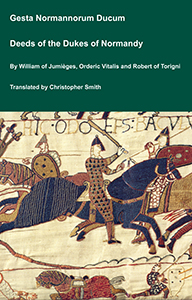
The Deeds of the Dukes of Normandy
The Gesta Normannorum Ducum [The Deeds of the Dukes of Normandy] is a landmark medieval chronicle tracing the rise and fall of the Norman dynasty from its early roots through the pivotal events surrounding the Norman Conquest of England. Originally penned in Latin by the monk William of Jumièges shortly before 1060 and later expanded at the behest of William the Conqueror, the work chronicles the deeds, politics, battles, and leadership of the Norman dukes, especially William’s own claim to the English throne. The narrative combines earlier historical sources with firsthand information and oral testimony to present an authoritative account of Normandy’s transformation from a Viking settlement into one of medieval Europe’s most powerful realms. William’s history emphasizes the legitimacy, military prowess, and governance of the Norman line, framing their expansion, including the conquest of England, as both divinely sanctioned and noble in purpose. Later chroniclers such as Orderic Vitalis and Robert of Torigni continued the history, extending the coverage into the 12th century, providing broader context on ducal rule and its impact. Today this classic work remains a foundational source for understanding Norman identity, medieval statesmanship, and the historical forces that reshaped England and Western Europe between 800AD and 1100AD.
Available at Amazon in eBook and Paperback format.
Oxford University is in Oxford, Oxfordshire [Map].
Around 1260 Thomas de Clare [aged 15] educated at Oxford University.
In 1440 John Saye [aged 60] was appointed Proctor of Oxford University.
In 1524 Edward Carne [aged 24] was awarded Doctor of Divinity at Oxford University.
Around August 1566 Queen Elizabeth I of England and Ireland [aged 32] visited Oxford University. William Cecil 1st Baron Burghley [aged 45] was created Master of Arts: Oxford University.
In 1568 Thomas Fitzherbert [aged 16] educated at Oxford University.
In 1572 Ferdinando Stanley 5th Earl of Derby [aged 13] was educated at Oxford University.
In 1588 Thomas Clinton 3rd Earl Lincoln [aged 17] was awarded Master of Arts at Oxford University.
In 1594 Philippe Carteret 3rd Seigneur Sark [aged 9] was educated at Oxford University.
On 1st July 1642 Thomas Strode of Parnham [aged 14] matriculated Oxford University.
John Evelyn's Diary. 15th July 1669. Having two days before had notice that the University intended me the honor of Doctorship, I was this morning attended by the beadles belonging to the Law, who conducted me to the Theater, where I found the Duke of Ormond [aged 58] (now Chancellor of the University) with the Earl of Chesterfield [aged 35] and Mr. Spencer [aged 40] (brother to the late Earl of Sunderland). Thence, we marched to the Convocation House, a convocation having been called on purpose; here, being all of us robed in the porch, in scarlet with caps and hoods, we were led in by the Professor of Laws, and presented respectively by name, with a short eulogy, to the Vice-Chancellor, who sat in the chair, with all the Doctors and Heads of Houses and masters about the room, which was exceedingly full. Then, began the Public Orator his speech, directed chiefly to the Duke of Ormond, the Chancellor; but in which I had my compliment, in course. This ended, we were called up, and created Doctors according to the form, and seated by the Vice-Chancellor among the Doctors, on his right hand; then, the Vice-Chancellor made a short speech, and so, saluting our brother Doctors, the pageantry concluded, and the convocation was dissolved. So formal a creation of honorary Doctors had seldom been seen, that a convocation should be called on purpose, and speeches made by the Orator; but they could do no less, their Chancellor being to receive, or rather do them, this honor. I should have been made Doctor with the rest at the public Act, but their expectation of their Chancellor made them defer it. I was then led with my brother Doctors to an extraordinary entertainment at Doctor Mewes's, head of St John's College, Oxford University, and, after abundance of feasting and compliments, having visited the Vice-Chancellor and other Doctors, and given them thanks for the honor done me, I went toward home the 16th, and got as far as Windsor, Berkshire [Map], and so to my house the next day.


 Become a Member via our Buy Me a Coffee page to read more.
In 1702 Peregrine Bertie 2nd Duke Ancaster and Kesteven [aged 15] graduated at Oxford University.
In 1706 William Glynne 2nd Baronet [aged 42] was awarded Doctor of Civil Law at Oxford University.
On 18th April 1745 Francis Scott 2nd Duke Buccleuch [aged 50] was awarded Doctor of Civil Law at Oxford University.
The Deeds of the Dukes of Normandy
The Gesta Normannorum Ducum [The Deeds of the Dukes of Normandy] is a landmark medieval chronicle tracing the rise and fall of the Norman dynasty from its early roots through the pivotal events surrounding the Norman Conquest of England. Originally penned in Latin by the monk William of Jumièges shortly before 1060 and later expanded at the behest of William the Conqueror, the work chronicles the deeds, politics, battles, and leadership of the Norman dukes, especially William’s own claim to the English throne. The narrative combines earlier historical sources with firsthand information and oral testimony to present an authoritative account of Normandy’s transformation from a Viking settlement into one of medieval Europe’s most powerful realms. William’s history emphasizes the legitimacy, military prowess, and governance of the Norman line, framing their expansion, including the conquest of England, as both divinely sanctioned and noble in purpose. Later chroniclers such as Orderic Vitalis and Robert of Torigni continued the history, extending the coverage into the 12th century, providing broader context on ducal rule and its impact. Today this classic work remains a foundational source for understanding Norman identity, medieval statesmanship, and the historical forces that reshaped England and Western Europe between 800AD and 1100AD.
Available at Amazon in eBook and Paperback format.
Bishop Henry Despencer educated at Oxford University.
In 1522 George Carew [aged 24] graduated Bachelor of Arts at Broadgates Hall, Oxford University.
On 19th April 1583 Charles Thynne [aged 15] was educated at Broadgates Hall, Oxford University.
On 6th May 1597 Sampson Hele [aged 15] was educated at Broadgates Hall, Oxford University.
In 1781 Benjamin Hobhouse 1st Baronet [aged 24] graduated Master of Arts: Oxford University at Broadgates Hall, Oxford University.
In 1513 Edward Bocking was awarded Bachelor of Divinity by Canterbury College, Oxford University.
In 1518 Edward Bocking was awarded Doctor of Divinity by Canterbury College, Oxford University.
Around 1828 Reginald Courtenay Bishop [aged 15] educated at Hertford College, Oxford University.
In 1579 Thomas Culpepper [aged 18] educated at Hart Hall Hertford College, Oxford University.
On 7th November 1617 Adrian Scrope [aged 16] was educated at Hart Hall Hertford College, Oxford University.
On 9th November 1621 John Glynne [aged 19] was educated at Hart Hall Hertford College, Oxford University.
On 9th March 1666 Halswell Tynte 1st Baronet [aged 17] matriculated at Hart Hall Hertford College, Oxford University.
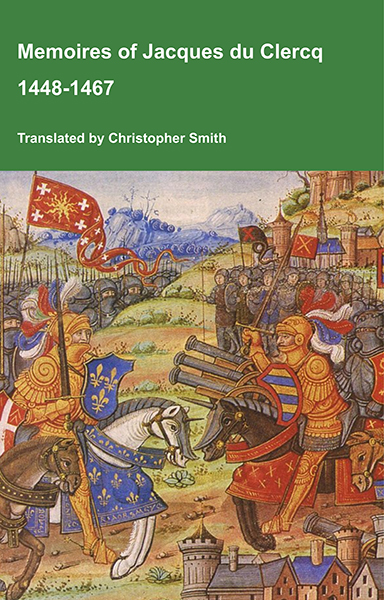
This is a translation of the 'Memoires of Jacques du Clercq', published in 1823 in two volumes, edited by Frederic, Baron de Reissenberg. In his introduction Reissenberg writes: 'Jacques du Clercq tells us that he was born in 1424, and that he was a licentiate in law and a counsellor to Philip the Good, Duke of Burgundy, in the castellany of Douai, Lille, and Orchies. It appears that he established his residence at Arras. In 1446, he married the daughter of Baldwin de la Lacherie, a gentleman who lived in Lille. We read in the fifth book of his Memoirs that his father, also named Jacques du Clercq, had married a lady of the Le Camelin family, from Compiègne. His ancestors, always attached to the counts of Flanders, had constantly served them, whether in their councils or in their armies.' The Memoires cover a period of nineteen years beginning in in 1448, ending in in 1467. It appears that the author had intended to extend the Memoirs beyond that date; no doubt illness or death prevented him from carrying out this plan. As Reissenberg writes the 'merit of this work lies in the simplicity of its narrative, in its tone of good faith, and in a certain air of frankness which naturally wins the reader’s confidence.' Du Clercq ranges from events of national and international importance, including events of the Wars of the Roses in England, to simple, everyday local events such as marriages, robberies, murders, trials and deaths, including that of his own father in Book 5; one of his last entries.
Available at Amazon in eBook and Paperback format.
In 1581 John Salusbury [aged 14] was educated at Jesus College, Oxford University.
In 1592 John Vaughan 1st Earl Carbery [aged 17] was educated at Jesus College, Oxford University.
In 1634 William Williams 1st Baronet was born to Hugh Williams and Emma Dolben. He was educated at Jesus College, Oxford University. He married 14th April 1664 Margaret Kyffin and had issue.
In 1656 William Glynne 1st Baronet [aged 17] graduated at Jesus College, Oxford University.
On 17th April 1698 John Aubrey 3rd Baronet [aged 17] matriculated Jesus College, Oxford University.
In 1700 Leonard Smelt [aged 17] admitted at Jesus College, Oxford University.
On or before 28th December 1775 Archdeacon John Jones was born to Roger Jones of Cefn Rug. He was baptised 28th December 1775. He was educated at Jesus College, Oxford University being awarded BA in 1798 and MA in 1802.
In 1868 Bishop Francis Jayne [aged 22] was elected Fellow of Jesus College, Oxford University.

In 1869 Bishop Edward Stuart Talbot [aged 24] was appointed Warden of Keble College, Oxford University which position he held until 1888.
In 1871 Bishop Francis Jayne [aged 25] was elected Master of Keble College, Oxford University.
In 1999 the Talbot Fund, named after Bishop Edward Stuart Talbot, was established at Keble College, Oxford University.
The History of William Marshal was commissioned by his son shortly after William’s death in 1219 to celebrate the Marshal’s remarkable life; it is an authentic, contemporary voice. The manuscript was discovered in 1861 by French historian Paul Meyer. Meyer published the manuscript in its original Anglo-French in 1891 in two books. This book is a line by line translation of the first of Meyer’s books; lines 1-10152. Book 1 of the History begins in 1139 and ends in 1194. It describes the events of the Anarchy, the role of William’s father John, John’s marriages, William’s childhood, his role as a hostage at the siege of Newbury, his injury and imprisonment in Poitou where he met Eleanor of Aquitaine and his life as a knight errant. It continues with the accusation against him of an improper relationship with Margaret, wife of Henry the Young King, his exile, and return, the death of Henry the Young King, the rebellion of Richard, the future King Richard I, war with France, the death of King Henry II, and the capture of King Richard, and the rebellion of John, the future King John. It ends with the release of King Richard and the death of John Marshal.
Available at Amazon in eBook and Paperback format.

In 1878 Bishop Edward Stuart Talbot [aged 33] and Lavinia Lyttelton [aged 28] founded Lady Margaret Hall, Oxford University.
In 1910 the Talbot Building at Lady Margaret Hall, Oxford University was named after Bishop Edward Stuart Talbot [aged 65].
Around 1505 Dean Hugh Weston was born at Burton-Overy, Leicestershire. He was educated at Balliol College, Oxford University then Lincoln College, Oxford University.
On 8th January 1538 Dean Hugh Weston [aged 33] was elected Rector of Lincoln College, Oxford University.
On 11th March 1609 Arthur Hopton Diplomat [aged 21] was educated at Lincoln College, Oxford University.
Around 1656 John Sandes [aged 5] was educated at Lincoln College, Oxford University.
On 31st January 1667 George Wheler [aged 16] matriculated Lincoln College, Oxford University.
In 1747 Reverend Newton Ogle [aged 21] was awarded BA by Lincoln College, Oxford University.
In 1579 Henry Hyde [aged 16] was educated at Magdalen Hall, Oxford University.
On 28th June 1620 Thomas Thynne [aged 10] was educated at Magdalen Hall, Oxford University.
On 23rd June 1621 John Freschville 1st Baron Frescheville [aged 13] was educated at Magdalen Hall, Oxford University.
This is a translation of the 'Memoires of Jacques du Clercq', published in 1823 in two volumes, edited by Frederic, Baron de Reissenberg. In his introduction Reissenberg writes: 'Jacques du Clercq tells us that he was born in 1424, and that he was a licentiate in law and a counsellor to Philip the Good, Duke of Burgundy, in the castellany of Douai, Lille, and Orchies. It appears that he established his residence at Arras. In 1446, he married the daughter of Baldwin de la Lacherie, a gentleman who lived in Lille. We read in the fifth book of his Memoirs that his father, also named Jacques du Clercq, had married a lady of the Le Camelin family, from Compiègne. His ancestors, always attached to the counts of Flanders, had constantly served them, whether in their councils or in their armies.' The Memoires cover a period of nineteen years beginning in in 1448, ending in in 1467. It appears that the author had intended to extend the Memoirs beyond that date; no doubt illness or death prevented him from carrying out this plan. As Reissenberg writes the 'merit of this work lies in the simplicity of its narrative, in its tone of good faith, and in a certain air of frankness which naturally wins the reader’s confidence.' Du Clercq ranges from events of national and international importance, including events of the Wars of the Roses in England, to simple, everyday local events such as marriages, robberies, murders, trials and deaths, including that of his own father in Book 5; one of his last entries.
Available at Amazon in eBook and Paperback format.
In 1626 Edward Hyde 1st Earl Clarendon [aged 16] graduated at Magdalen Hall, Oxford University.


On 23rd November 1632 Thomas Holt [aged 16] matriculated Magdalen Hall, Oxford University.
John Evelyn's Diary. 11th July 1675. We heard the speeches, and saw the ceremony of creating doctors in Divinity, Law and Physic. I had, early in the morning, heard Dr. Morison, Botanic Professor, read on divers plants in the Physic Garden; and saw that rare collection of natural curiosities of Dr. Plot's, of Magdalen Hall, Oxford University, author of "The Natural History of Oxfordshire", all of them collected in that shire, and indeed extraordinary, that in one county there should be found such variety of plants, shells, stones, minerals, marcasites, fowls, insects, models of works, crystals, agates, and marbles. He was now intending to visit Staffordshire, and, as he had of Oxfordshire, to give us the natural, topical, political, and mechanical history. Pity it is that more of this industrious man's genius were not employed so to describe every county of England; it would be one of the most useful and illustrious works that was ever produced in any age or nation.
Reverend Edward Duke [aged 23] was educated at Magdalen Hall, Oxford University being awarded BA in 1803 and MA in 1807.
Bishop John Harley was born at Newport Pagnell, Buckinghamshire [Map]. He was educated at Magdalen Hall, Oxford University.
On 24th April 1635 John Bennet 1st Baron Ossulston [aged 18] was educated at Pembroke College, Oxford University.

In 1641 Thomas Stanley [aged 16] educated at Pembroke College, Oxford University.
In 1643 George Joyliffe [aged 22] was awarded Master of Arts: Oxford University from Pembroke College, Oxford University.
On 15th April 1687 Samuel Edwin [aged 16] was educated at Pembroke College, Oxford University.
Around 1714 William Godolphin [aged 14] educated at Pembroke College, Oxford University.

Anne Boleyn. Her Life as told by Lancelot de Carle's 1536 Letter.
In 1536, two weeks after the execution of Anne Boleyn, her brother George and four others, Lancelot du Carle, wrote an extraordinary letter that described Anne's life, and her trial and execution, to which he was a witness. This book presents a new translation of that letter, with additional material from other contemporary sources such as Letters, Hall's and Wriothesley's Chronicles, the pamphlets of Wynkyn the Worde, the Memorial of George Constantyne, the Portuguese Letter and the Baga de Secrets, all of which are provided in Appendices.
Available at Amazon in eBook and Paperback format.

1931. Roger Fry [aged 64]. Portrait of his sister Sara Margery Fry [aged 56] as Principal of Somerville College, Oxford University.
Sara Margery Fry: On 11th March 1874 she was born to Edward Fry and Mariabella Hodgkin. On 21st April 1958 she died.
Around 1678 William Glynne 2nd Baronet [aged 14] educated at St Edmund Hall, Oxford University.
On 12th June 1702 John Stapylton 3rd Baronet [aged 19] matriculated St Edmund Hall, Oxford University.
On 24th March 1721 George Chamberlayne [aged 18] matriculated at St Edmund Hall, Oxford University.
On 27th February 1674 Edward Reade 2nd Baronet [aged 14] matriculated St Mary Hall, Oxford University.
Around 1729 Percy Wyndham O'Brien 1st Earl Thomond [aged 16] educated at St Mary Hall, Oxford University.
From 1960 to 1963 Martin Henig [aged 17] was educated at Worcester College, Oxford University where he was awarded a doctorate for a thesis on Engraved Gemstones from British Sites published in 1974, with new editions published in 1978 and 2007.