


William of Worcester's Chronicle of England
William of Worcester, born around 1415, and died around 1482 was secretary to John Fastolf, the renowned soldier of the Hundred Years War, during which time he collected documents, letters, and wrote a record of events. Following their return to England in 1440 William was witness to major events. Twice in his chronicle he uses the first person: 1. when writing about the murder of Thomas, 7th Baron Scales, in 1460, he writes '… and I saw him lying naked in the cemetery near the porch of the church of St. Mary Overie in Southwark …' and 2. describing King Edward IV's entry into London in 1461 he writes '… proclaimed that all the people themselves were to recognize and acknowledge Edward as king. I was present and heard this, and immediately went down with them into the city'. William’s Chronicle is rich in detail. It is the source of much information about the Wars of the Roses, including the term 'Diabolical Marriage' to describe the marriage of Queen Elizabeth Woodville’s brother John’s marriage to Katherine, Dowager Duchess of Norfolk, he aged twenty, she sixty-five or more, and the story about a paper crown being placed in mockery on the severed head of Richard, 3rd Duke of York.
Available at Amazon in eBook and Paperback format.
St Botolph's without Bishopgate is in Bishopsgate [Map].
On 19th September 1544 Dean Hugh Weston (age 39) was collated Rector of St Botolph's without Bishopgate.
Henry Machyn's Diary. 28th February 1552. The xxviijth day of Feybruarii was mared M. James .... clarke of the gren cloth in (the) kyng('s) howsse, unto Annes .. late wyffe of John Heth, serjant of the kyng('s) bakhowsse, [at the] parryche of saynt Botoulffe with-owt Bysshopgate, and ..
Henry Machyn's Diary. 7th September 1554. The vij day of September was bered in sant Bothulff with-owt Bysshope-gate chyrche, good master James Suttun sqwyre, and clarke of the gren cloth unto kyng Henry the viijth. and unto kyng Edward the vjth. and unto quen Mare, and so buried with a cot armur, and a penon of armes, and ij dosen of schochyons, and ij whyt branchys and xij stayff torchys, and mony mornars, and the compene of the Clarkes; and vj of ys servantes bare hym in blake cotes, and ther dyd pryche master doctur Smyth at ys masse.
Henry Machyn's Diary. 10th January 1557. The x day of January was bered at sant Botollf without Althergatt on master Tayller a gold-fyner [gold refiner], with ij fayre whytt branchys and a xij stayffes torchys, and iiij grett tapurs, and mony morners, and the compene of the Goldsmyth(s) in ther levery.
Henry Machyn's Diary. 14th July 1557. The xiiij day of July was bered at [saint] Bowtolfe in Temes strett master Tornburn, fysmonger, with ij whytt branchys, and xii torchys, and iiij grett tapurs, and mony morners.
Henry Machyn's Diary. 25th August 1559. The tyme afor Bathellmuwtyd and after was all the rodes and Mares (and) John, and mony odur of the chyrche gudes [goods], bowth copes, crosses, sensors, alter-clothes, rod clothes, bokes, baners, bokes, and baner-stays, waynskott, with myche odur gayre, abowt, London .... and the xxv day of August, at saint Botulph's with-owt Bysshyope-gatt the rod, Mare and John [patron of that] chyrche, and bokes; and ther was a felow within the chyrche [wall] mad a sermon at the bornyng [burning] of the chyrche goodes ... thruw in serten bokes in-to the fyre, and ther thay [took away the] crosse of wod that stod in the chyrche-yerde, of master ... cost, a tawhear of skynnes.
Henry Machyn's Diary. 4th November 1559. The iiij day of November was a prest mared with a prest('s) wedow of Ware in Hardforshyre at sant Botulfe with-owt Bysshopegatt; and ther was one West, a nuw doctur, and he raylyd of the rod-loft, and that whe owght to helpe them that fled for the word of God, and to gyff them a lyffyng.
P. 216. One West, a new doctor. Probably this "railer" at roodlofts was the person commemorated in the following epitaph, who was not actually a doctor: "Here lyeth buried Mr. Reginald West, batchelor in divinity, and late parson of this parish, who deceased the second of October anno Domini 1563, for whose sincere, pure, and godly doctrine, as also his virtuous end, the Lord be praised for evermore." Under the Communion table at St. Margaret Pattens. Stowe.
William of Worcester's Chronicle of England
William of Worcester, born around 1415, and died around 1482 was secretary to John Fastolf, the renowned soldier of the Hundred Years War, during which time he collected documents, letters, and wrote a record of events. Following their return to England in 1440 William was witness to major events. Twice in his chronicle he uses the first person: 1. when writing about the murder of Thomas, 7th Baron Scales, in 1460, he writes '… and I saw him lying naked in the cemetery near the porch of the church of St. Mary Overie in Southwark …' and 2. describing King Edward IV's entry into London in 1461 he writes '… proclaimed that all the people themselves were to recognize and acknowledge Edward as king. I was present and heard this, and immediately went down with them into the city'. William’s Chronicle is rich in detail. It is the source of much information about the Wars of the Roses, including the term 'Diabolical Marriage' to describe the marriage of Queen Elizabeth Woodville’s brother John’s marriage to Katherine, Dowager Duchess of Norfolk, he aged twenty, she sixty-five or more, and the story about a paper crown being placed in mockery on the severed head of Richard, 3rd Duke of York.
Available at Amazon in eBook and Paperback format.
On 22nd May 1560 Joanne Daborn (age 37) died in childbirth.
After 22nd May 1560 she was buried at St Leonard Eastcheap Church [Map] where the inscription read:
"Here under this stone lieth Joane wife of William Allyn (age 45) citizen and alderman, who died in childbed of her 9th child the 22. of May 1560." (MS. Lansd. 874, f. 10b.)
Sir William Allen (for he was afterwards knighted) was the son of William Allen, citizen and poulterer of London; was sheriff 1562-3, lord mayor 1571-2. "He was at first free of the Leathersellers, afterwards a Mercer. And dwelled when he was sheriff in Bow-lane; when he was maior, in Tower-strete. But buried at St. Botulphes without Bishopsgate, in which parish he was borne."
Arms, Per fess sable and argent, a pale engrailed counterchanged, and three talbots passant of the second, collared gules.
Henry Machyn's Diary. After 24th May 1560. The .. day of May [was buried mistress Allen (deceased) the] wyff of master Wylliam Allen (age 45) altherman and lethers[eller; and] she ded in chyld-bed, and ther wher mony morners in blake, and the masters of the hospetalle with ther gren stayffes; and he gayff to pore women (blank) gownes ... when the compeny of ys craftes and the compene of [the Clerks,] and after to ys plase, and ther spyse-bred and wyne.
Note. P. 235. Funeral of mistress Allen. At St. Leonard's Fish street hill [Map] was this inscription: "Here under this stone lieth Joane wife of William Allyn citizen and alderman, who died in childbed of her 9th child the 22. of May 1560." (MS. Lansd. 874, f. 10b.) Sir William Allen (for he was afterwards knighted) was the son of William Allen, citizen and poulterer of London; was sheriff 1562–3, lord mayor 1571–2. "He was at first free of the Leathersellers, afterwards a Mercer. And dwelled when he was sheriff in Bow-lane; when he was maior, in Tower-strete. But buried at St. Botulphes without Bishopsgate, in which parish he was borne." Arms, Per fess sable and argent, a pale engrailed counterchanged, and three talbots passant of the second, collared gules. (List by Wm. Smith, Rouge-dragon.)
Henry Machyn's Diary. 3rd September 1561. The iij day of September was a yonge stryplyng whypyd at a post in Chepe-syd for (blank); and the sam day was bered withowt Althergate old master Swyft, aude[tor,] with grett ryngyng and syngyng and much money delt.
Note. P. 266. Funeral of auditor Swift. He was auditor to the church of St. Paul's, and had this epitaph on a stone in the south aile of St. Botulph's without Bishopsgate: "Here lies Peter Swift of London, gentleman, while he lived an auditor of St. Paul's Cathedral, London, who died on the 2nd day of September in the year of our Lord 1562. Of whom, etc." (Stowe.)
Hic jacet Petrus Swift de London. generos. dum vixit auditor eccles. cathedrali D. Pauli London. Qui obiit 2. die Septemb. An. Dom. 1562. Cujus, &c.
Henry Machyn's Diary. 23rd July 1562. The xxiij day of July was my lord Gylles dowther cristened at sant Botulf with-owtt Byshope-gatt, Mare, the dowther of my lade Powlett; the godfather master Smyth of the custum-howse, and master John Whyt('s) wyff altherman and mastores (blank)
Note. My lord Giles's daughter. Another daughter of lord Giles Pawlet was christened the next year at the same church: "lady Elizabeth Pawlett, 31 Aug. 1563:" and on the 25th Julie, 1572, was buried at St. Botulph's "Lady Pallat, wife to the right hon. lord Gyles Pallat." Malcolm's Lond. Rediv. i. 344.
On 27th January 1569 Aemilia Bassano was baptised at St Botolph's without Bishopgate.
In 1586 William Allen (age 71) died. He was buried at St Botolph's without Bishopgate.
On 25th February 1603 John Savage 2nd Earl Rivers was born to Thomas Savage 1st Viscount Savage (age 17) and Elizabeth Darcy 1st Countess Rivers (age 22). He was christened at St Botolph's without Bishopgate on 11th March 1603. He married (1) before 1626 Catherine Parker, daughter of William Parker 4th Baron Monteagle 14th Baron Marshal 13th Baron Morley and Elizabeth Tresham, and had issue (2) before 6th March 1647 Mary Ogle Countess Rivers and had issue.

On 12th January 1667 Johnathan "The Elder" Richardson was born in St Botolph's without Bishopgate.
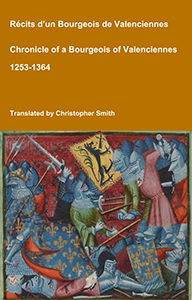
Chronicle of a Bourgeois of Valenciennes
Récits d’un bourgeois de Valenciennes aka The Chronicle of a Bourgeois of Valenciennes is a vivid 14th-century vernacular chronicle written by an anonymous urban chronicler from Valenciennes in the County of Hainaut. It survives in a manuscript that describes local and regional history from about 1253 to 1366, blending chronology, narrative episodes, and eyewitness-style accounts of political, military, and social events in medieval France, Flanders, and the Low Countries. The work begins with a chronological framework of events affecting Valenciennes and its region under rulers such as King Philip VI of France and the shifting allegiances of local nobility. It includes accounts of conflicts, sieges, diplomatic manoeuvres, and the impact of broader struggles like the Hundred Years’ War on urban life in Hainaut. Written from the perspective of a burgher (bourgeois) rather than a monastery or royal court, the chronicle offers a rare lay viewpoint on high politics and warfare, reflecting how merchants, townspeople, and civic institutions experienced the turbulence of the 13th and 14th centuries. Its narrative style combines straightforward reporting of events with moral and civic observations, making it a valuable source for readers interested in medieval urban society, regional politics, and the lived experience of war and governance in pre-modern Europe.
Available at Amazon in eBook and Paperback format.
In March 1691 John Riley (age 45) died of gout. He was buried in St Botolph's without Bishopgate.


On 8th June 1761 Johnathan Wathen (age 33) and Anne Waller (age 48) were married at St Botolph's without Bishopgate.
On 28th October 1656 Stephen Bachiler (age 95) died. He was buried at New Churchyard St Botolph's without Bishopgate.