

The History of William Marshal was commissioned by his son shortly after William’s death in 1219 to celebrate the Marshal’s remarkable life; it is an authentic, contemporary voice. The manuscript was discovered in 1861 by French historian Paul Meyer. Meyer published the manuscript in its original Anglo-French in 1891 in two books. This book is a line by line translation of the first of Meyer’s books; lines 1-10152. Book 1 of the History begins in 1139 and ends in 1194. It describes the events of the Anarchy, the role of William’s father John, John’s marriages, William’s childhood, his role as a hostage at the siege of Newbury, his injury and imprisonment in Poitou where he met Eleanor of Aquitaine and his life as a knight errant. It continues with the accusation against him of an improper relationship with Margaret, wife of Henry the Young King, his exile, and return, the death of Henry the Young King, the rebellion of Richard, the future King Richard I, war with France, the death of King Henry II, and the capture of King Richard, and the rebellion of John, the future King John. It ends with the release of King Richard and the death of John Marshal.
Available at Amazon in eBook and Paperback format.
St Mary's Church, Wirksworth is in Derbyshire Dales, Churches in Derbyshire.
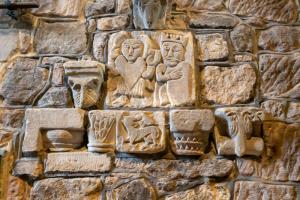
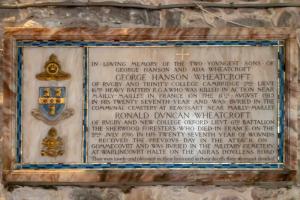
St Mary's Church, Wirksworth [Map]. General Photos of the Interior and Saxon Carving.
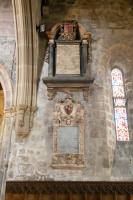
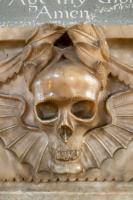
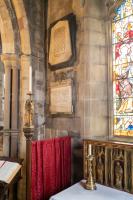
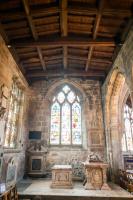
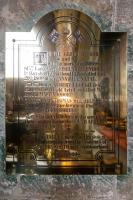
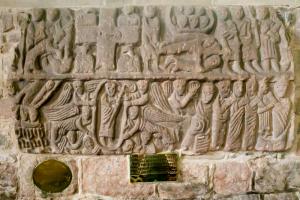
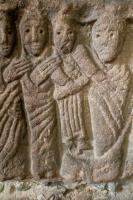
In 1555 Anthony Lowe [aged 73] died. St Mary's Church, Wirksworth [Map]. Monument to Anthony Lowe. Elizabethan Period.
Anthony Lowe: In 1482 he was born.
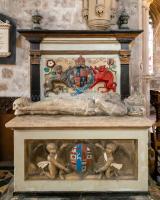
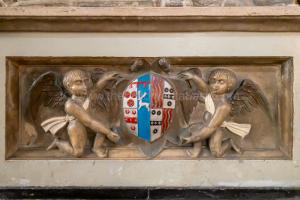
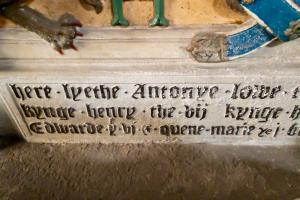
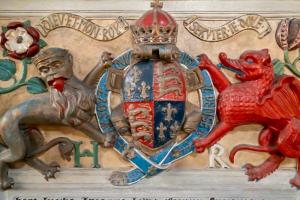
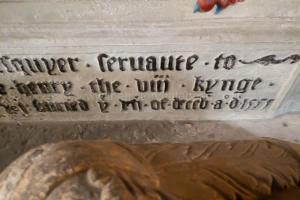
On 7th June 1564 Ralph Gell [aged 73] died. He was buried in St Mary's Church, Wirksworth [Map]. Elizabethan Period. Chest with Weepers.
The inscription reads: Here lyeth RAFF GELL of Hopton sun of John Gell of Hopton and Godythe and Emme [aged 54] his wyffes, which Raff deceased ye VIIth day of June Anno Dmi MVLXIIII. THis body whych of kynde we have ... to earth it must. A gostly bodye shall at length be raised out of dust. What harm at all recyveth man by yeldyne uppe his brethe. Synce he unto a dyryng lyffe hath passage throughe dethe. God of His mercy meer us those in a lyves booke us writ. Dy must thou onced then yelde thyselfe and dred not deathe a wyt.
Ralph Gell: In 1491 he was born. Before 1522 Ralph Gell and Godeth Ashby were married. After 1535 Ralph Gell and Emma Beresford were married.
Godeth Ashby: Around 1500 she was born to Nicholas Ashby of Willoughby on the Wolds in Nottinghamshire. Around 1535 she died.
Emma Beresford: Around 1510 she was born to Hugh Beresford.

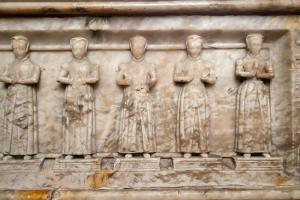


On 29th June 1583 Anthony Gell [aged 61] died. He was buried in St Mary's Church, Wirksworth [Map]. Elizabethan Period.
Anthony Gell: In 1522 he was born to Ralph Gell and Godeth Ashby.
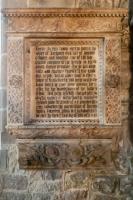
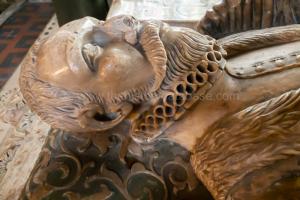
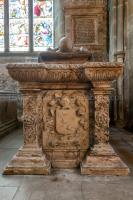
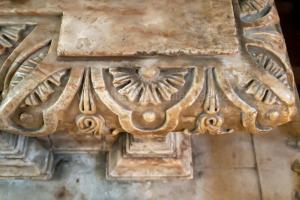
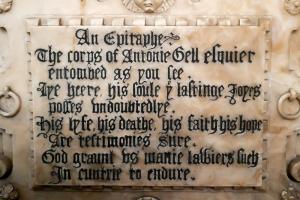
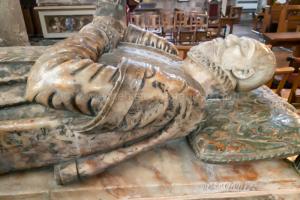
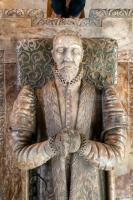
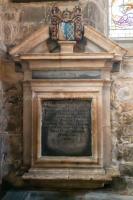
On 26th January 1671 John Gell 1st Baronet [aged 77] died. He was buried in St Mary's Church, Wirksworth [Map]. His son John [aged 58] succeeded 2nd Baronet Gell of Hopton in Derbyshire.
John Gell 2nd Baronet: In 1613 he was born to John Gell 1st Baronet and Elizabeth Willoughby Lady Gell. Before 8th February 1688 John Gell 2nd Baronet and Katherine Packer of Shelingford were married. On 8th February 1688 John Gell 2nd Baronet died. His son Philip succeeded 3rd Baronet Gell of Hopton in Derbyshire. Elizabeth Fagge Lady Gell by marriage Lady Gell of Hopton in Derbyshire.
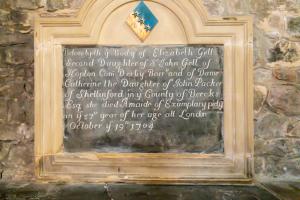
On 19th October 1704 Elizabeth Gell died. St Mary's Church, Wirksworth [Map]. Monument to Elizabeth Gell.
Elizabeth Gell: she was born to John Gell 2nd Baronet and Katherine Packer of Shelingford.

On 16th July 1719 Philip Gell 3rd Baronet [aged 68] died without issue. He was buried at St Mary's Church, Wirksworth [Map]. Monument to Philip Gell 3rd Baronet. Baronet Gell of Hopton in Derbyshire extinct. His esates were inherited by his nephew John Gell son of William Eyre and Philip's sister Katherine Gell who adopted the name Gell.

On or before 22nd April 1892 Thomas Goodwin [aged 82] died. He was buried at St Mary's Church, Wirksworth [Map].