This is a translation of the 'Memoires of Jacques du Clercq', published in 1823 in two volumes, edited by Frederic, Baron de Reissenberg. In his introduction Reissenberg writes: 'Jacques du Clercq tells us that he was born in 1424, and that he was a licentiate in law and a counsellor to Philip the Good, Duke of Burgundy, in the castellany of Douai, Lille, and Orchies. It appears that he established his residence at Arras. In 1446, he married the daughter of Baldwin de la Lacherie, a gentleman who lived in Lille. We read in the fifth book of his Memoirs that his father, also named Jacques du Clercq, had married a lady of the Le Camelin family, from Compiègne. His ancestors, always attached to the counts of Flanders, had constantly served them, whether in their councils or in their armies.' The Memoires cover a period of nineteen years beginning in in 1448, ending in in 1467. It appears that the author had intended to extend the Memoirs beyond that date; no doubt illness or death prevented him from carrying out this plan. As Reissenberg writes the 'merit of this work lies in the simplicity of its narrative, in its tone of good faith, and in a certain air of frankness which naturally wins the reader’s confidence.' Du Clercq ranges from events of national and international importance, including events of the Wars of the Roses in England, to simple, everyday local events such as marriages, robberies, murders, trials and deaths, including that of his own father in Book 5; one of his last entries.
Available at Amazon in eBook and Paperback format.
St Mary's Place, Newcastle upon Tyne is in Newcastle upon Tyne, Northumberland [Map].
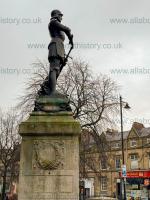
"The Response" aka Northumberland Fusiliers War Memorial, Newcastle upon Tyne [Map] Sculpted by William Goscombe John (age 63). The memorial was inauguratred on the 5th of July, 1923, by the Prince of Wales (age 29).
A portrayal of the spirit of 1914 with which Great Britain entered WWI. The memorial was given by ship-owner and MP Sir George Renwick to commemorate the raising of the B. Coy. 9th Battalion and the 16th, 18th and 19th Service Battalions Northumberland Fusiliers.


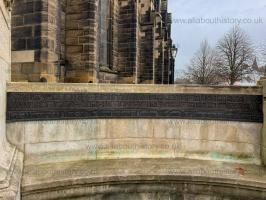
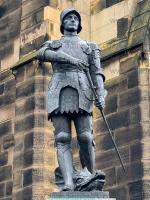
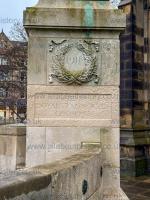
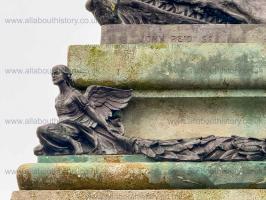
On 30th November 1924 the Northumberland Fusiliers and Royal Tank Regiment War Memorial, Newcastle upon Tyne [Map] was unveiled by the commanding officer of the Northumberland Fusiliers, Major General Sir Percival S. Wilson, and dedicated by the Rev Canon T E Crawhall, the memorial had been raised by public subscription at a cost of £3,000. The figure which represents St George slaying the dragon was designed by John W M Reid who at the time was Master of Sculpture at the nearby University of Durham's Armstrong College (now Newcastle University). The intricate detail found in the representation of St George's armour was researched by Reid during a visit to see examples of the period in the Tower of London. The sculptor of the figure was William Currie and the architects were Newcastle-based Cackett and Burns Dick. The memorial's figure is made from bronze, supported by a pedestal and screen of Portland Stone. The memorial commemorates the service of both the 6th (Territorial/City) Northumberland Fusiliers and the 43rd and 49th battalions of the Royal Tank Regiment. The latter was added after World War Two to mark an amalgamation in 1938 of the Northumberland Fusiliers with the Royal Tank Regiment. In 1938 the Fusiliers had changed from an infantry to an armoured role.
St Thomas the Martyr's Church, Newcastle upon Tyne is also in Churches in Northumberland.
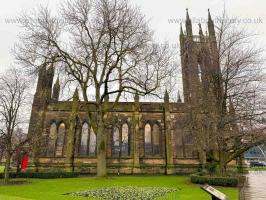
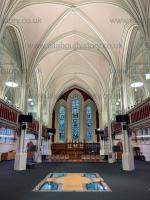
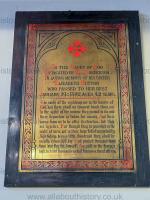
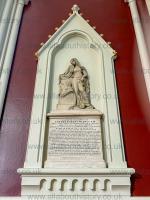
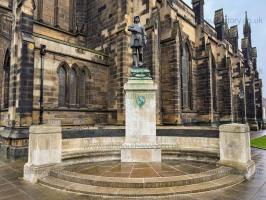
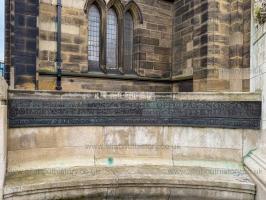
St Thomas the Martyr's Church, Newcastle upon Tyne [Map]. A 19th-century Anglican re-foundation of a medieval chapel, traditionally said to have been created by Hugh de Morville, one of the assassins of Thomas Becket, who, in additition to serving a period as confreres (associate brother) of the Knights Templar, elected to found a chapel dedicated to the saint as a private penance.