

Annals of the six Kings of England by Nicholas Trivet
Translation of the Annals of the Six Kings of England by that traces the rise and rule of the Angevin aka Plantagenet dynasty from the mid-12th to early 14th century. Written by the Dominican scholar Nicholas Trivet, the work offers a vivid account of English history from the reign of King Stephen through to the death of King Edward I, blending political narrative with moral reflection. Covering the reigns of six monarchs—from Stephen to Edward I—the chronicle explores royal authority, rebellion, war, and the shifting balance between crown, church, and nobility. Trivet provides detailed insight into defining moments such as baronial conflicts, Anglo-French rivalry, and the consolidation of royal power under Edward I, whose reign he describes with particular immediacy. The Annals combines careful year-by-year reporting with thoughtful interpretation, presenting history not merely as a sequence of events but as a moral and political lesson. Ideal for readers interested in medieval history, kingship, and the origins of the English state, this chronicle remains a valuable and accessible window into the turbulent world of the Plantagenet kings.
Available at Amazon in eBook and Paperback format.
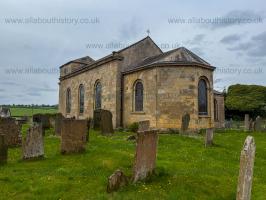
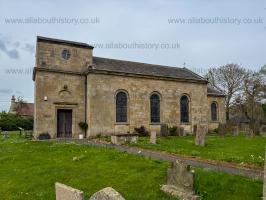
St Peter's Church, Elmton is in Elmton, Derbyshire, Churches in Derbyshire.
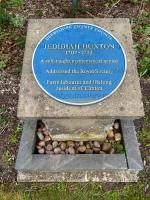
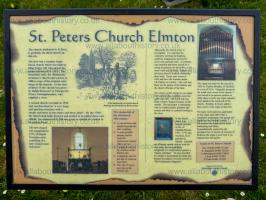
Commorative plaque to Jedidiah Buxon, a self-taught mathematical genius who addressed the Royal Society and who was born at Elmton, Derbyshire and who was buried in the churchyard at St Peter's Church, Elmton [Map].
The first church [Map] at Elmton was a wooden Anglo-Saxon church commissioned by King Sweyn Cilt who owned the manor bwteen 979-1017. The Domesday entry for 'Helmetune' mentions a church and a priest. At the time of King Hnery II the church was given by Ralph Deincourt to Thurgarton Priory, Nottinghamshire, who provided a vicar.
A second church at Elmton was built in 1550 and was described as 'a very large and spaciouos structure with a steeple and tower in the centre and three aisles.' By the 1750's the church had badly decayed and need to be pulled dow and rebuilt. An estimate of £1,288 was given to rebuild the church in its present form.
St Peter's Church, Elmton [Map] was completed in 1771, of simple Georgian style, consisting of a nave, chancel, and bell towe.r
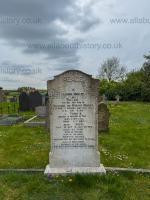
Memorial at St Peter's Church, Elmton [Map] to brothers William Milnes, died of wounds, 15th May 1918, aged 26, Thomas Milnes, killed in action, 11th March 1917 aged 23, and Joseph Milnes, killed in action 1st July 1917, aged 27.