

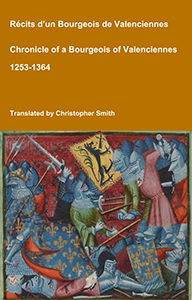
Chronicle of a Bourgeois of Valenciennes
Récits d’un bourgeois de Valenciennes aka The Chronicle of a Bourgeois of Valenciennes is a vivid 14th-century vernacular chronicle written by an anonymous urban chronicler from Valenciennes in the County of Hainaut. It survives in a manuscript that describes local and regional history from about 1253 to 1366, blending chronology, narrative episodes, and eyewitness-style accounts of political, military, and social events in medieval France, Flanders, and the Low Countries. The work begins with a chronological framework of events affecting Valenciennes and its region under rulers such as King Philip VI of France and the shifting allegiances of local nobility. It includes accounts of conflicts, sieges, diplomatic manoeuvres, and the impact of broader struggles like the Hundred Years’ War on urban life in Hainaut. Written from the perspective of a burgher (bourgeois) rather than a monastery or royal court, the chronicle offers a rare lay viewpoint on high politics and warfare, reflecting how merchants, townspeople, and civic institutions experienced the turbulence of the 13th and 14th centuries. Its narrative style combines straightforward reporting of events with moral and civic observations, making it a valuable source for readers interested in medieval urban society, regional politics, and the lived experience of war and governance in pre-modern Europe.
Available at Amazon in eBook and Paperback format.
Wolverhampton, Staffordshire is in Staffordshire.
On 24th January 1724 Henry Gough (age 75) died. He was buried at Bushbury.
In 1863 George Body (age 22) was ordained Deacon. In 1864 he was ordained Priest. Thereafter he was appointed to the curacies of St James's Church, Wednesbury, and Christ Church, Wolverhampton.


St Peter's Collegiate Church, Wolverhampton is also in Churches in Staffordshire.
St Peter's Collegiate Church, Wolverhampton [Map]. The tomb of John and Joyce Leveson in the Lady Chapel, 1575, attributed to Robert Royley of Burton on Trent, the oldest surviving monument in the church. John was a cousin of James Leveson, like him a Merchant of the Staple, and like him had financial interests in the deanery and prebends. This financial entanglement ultimately proved ruinous for the church.
St Peter's Collegiate Church, Wolverhampton [Map]. Tomb of Thomas and Katherine Lane of Bentley, c. 1585, attributed to Robert Royley of Burton on Trent, in the north chapel. The Lanes were important landowners in Staffordshire and, although they accepted the Reformation, closely allied with the recusant Giffard family of Chillington Hall.
On 2nd August 1605 Admiral Richard Leveson (age 35) died. He was buried at St Peter's Collegiate Church, Wolverhampton [Map].
Anglo-Saxon Chronicle. 910. This year Frithestan took to the bishopric of Winchester; and Asser died soon after, who was Bishop of Sherborne. The same year King Edward (age 36) sent an army both from Wessex and Mercia, which very much harassed the northern army by their attacks on men and property of every kind. They slew many of the Danes, and remained in the country five weeks. This year the Angles and the Danes fought at Tootenhall; and the Angles had the victory. The same year Ethelfleda (age 40) built the fortress at Bramsbury.

1853 to 1854. John Everett Millais 1st Baronet (age 23). "Effie (age 24) with Foxgloves in her hair". On display at Wightwick Manor, Wolverhampton. On display at Wightwick Manor, Wolverhampton.
In 1887 Wightwick Manor, Wolverhampton was commissioned by Samuel Theodore Mander (age 34) of Mander Brothers, a Wolverhampton paint and varnish manufacturer. The architect was Edward Ould.
In 1900 Samuel Theodore Mander (age 47) died. Geoffrey Le Mesurier Mander (age 17) inherited Wightwick Manor, Wolverhampton.

The True Chronicles of Jean le Bel Volume 1 Chapters 1-60 1307-1342
The True Chronicles of Jean le Bel offer one of the most vivid and immediate accounts of 14th-century Europe, written by a knight who lived through the events he describes, and experienced some of them first hand. Covering the early decades of the Hundred Years’ War, this remarkable chronicle follows the campaigns of Edward III of England, the politics of France and the Low Countries, and the shifting alliances that shaped medieval warfare. Unlike later historians, Jean le Bel writes with a strong sense of eyewitness authenticity, drawing on personal experience and the testimony of fellow soldiers. His narrative captures not only battles and sieges, but also the realities of military life, diplomacy, and the ideals of chivalry that governed noble society. A key source for Jean Froissart, Le Bel’s chronicle stands on its own as a compelling and insightful work, at once historical record and literary achievement. This translation builds on the 1905 edition published in French by Jules Viard, adding extensive translations from other sources Rymer's Fœdera, the Chronicles of Adam Murimuth, William Nangis, Walter of Guisborough, a Bourgeois of Valenciennes, Geoffrey le Baker of Swinbroke and Richard Lescot to enrich the original text and Viard's notes.
Available at Amazon in eBook and Paperback format.
In 1937 Geoffrey Le Mesurier Mander (age 54) gifted Wightwick Manor, Wolverhampton to the National Trust.