


The True Chronicles of Jean le Bel Volume 1 Chapters 1-60 1307-1342
The True Chronicles of Jean le Bel offer one of the most vivid and immediate accounts of 14th-century Europe, written by a knight who lived through the events he describes, and experienced some of them first hand. Covering the early decades of the Hundred Years’ War, this remarkable chronicle follows the campaigns of Edward III of England, the politics of France and the Low Countries, and the shifting alliances that shaped medieval warfare. Unlike later historians, Jean le Bel writes with a strong sense of eyewitness authenticity, drawing on personal experience and the testimony of fellow soldiers. His narrative captures not only battles and sieges, but also the realities of military life, diplomacy, and the ideals of chivalry that governed noble society. A key source for Jean Froissart, Le Bel’s chronicle stands on its own as a compelling and insightful work, at once historical record and literary achievement. This translation builds on the 1905 edition published in French by Jules Viard, adding extensive translations from other sources Rymer's Fœdera, the Chronicles of Adam Murimuth, William Nangis, Walter of Guisborough, a Bourgeois of Valenciennes, Geoffrey le Baker of Swinbroke and Richard Lescot to enrich the original text and Viard's notes.
Available at Amazon in eBook and Paperback format.
Associate of the Royal Academy is in Royal Academy.
In 1784 Thomas Banks [aged 48] was elected Associate of the Royal Academy.

In 1792 Thomas Stothard [aged 36] was elected Associate of the Royal Academy.
In 1798 Martin Archer Shee [aged 28] was elected Associate of the Royal Academy.
In 1805 Richard Westmacott [aged 29] was elected Associate of the Royal Academy.
In 1812 Alfred Edward Chalon [aged 31] was elected Associate of the Royal Academy.
In 1816 Francis Leggatt Chantrey [aged 34] was elected Associate of the Royal Academy.
On 4th November 1833 John Gibson [aged 43] was elected Associate of the Royal Academy despite not meeting the criterion of being resident in Britain.
In 1838 Richard "The Younger" Westmacott [aged 39] was elected Associate of the Royal Academy at which time he was living at 21 Wilton Place, Belgravia.
In 1844 William Calder Marshall [aged 30] was appointed Associate of the Royal Academy. He participated in an exhibition held at Westminster Hall to select artists to decorate the rebuilt Palace of Westminster. It proved to be the turning point of his career, leading to many commissions for public monuments not only for the new Houses of Parliament - for which he made statues of the Lord Chancellors Clarendon and Somers, and of Chaucer.
In 1868 William Quiller Orchardson [aged 35] was elected Associate of the Royal Academy.
On 16th January 1875 Henry Hugh Armstead [aged 46] was elected Associate of the Royal Academy.
In 1891 Frank Bernard Dicksee [aged 37] was appointed Associate of the Royal Academy.
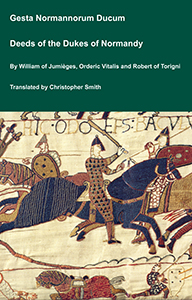
The Deeds of the Dukes of Normandy
The Gesta Normannorum Ducum [The Deeds of the Dukes of Normandy] is a landmark medieval chronicle tracing the rise and fall of the Norman dynasty from its early roots through the pivotal events surrounding the Norman Conquest of England. Originally penned in Latin by the monk William of Jumièges shortly before 1060 and later expanded at the behest of William the Conqueror, the work chronicles the deeds, politics, battles, and leadership of the Norman dukes, especially William’s own claim to the English throne. The narrative combines earlier historical sources with firsthand information and oral testimony to present an authoritative account of Normandy’s transformation from a Viking settlement into one of medieval Europe’s most powerful realms. William’s history emphasizes the legitimacy, military prowess, and governance of the Norman line, framing their expansion, including the conquest of England, as both divinely sanctioned and noble in purpose. Later chroniclers such as Orderic Vitalis and Robert of Torigni continued the history, extending the coverage into the 12th century, providing broader context on ducal rule and its impact. Today this classic work remains a foundational source for understanding Norman identity, medieval statesmanship, and the historical forces that reshaped England and Western Europe between 800AD and 1100AD.
Available at Amazon in eBook and Paperback format.
In 1895 John William Waterhouse [aged 45] was appointed Associate of the Royal Academy.

In 1899 Alfred East [aged 54] was elected Associate of the Royal Academy.
In 1907 Frank Cowper [aged 57] was elected Associate of the Royal Academy.
In 1909 Adrian Scott Stokes [aged 54] was elected Associate of the Royal Academy.
In 1924 Ambrose McEvoy [aged 46] was appointed Associate of the Royal Academy.