

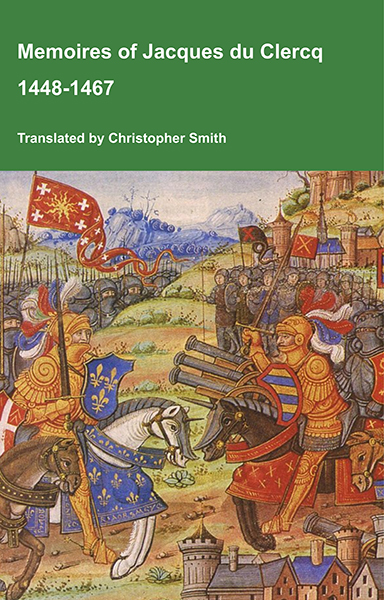
This is a translation of the 'Memoires of Jacques du Clercq', published in 1823 in two volumes, edited by Frederic, Baron de Reissenberg. In his introduction Reissenberg writes: 'Jacques du Clercq tells us that he was born in 1424, and that he was a licentiate in law and a counsellor to Philip the Good, Duke of Burgundy, in the castellany of Douai, Lille, and Orchies. It appears that he established his residence at Arras. In 1446, he married the daughter of Baldwin de la Lacherie, a gentleman who lived in Lille. We read in the fifth book of his Memoirs that his father, also named Jacques du Clercq, had married a lady of the Le Camelin family, from Compiègne. His ancestors, always attached to the counts of Flanders, had constantly served them, whether in their councils or in their armies.' The Memoires cover a period of nineteen years beginning in in 1448, ending in in 1467. It appears that the author had intended to extend the Memoirs beyond that date; no doubt illness or death prevented him from carrying out this plan. As Reissenberg writes the 'merit of this work lies in the simplicity of its narrative, in its tone of good faith, and in a certain air of frankness which naturally wins the reader’s confidence.' Du Clercq ranges from events of national and international importance, including events of the Wars of the Roses in England, to simple, everyday local events such as marriages, robberies, murders, trials and deaths, including that of his own father in Book 5; one of his last entries.
Available at Amazon in eBook and Paperback format.
Bishop of Lindisfarne is in Bishop. See Lindisfarne Abbey [Map].
In 635 Bishop Aidan of Lindisfarne was appointed Bishop of Lindisfarne.
In 664 Bishop Tuda was appointed Bishop of Lindisfarne.
Bede. 2nd March 672. Ceadda died on the 2nd of March, and was first buried by St. Mary's Church [Map], but afterwards, when the church [Map] of the most holy prince of the apostles, Peter, was built, his bones were translated into it. In both which places, as a testimony of his virtue, frequent miraculous cures are wont to be wrought. And of late, a certain distracted person, who had been wandering about everywhere, arrived there in the evening, unknown or unregarded by the keepers of the place, and having rested there all the night, went out in his perfect senses the next morning, to the surprise and delight of all; thus showing that a cure had been performed on him through the goodness of God. The place of the sepulchre is a wooden monument, made like a little house, covered, having a hole in the wall, through which those that go thither for devotion usually put in their hand and take out some of the dust, which they put into water and give to sick cattle or men to drink, upon which they are presently eased of their infirmity, and restored to health. In his place, Theodore [aged 70] ordained Winfrid, a good and modest man, to preside, as his predecessors had done, over the bishoprics of the Mercians, the Midland Angles, and the Lindisfarnes, of all which, Wulfhere [aged 32], who was still living, was king. Winfrid was one of the clergy of the prelate he had succeeded, and had for a considerable time filled the office of deacon under him.
Bede. 678. In the year of our Lord's incarnation 678, which is the eighth of the reign of Egfrid [aged 33], in the month of August, appeared a star, called a comet, which continued for three months, rising in the morning, and darting out, as it were, a pillar of radiant flame. The same year a dissension broke out between King Egfrid and the most reverend prelate, Wilfrid, who was driven from his see, and two bishops substituted in his stead, to preside over the nation of the Northumbrians, namely, Bosa, to preside over the nation of the Deiri; and Eata over that of the Bernicians; the latter having his see in the city of York [Map], the former in the church of Hagulstad [Map], or else Lindisfarne [Map]; both of them promoted to the episcopal dignity from a society of monks. With them also was Edhed ordained bishop in the province of Lindsey, which King Egfrid had but newly subdued, having overcome and vanquished Wulfhere; and this was the first bishop of its own which that province had; the second was Ethelwin; the third Eadgar; the fourth Cynebert, who is there at present. Before Edhed, Sexwulf was bishop as well of that province, as of the Mercians and Midland Angles; so that when expelled from Lindsey, he continued in the government of those provinces. Edhed, Bosa, and Eata, were ordained at York [Map] by Archbishop Theodore [aged 76]; who also, three years after the departure of Wilfrid, added two bishops to their number; Trumbert, in the church of Hagulstad [Map], Eata still continuing in that of Lindisfarne; and Trumwine in the province of the Picts, which at that time was subject to the English. Edhed returning from Lindsey, because Ethelred had recovered that province, was placed by him over the church of Ripon.
In 688 Bishop Eadberht of Lindisfarne was appointed Bishop of Lindisfarne.
In 721 Bishop Æthelwold was appointed Bishop of Lindisfarne.
In 737 Bishop Cynewulf of Lindisfarne was consecrated Bishop of Lindisfarne.
Anglo-Saxon Chronicle. Bishop Cynewulf retired to Holy-island; Elmund, Bishop of Hexham, died on the seventh day before the ides of September [7th September 781], and Tilbert was consecrated in his stead, on the sixth day before the nones of October [2nd October 780]; Hibbald was consecrated Bishop of Holy-island at Sockbury; and King Elwald sent to Rome for a pall in behoof of Archbishop Eanbald.
On 11th June 803 Bishop Egbert of Lindisfarne was consecrated Bishop of Lindisfarne.
Bede. HOW CEADDA, ABOVE-MENTIONED, WAS MADE BISHOP OF THE MERCIANS. OF HIS LIFE, DEATH, AND BURIAL.
At that time, the Mercians were governed by King Wulfhere, who, on the death of Jaruman, desired of Theodore to supply him and his people with a bishop; but Theodore would not obtain a new one for them, but requested of King Oswy that Ceadda might be their bishop. He then lived retired at his monastery, which is at Lestingau, Wilfrid filling the bishopric of York, and of all the Northumbrians, and likewise of the Picts, as far as the dominions of King Oswy extended. And, seeing that it was the custom of that most reverend prelate to go about the work of the Gospel to several places rather on foot than on horseback, Theodore commanded him to ride whenever he had a long journey to undertake, and finding him very unwilling to omit his former pious labour, he himself, with his hands, lifted him on the horse; for he thought him a holy man, and therefore obliged him to ride wherever lie had need to go. Ceadda having received the bishopric of the Mercians and Lindisfarne, took care to administer the same with great rectitude of life, according to the example of the ancients. King Wulfhere also gave him land of fifty families, to build a monastery, at the place called Barvc, or "The Wood," in the province of Lindsey, wherein marks of the regular life instituted by him continue to this day.
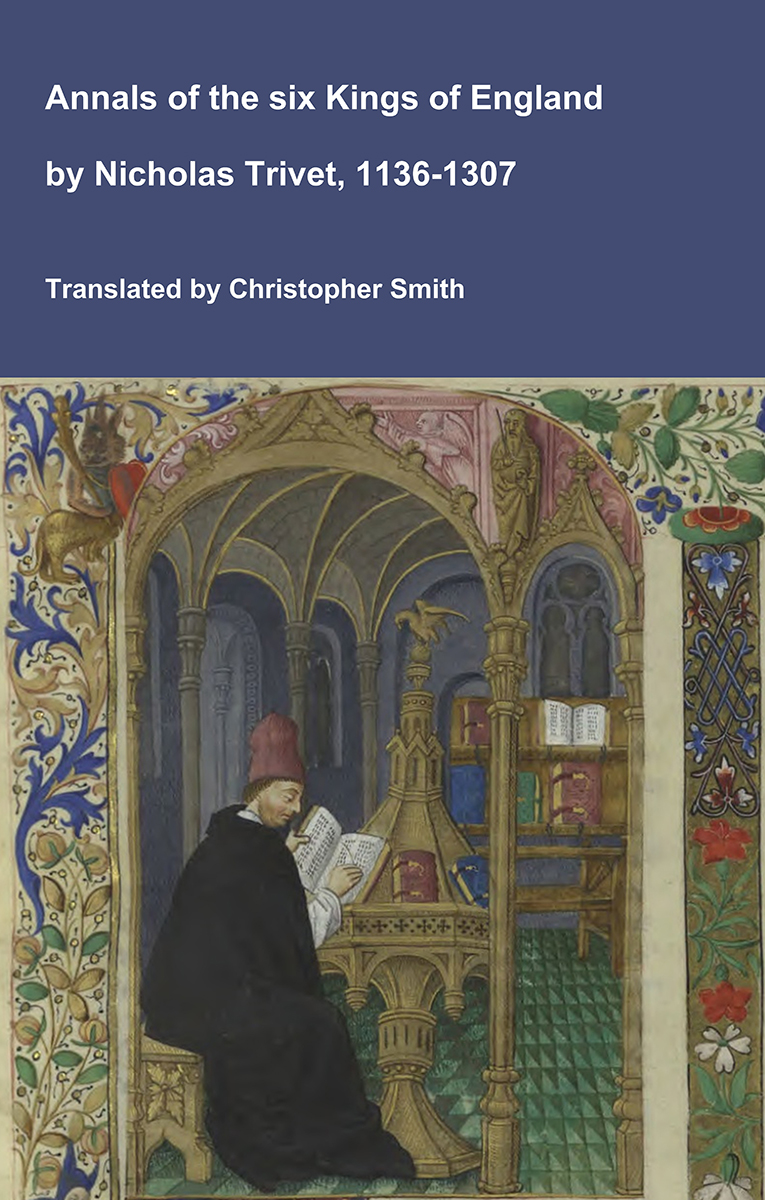
Annals of the six Kings of England by Nicholas Trivet
Translation of the Annals of the Six Kings of England by that traces the rise and rule of the Angevin aka Plantagenet dynasty from the mid-12th to early 14th century. Written by the Dominican scholar Nicholas Trivet, the work offers a vivid account of English history from the reign of King Stephen through to the death of King Edward I, blending political narrative with moral reflection. Covering the reigns of six monarchs—from Stephen to Edward I—the chronicle explores royal authority, rebellion, war, and the shifting balance between crown, church, and nobility. Trivet provides detailed insight into defining moments such as baronial conflicts, Anglo-French rivalry, and the consolidation of royal power under Edward I, whose reign he describes with particular immediacy. The Annals combines careful year-by-year reporting with thoughtful interpretation, presenting history not merely as a sequence of events but as a moral and political lesson. Ideal for readers interested in medieval history, kingship, and the origins of the English state, this chronicle remains a valuable and accessible window into the turbulent world of the Plantagenet kings.
Available at Amazon in eBook and Paperback format.
Bishop Aldun of Northumbria was appointed Bishop of Lindisfarne.