

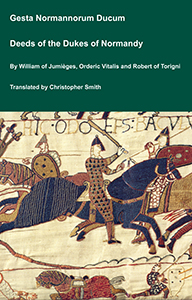
The Deeds of the Dukes of Normandy
The Gesta Normannorum Ducum [The Deeds of the Dukes of Normandy] is a landmark medieval chronicle tracing the rise and fall of the Norman dynasty from its early roots through the pivotal events surrounding the Norman Conquest of England. Originally penned in Latin by the monk William of Jumièges shortly before 1060 and later expanded at the behest of William the Conqueror, the work chronicles the deeds, politics, battles, and leadership of the Norman dukes, especially William’s own claim to the English throne. The narrative combines earlier historical sources with firsthand information and oral testimony to present an authoritative account of Normandy’s transformation from a Viking settlement into one of medieval Europe’s most powerful realms. William’s history emphasizes the legitimacy, military prowess, and governance of the Norman line, framing their expansion, including the conquest of England, as both divinely sanctioned and noble in purpose. Later chroniclers such as Orderic Vitalis and Robert of Torigni continued the history, extending the coverage into the 12th century, providing broader context on ducal rule and its impact. Today this classic work remains a foundational source for understanding Norman identity, medieval statesmanship, and the historical forces that reshaped England and Western Europe between 800AD and 1100AD.
Available at Amazon in eBook and Paperback format.
Governors is in Crown.
Ralph Grey of Chillingham was appointed Governor of Bamburgh Castle.
In 1539 William Eure 1st Baron Eure [aged 56] was appointed Governor of Berwick on Tweed.
On 25th August 1568 Henry Carey 1st Baron Hunsdon [aged 42] was appointed Governor of Berwick on Tweed.

In 1598 Peregrine Bertie 13th Baron Willoughby [aged 42] was appointed Warden of the East Marches and Governor of Berwick on Tweed.
John Conyers 3rd Baron Conyers was appointed Governor of Berwick on Tweed.
In 1388 Richard Fitzalan 9th Earl of Surrey 4th or 11th Earl of Arundel [aged 42] was appointed Governor of Brest. He was buried at Church of Augustin Friars Bread Street.
In 1307 Bartholomew Badlesmere 1st Baron Badlesmere [aged 31] was appointed Governor of Bristol Castle.
In 1377 William Latimer 4th Baron Latimer of Corby [aged 46] was appointed Governor of Calais.
In October 1265 Roger Leybourne [aged 50] was appointed Governor of Carlisle Castle and High Sheriff of Cumberland.
Jean de Waurin's Chronicle of England Volume 6 Books 3-6: The Wars of the Roses
Jean de Waurin was a French Chronicler, from the Artois region, who was born around 1400, and died around 1474. Waurin’s Chronicle of England, Volume 6, covering the period 1450 to 1471, from which we have selected and translated Chapters relating to the Wars of the Roses, provides a vivid, original, contemporary description of key events some of which he witnessed first-hand, some of which he was told by the key people involved with whom Waurin had a personal relationship.
Available at Amazon in eBook and Paperback format.
After 1296 Robert Clifford 1st Baron Clifford [aged 21] was appointed Governor of Carlisle Castle.
In 1484 Humphrey Dacre 1st Baron Dacre Gilsland [aged 60] was appointed Governor of Carlisle Castle and Warden of the West Marches.
On 18th June 1525 Henry Fitzroy [aged 6] was taken by barge to Bridewell Palace [Map] where he was enobled by his father King Henry VIII of England and Ireland [aged 33].
In the morning Henry Fitzroy was created 1st Earl Nottingham.
In the afternoon Henry Fitzroy was created 1st Duke of Richmond and Somerset.
Henry Percy 5th Earl of Northumberland [aged 47] carried the Sword of State. Thomas More [aged 47] read the patents of nobility. Charles Brandon 1st Duke of Suffolk [aged 41], Thomas Grey 2nd Marquess Dorset [aged 47],
Henry Courtenay [aged 29] was created 1st Marquess Exeter. Gertrude Blount Marchioness of Exeter [aged 22] by marriage Marchioness Exeter.
Henry Clifford [aged 32] was created 1st Earl of Cumberland, Warden of the West Marches and Governor of Carlisle Castle.
Thomas Manners [aged 33] was created 1st Earl of Rutland. Eleanor Paston Countess Rutland [aged 30] by marriage Countess of Rutland. He was given the Earldom of Rutland to reflect his descent from Anne York Duchess Exeter sister of the previous Earl of Rutland. At the same time his arms  Manners Arms were augmented with the
  Manners Augmented Arms
Henry Brandon [aged 2] was created 1st Earl Lincoln.
Robert Radclyffe [aged 42] was created 1st Viscount Fitzwalter.
Thomas Boleyn 1st Earl Wiltshire and Ormonde [aged 48] was created 1st Viscount Rochford. Elizabeth Howard Countess of Wiltshire and Ormonde [aged 45] by marriage Viscountess Rochford.
Thomas Howard 3rd Duke of Norfolk [aged 52], William Fitzalan 11th or 18th Earl of Arundel [aged 49] and John de Vere 14th Earl of Oxford [aged 25] attended.


 Become a Member via our Buy Me a Coffee page to read more.
After 1643 Philip Musgrave 2nd Baronet [aged 35] was appointed Governor of Carlisle Castle.
In 1677 Christopher Musgrave 4th Baronet [aged 45] was appointed Governor of Carlisle Castle.
John Conyers 3rd Baron Conyers was appointed Governor of Carlisle Castle.

In February 1645 John Owen [aged 45] was appointed Sergeant Major General of foot under the Governor of Chester, John Byron 1st Baron Byron [aged 46].
Around December 1644 John Owen [aged 44] was appointed Governor of Conwy Castle.
In 1299 Simon Montagu 1st Baron Montagu [aged 49] was appointed Governor of Corfe Castle.

John Evelyn's Diary. 2nd April 1686. Sir Edward Hales [aged 41], a papist, made Governor of Dover Castle .
In 1314 John Botetort 1st Baron Botetort [aged 49] was appointed Governor of Framlingham Castle.
In 1667 John Griffith was appointed Governor of Gravesend.
Robert Pierrepont was appointed Governor of Newark Castle.

Chronicle of a Bourgeois of Valenciennes
Récits d’un bourgeois de Valenciennes aka The Chronicle of a Bourgeois of Valenciennes is a vivid 14th-century vernacular chronicle written by an anonymous urban chronicler from Valenciennes in the County of Hainaut. It survives in a manuscript that describes local and regional history from about 1253 to 1366, blending chronology, narrative episodes, and eyewitness-style accounts of political, military, and social events in medieval France, Flanders, and the Low Countries. The work begins with a chronological framework of events affecting Valenciennes and its region under rulers such as King Philip VI of France and the shifting allegiances of local nobility. It includes accounts of conflicts, sieges, diplomatic manoeuvres, and the impact of broader struggles like the Hundred Years’ War on urban life in Hainaut. Written from the perspective of a burgher (bourgeois) rather than a monastery or royal court, the chronicle offers a rare lay viewpoint on high politics and warfare, reflecting how merchants, townspeople, and civic institutions experienced the turbulence of the 13th and 14th centuries. Its narrative style combines straightforward reporting of events with moral and civic observations, making it a valuable source for readers interested in medieval urban society, regional politics, and the lived experience of war and governance in pre-modern Europe.
Available at Amazon in eBook and Paperback format.

In 1629 William Killigrew [aged 23] was appointed Governor of Pendennis Castle.
John Killigrew was appointed Governor of Pendennis Castle.
In 1547 Anthony Knyvet [aged 30] was appointed Governor of Portsmouth and oversaw the construction of Southsea Castle [Map].
Francis Cheney was appointed Governor of Queenborough Castle.
In 1273 John Vesci was appointed Governor of Scarborough Castle.
In 1319 Thomas Ughtred 1st Baron Ughtred [aged 27] was appointed Governor of Scarborough Castle.
John Evelyn's Diary. 2nd June 1672. At Sheerness [Map], I gave his Majesty [aged 42] and his Royal Highness [aged 38] an account of my charge, and returned to Queenborough [Map]; next day dined at Major Dorel's, Governor of Sheerness; thence, to Rochester, Kent [Map]; and the following day, home.


In 1291 John Botetort 1st Baron Botetort [aged 26] was appointed Governor of St Briavels Castle.
In 1642 Thomas Blagge [aged 29] was appointed Governor of Wallingford Castle.
On 17th June 1644 William Sydenham [aged 29] was appointed Governor of Weymouth by Robert Devereux 3rd Earl Essex [aged 53].
In 1307 Robert Fitzpayn 1st Baron Fitzpayn [aged 53] was appointed Governor of Winchester Castle.
In 1247 Nicholas Moels [aged 52] was appointed Governor of the Channel Isles.
The Deeds of the Dukes of Normandy
The Gesta Normannorum Ducum [The Deeds of the Dukes of Normandy] is a landmark medieval chronicle tracing the rise and fall of the Norman dynasty from its early roots through the pivotal events surrounding the Norman Conquest of England. Originally penned in Latin by the monk William of Jumièges shortly before 1060 and later expanded at the behest of William the Conqueror, the work chronicles the deeds, politics, battles, and leadership of the Norman dukes, especially William’s own claim to the English throne. The narrative combines earlier historical sources with firsthand information and oral testimony to present an authoritative account of Normandy’s transformation from a Viking settlement into one of medieval Europe’s most powerful realms. William’s history emphasizes the legitimacy, military prowess, and governance of the Norman line, framing their expansion, including the conquest of England, as both divinely sanctioned and noble in purpose. Later chroniclers such as Orderic Vitalis and Robert of Torigni continued the history, extending the coverage into the 12th century, providing broader context on ducal rule and its impact. Today this classic work remains a foundational source for understanding Norman identity, medieval statesmanship, and the historical forces that reshaped England and Western Europe between 800AD and 1100AD.
Available at Amazon in eBook and Paperback format.
Richard Grey was appointed Governor of the Channel Isles.
On 14th August 1649 William Sydenham [aged 34] and Colonel Fleetwood were appointed Governor of the Isle of Wight.
In 1734 John Wallop 1st Earl Portsmouth [aged 43] was appointed Governor of the Isle of Wight which office he held until 1742.

In 1791 Thomas Orde-Powlett 1st Baron Bolton [aged 50] was appointed Governor of the Isle of Wight.
John Evelyn's Diary. 14th November 1671. To Council, where Sir Charles Wheeler [aged 51], late Governor of the Leeward Islands, having been complained of for many indiscreet managements, it was resolved, on scanning many of the particulars, to advise his Majesty [aged 41] to remove him; and consult what was to be done, to prevent these inconveniences he had brought things to. This business staid me in London almost a week, being in Council, or Committee, every morning till the 25th.
In 1608 William Godolphin [aged 41] was appointed Governor of the Scilly Isles.
Before 1636 William Godolphin was appointed Governor of the Scilly Isles.
On 18th April 1733 Francis Godolphin 2nd Earl Godolphin [aged 54] was appointed Governor of the Scilly Isles.


In 1766 Francis Godolphin 2nd Baron Goldolphin [aged 59] was appointed Governor of the Scilly Isles.
Thomas Godolphin was appointed Governor of the Scilly Isles.
Chronicle of Walter of Guisborough
A canon regular of the Augustinian Guisborough Priory, Yorkshire, formerly known as The Chronicle of Walter of Hemingburgh, describes the period from 1066 to 1346. Before 1274 the Chronicle is based on other works. Thereafter, the Chronicle is original, and a remarkable source for the events of the time. This book provides a translation of the Chronicle from that date. The Latin source for our translation is the 1849 work edited by Hans Claude Hamilton. Hamilton, in his preface, says: 'In the present work we behold perhaps one of the finest samples of our early chronicles, both as regards the value of the events recorded, and the correctness with which they are detailed; Nor will the pleasing style of composition be lightly passed over by those capable of seeing reflected from it the tokens of a vigorous and cultivated mind, and a favourable specimen of the learning and taste of the age in which it was framed.'
Available at Amazon in eBook and Paperback format.
Sidney Godolphin was appointed Governor of the Scilly Isles.
In 1597 William Godolphin [aged 30] was appointed Lieutenant Governor of the Scilly Isles.
In 1739 Francis Godolphin 2nd Baron Goldolphin [aged 32] was appointed Lieutenant Governor of the Scilly Isles.