

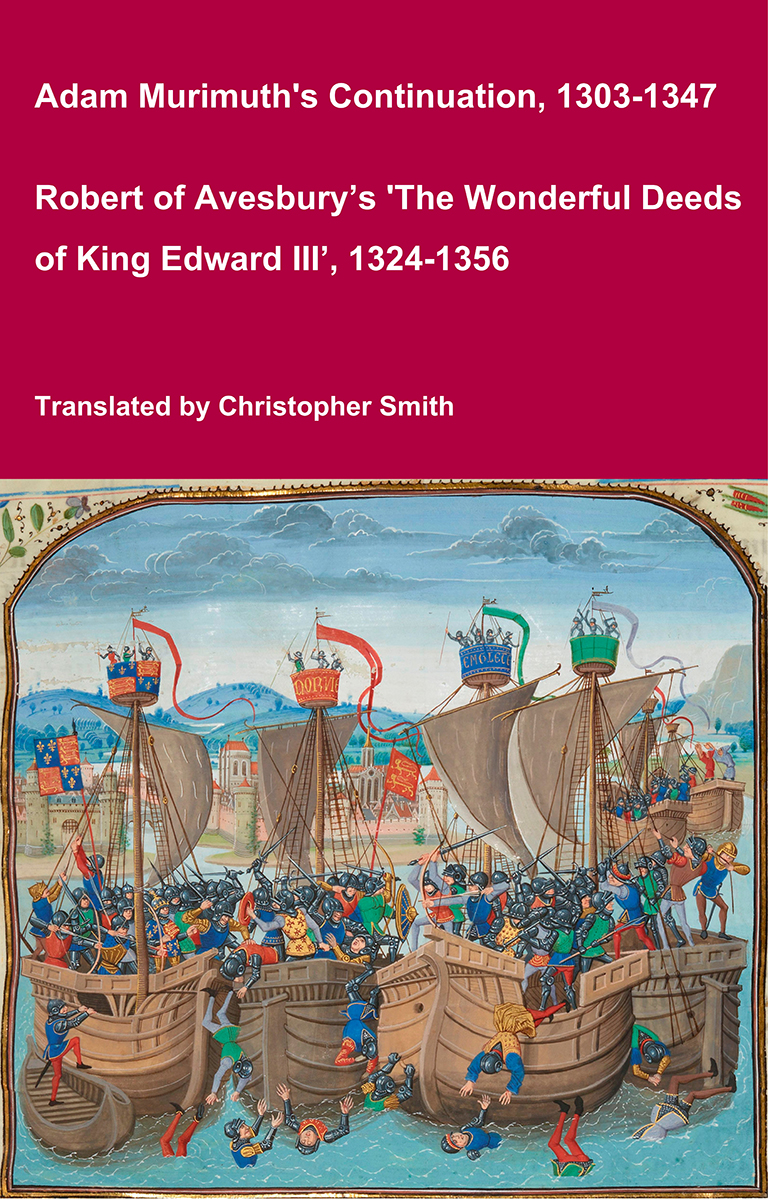
Adam Murimuth's Continuation and Robert of Avesbury’s 'The Wonderful Deeds of King Edward III'
This volume brings together two of the most important contemporary chronicles for the reign of Edward III and the opening phases of the Hundred Years’ War. Written in Latin by English clerical observers, these texts provide a vivid and authoritative window into the political, diplomatic, and military history of fourteenth-century England and its continental ambitions. Adam Murimuth Continuatio's Chronicarum continues an earlier chronicle into the mid-fourteenth century, offering concise but valuable notices on royal policy, foreign relations, and ecclesiastical affairs. Its annalistic structure makes it especially useful for establishing chronology and tracing the development of events year by year. Complementing it, Robert of Avesbury’s De gestis mirabilibus regis Edwardi tertii is a rich documentary chronicle preserving letters, treaties, and official records alongside narrative passages. It is an indispensable source for understanding Edward III’s claim to the French crown, the conduct of war, and the mechanisms of medieval diplomacy. Together, these works offer scholars, students, and enthusiasts a reliable and unembellished account of a transformative period in English and European history. Essential for anyone interested in medieval chronicles, the Hundred Years’ War, or the reign of Edward III.
Available at Amazon in eBook and Paperback format.
Lords Spritual England is in England.
In 779 Archbishop Hygeberht was elected Archbishop Lichfield.
On 4th January 1601 Archbishop William Laud [aged 27] was ordained Deacon.


In 1833 Bishop Walter Kerr Hamilton [aged 24] was appointed Deacon.
Patent Rolls. On 10th July 1461. Westminster Palace [Map]. Ratification for life of the estate of Master Robert Stillyngton [aged 41], king's clerk as deacon of the king's free chapel of St Martin le Grand, London, archdeacon of Colchester in the cathedral of London and of Taunton in the cathedral of Wells, prebendary of Wetewang in the cathedral of York, Marther (possibly typo since 'Martha' unknown) in the cathedral of St Davids and the prebend which John Luca lately had in the king's free chapel of St Stephen within his palace of Wesminster, and person of the church of Aysshebury, in the diocese of Salisbury.
In 1302 William Pontington Canon Exeter was appointed Precentor Exeter Cathedral.
In 1294 John Swinfield was appointed Precentor Hereford.
On 2nd May 1674 Robert Crichton [aged 35] was appointed Canon Wells and installed as Precentor Wells.
Before 11th June 1907 Everard Aloysius Gonzaga Arundell 13th Baron Arundel [aged 72] was appointed Priest.
George Grey was appointed Priest.
The Deeds of the Dukes of Normandy
The Gesta Normannorum Ducum [The Deeds of the Dukes of Normandy] is a landmark medieval chronicle tracing the rise and fall of the Norman dynasty from its early roots through the pivotal events surrounding the Norman Conquest of England. Originally penned in Latin by the monk William of Jumièges shortly before 1060 and later expanded at the behest of William the Conqueror, the work chronicles the deeds, politics, battles, and leadership of the Norman dukes, especially William’s own claim to the English throne. The narrative combines earlier historical sources with firsthand information and oral testimony to present an authoritative account of Normandy’s transformation from a Viking settlement into one of medieval Europe’s most powerful realms. William’s history emphasizes the legitimacy, military prowess, and governance of the Norman line, framing their expansion, including the conquest of England, as both divinely sanctioned and noble in purpose. Later chroniclers such as Orderic Vitalis and Robert of Torigni continued the history, extending the coverage into the 12th century, providing broader context on ducal rule and its impact. Today this classic work remains a foundational source for understanding Norman identity, medieval statesmanship, and the historical forces that reshaped England and Western Europe between 800AD and 1100AD.
Available at Amazon in eBook and Paperback format.
Humphrey Pole was appointed Priest.
Philip Cornwall was appointed Priest.
John Fitzalan was appointed Priest.