

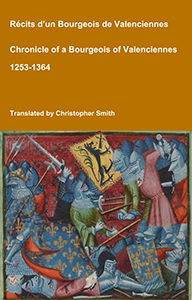
Chronicle of a Bourgeois of Valenciennes
Récits d’un bourgeois de Valenciennes aka The Chronicle of a Bourgeois of Valenciennes is a vivid 14th-century vernacular chronicle written by an anonymous urban chronicler from Valenciennes in the County of Hainaut. It survives in a manuscript that describes local and regional history from about 1253 to 1366, blending chronology, narrative episodes, and eyewitness-style accounts of political, military, and social events in medieval France, Flanders, and the Low Countries. The work begins with a chronological framework of events affecting Valenciennes and its region under rulers such as King Philip VI of France and the shifting allegiances of local nobility. It includes accounts of conflicts, sieges, diplomatic manoeuvres, and the impact of broader struggles like the Hundred Years’ War on urban life in Hainaut. Written from the perspective of a burgher (bourgeois) rather than a monastery or royal court, the chronicle offers a rare lay viewpoint on high politics and warfare, reflecting how merchants, townspeople, and civic institutions experienced the turbulence of the 13th and 14th centuries. Its narrative style combines straightforward reporting of events with moral and civic observations, making it a valuable source for readers interested in medieval urban society, regional politics, and the lived experience of war and governance in pre-modern Europe.
Available at Amazon in eBook and Paperback format.
Viscount Wallingford is in Viscountcies of England Alphabetically.
In 1616 William Knollys 1st Earl Banbury [aged 72] was created 1st Viscount Wallingford. Elizabeth Howard Countess Banbury [aged 33] by marriage Viscountess Wallingford.


On 25th May 1632 William Knollys 1st Earl Banbury [aged 88] died. His son Edward [aged 5] de jure 2nd Earl Banbury, 2nd Viscount Wallingford, 2nd Baron Knollys. Parliament disallowed the succession on the basis that Edward had been born when William was some eighty-two years old and Edward was, in fact, the son of Edward Vaux 4th Baron Vaux Harrowden [aged 43] whom Edward's mother [aged 49] subsequently married around a month after William's death.
Before June 1645 Edward Knollys 2nd Earl Banbury [aged 18] was killed in a duel. His brother Nicholas [aged 14] succeeded 3rd Earl Banbury, 3rd Viscount Wallingford, 3rd Baron Knollys although was never summoned to Parliament as a consequence of questions over his father's paternity.
In 1674 Nicholas Knollys 3rd Earl Banbury [aged 43] died. His son Charles [aged 11] de jure 4th Earl Banbury, 4th Viscount Wallingford, 4th Baron Knollys.
On 26th August 1740 Charles Knollys 4th Earl Banbury [aged 78] died at Dunkirk. His son Charles [aged 37] de jure 5th Earl Banbury, 5th Viscount Wallingford, 5th Baron Knollys.
On 13th March 1771 Charles Knollys 5th Earl Banbury [aged 67] died. He was buried on 19th March 1771 at St John the Baptist Church, Burford. His son William [aged 44] de jure 6th Earl Banbury, 6th Viscount Wallingford, 6th Baron Knollys.
On 18th March 1793 Thomas Woods Knollys 7th Earl Banbury [aged 65] died. He was buried at Winchester Cathedral [Map]. His son William [aged 30] de jure 8th Earl Banbury, 7th Viscount Wallingford, 7th Baron Knollys.
On 20th March 1834 William Knollys 8th Earl Banbury [aged 71] died. The House of Lords passed a resolution rejecting his claim to the Earldom and as a consequence Earl Banbury, Viscount Wallingford and Baron Knollys extinct.