

Abbot John Whethamstede’s Chronicle of the Abbey of St Albans
Abbot John Whethamstede's Register aka Chronicle of his second term at the Abbey of St Albans, 1451-1461, is a remarkable text that describes his first-hand experience of the beginning of the Wars of the Roses including the First and Second Battles of St Albans, 1455 and 1461, respectively, their cause, and their consequences, not least on the Abbey itself. His text also includes Loveday, Blore Heath, Northampton, the Act of Accord, Wakefield, and Towton, and ends with the Coronation of King Edward IV. In addition to the events of the Wars of the Roses, Abbot John, or his scribes who wrote the Chronicle, include details in the life of the Abbey such as charters, letters, land exchanges, visits by legates, and disputes, which provide a rich insight into the day-to-day life of the Abbey, and the challenges faced by its Abbot.
Available at Amazon in eBook and Paperback format.
Worshipful Companies is in Societies.
In 1654 John Frederick (age 52) was elected Master of the Worshipful Company of Barber Surgeons.
In 1658 John Frederick (age 56) was elected Master of the Worshipful Company of Barber Surgeons.
In 1654 Richard Hill of Lime Street was appointed Alderman of the Worshipful Company of Cordwainers.
In 1655 Richard Hill of Lime Street was appointed Master of the Worshipful Company of Cordwainers.
On 10th July 1621 Edward Barkham (age 51) was translated to the Worshipful Company of Drapers.
From 1622 to 1623 Edward Barkham (age 52) was Master of the Worshipful Company of Drapers.
After 1623 Thomas Lawley 1st Baronet (age 42) joined as Worshipful Company of Drapers.
In 1642 Thomas Lawley 1st Baronet (age 61) was elected Master of the Worshipful Company of Drapers.
John Evelyn's Diary. 7th August 1679. Dined at the Sheriff's, when, the Company of Drapers and their wives being invited, there was a sumptuous entertainment, according to the forms of the city, with music, etc., comparable to any prince's service in Europe.
Chronicle of Walter of Guisborough
A canon regular of the Augustinian Guisborough Priory, Yorkshire, formerly known as The Chronicle of Walter of Hemingburgh, describes the period from 1066 to 1346. Before 1274 the Chronicle is based on other works. Thereafter, the Chronicle is original, and a remarkable source for the events of the time. This book provides a translation of the Chronicle from that date. The Latin source for our translation is the 1849 work edited by Hans Claude Hamilton. Hamilton, in his preface, says: 'In the present work we behold perhaps one of the finest samples of our early chronicles, both as regards the value of the events recorded, and the correctness with which they are detailed; Nor will the pleasing style of composition be lightly passed over by those capable of seeing reflected from it the tokens of a vigorous and cultivated mind, and a favourable specimen of the learning and taste of the age in which it was framed.'
Available at Amazon in eBook and Paperback format.
In 1668 William Warren was elected Master of the Drapers Company.
Before 1617 John Gayer (age 32) became a member of the Worshipful Company of Fishmongers.
In 1442 Matthew Philip was appointed Prime Warden of the Worshipful Company of Goldsmiths.
On 20th May 1576 Robert "The Elder" Peake (age 25) became a Freeman of the Worshipful Company of Goldsmiths.
After 15th December 1588 Thomas Vyner 1st Baronet became a member of the Worshipful Company of Goldsmiths.
In 1555 John White was appointed Master of the Worshipful Company of Grocers.
In 1560 John White was appointed Master of the Worshipful Company of Grocers.
In 1679 Alderman William Hooker (age 67) was elected Master of the Worshipful Company of Grocers.
Before 1693 John Cutler 1st Baronet (age 89) was appointed Master of the Worshipful Company of Grocers four times.
In 1710 Samuel Garrard 4th Baronet (age 60) was elected Master of the Worshipful Company of Grocers.
The History of William Marshal was commissioned by his son shortly after William’s death in 1219 to celebrate the Marshal’s remarkable life; it is an authentic, contemporary voice. The manuscript was discovered in 1861 by French historian Paul Meyer. Meyer published the manuscript in its original Anglo-French in 1891 in two books. This book is a line by line translation of the first of Meyer’s books; lines 1-10152. Book 1 of the History begins in 1139 and ends in 1194. It describes the events of the Anarchy, the role of William’s father John, John’s marriages, William’s childhood, his role as a hostage at the siege of Newbury, his injury and imprisonment in Poitou where he met Eleanor of Aquitaine and his life as a knight errant. It continues with the accusation against him of an improper relationship with Margaret, wife of Henry the Young King, his exile, and return, the death of Henry the Young King, the rebellion of Richard, the future King Richard I, war with France, the death of King Henry II, and the capture of King Richard, and the rebellion of John, the future King John. It ends with the release of King Richard and the death of John Marshal.
Available at Amazon in eBook and Paperback format.
In 1580 Thomas Smythe (age 22) was admitted to the Worshipful Company of Haberdashers and the Worshipful Company of Skinners.

In 1661 Thomas Vernon (age 29) was elected Freeman of the Worshipful Company of Haberdashers.
In 1665 Arthur Ingram (age 48) was appointed Master of the Worshipful Company of Haberdashers.
In 1685 Thomas Vernon (age 53) was elected Master of the Worshipful Company of Haberdashers.
On 19th June 1716 John Eyles 2nd Baronet (age 33) was appointed Master of the Worshipful Company of Haberdashers and Alderman of Vintry.
In 1717 Joseph Eyles (age 27) was elected Master of the Worshipful Company of Haberdashers which position he held until 1721.
In 1604 Thomas Cambell (age 68) was elected Master of the Worshipful Company of Ironmongers.
In 1613 Thomas Cambell (age 77) was elected Master of the Worshipful Company of Ironmongers.
Samuel Pepys' Diary. 6th August 1663. At noon I to the 'Change [Map], and meeting with Sir W. Warren, to a coffee-house, and there finished a contract with him for the office, and so parted, and I to my cozen Mary Joyce's at a gossiping, where much company and good cheer. There was the King's Falconer, that lives by Paul's, and his wife, an ugly pusse, but brought him money. He speaking of the strength of hawkes, which will strike a fowle to the ground with that force that shall make the fowle rebound a great way from ground, which no force of man or art can do, but it was very pleasant to hear what reasons he and another, one Ballard, a rich man of the same Company of Leathersellers of which the Joyces are, did give for this. Ballard's wife, a pretty and a very well-bred woman, I took occasion to kiss several times, and she to carve, drink, and show me great respect.
In 1702 Edward Stanton (age 21) was admitted to the Worshipful Company of Masons.

Anne Boleyn. Her Life as told by Lancelot de Carle's 1536 Letter.
In 1536, two weeks after the execution of Anne Boleyn, her brother George and four others, Lancelot du Carle, wrote an extraordinary letter that described Anne's life, and her trial and execution, to which he was a witness. This book presents a new translation of that letter, with additional material from other contemporary sources such as Letters, Hall's and Wriothesley's Chronicles, the pamphlets of Wynkyn the Worde, the Memorial of George Constantyne, the Portuguese Letter and the Baga de Secrets, all of which are provided in Appendices.
Available at Amazon in eBook and Paperback format.
In 1709 Thomas Stayner (age 44) was elected Master of the Worshipful Company of Masons.
In 1719 Edward Stanton (age 38) was appointed Master of the Worshipful Company of Masons.
On 17th September 1499 William Holles (age 28) admitted as Worshipful Company of Mercers.
In 1507 Richard Gresham (age 22) admitted as Worshipful Company of Mercers.
In 1507 John Gresham (age 12) admitted as Worshipful Company of Mercers.
In 1547 John Thynne (age 32) was appointed Worshipful Company of Mercers.
Before 1656 John Dethick was appointed a member of the Worshipful Company of Mercers.
In 1656 Alderman William Barker was elected Master of the Worshipful Company of Mercers.

John Evelyn's Diary. 14th August 1662. I sat on the commission for Charitable Uses, the Lord Mayor and others of the Mercers' Company being summoned, to answer some complaints of the Professors, grounded on a clause in the will of Sir Thomas Gresham, the founder.
In 1672 Alderman William Barker was elected Master of the Worshipful Company of Mercers.
Thomas Edwards was appointed Worshipful Company of Mercers.
Before 1637 Jacob Garrard 1st Baronet (age 50) joined the Worshipful Company of Salters.
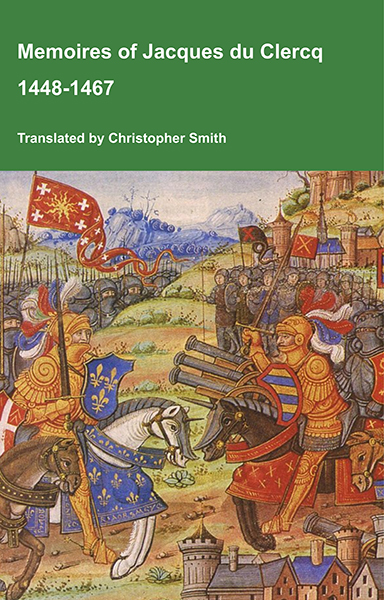
This is a translation of the 'Memoires of Jacques du Clercq', published in 1823 in two volumes, edited by Frederic, Baron de Reissenberg. In his introduction Reissenberg writes: 'Jacques du Clercq tells us that he was born in 1424, and that he was a licentiate in law and a counsellor to Philip the Good, Duke of Burgundy, in the castellany of Douai, Lille, and Orchies. It appears that he established his residence at Arras. In 1446, he married the daughter of Baldwin de la Lacherie, a gentleman who lived in Lille. We read in the fifth book of his Memoirs that his father, also named Jacques du Clercq, had married a lady of the Le Camelin family, from Compiègne. His ancestors, always attached to the counts of Flanders, had constantly served them, whether in their councils or in their armies.' The Memoires cover a period of nineteen years beginning in in 1448, ending in in 1467. It appears that the author had intended to extend the Memoirs beyond that date; no doubt illness or death prevented him from carrying out this plan. As Reissenberg writes the 'merit of this work lies in the simplicity of its narrative, in its tone of good faith, and in a certain air of frankness which naturally wins the reader’s confidence.' Du Clercq ranges from events of national and international importance, including events of the Wars of the Roses in England, to simple, everyday local events such as marriages, robberies, murders, trials and deaths, including that of his own father in Book 5; one of his last entries.
Available at Amazon in eBook and Paperback format.
On 27th February 1599 John Milton (age 37) registered with the Worshipful Company of Scriveners.
In 1635 Robert Abbott Scrivener (age 25) became a member of the Worshipful Company of Scriveners. He established his own shop, the Flying Horse, in the parish of St Michael, Cornhill.
In 1580 Thomas Smythe (age 22) was admitted to the Worshipful Company of Haberdashers and the Worshipful Company of Skinners.
In 1582 Robert Myddelton (age 19) was apprenticed to Eramus Harby 2nd Baronet of the Worshipful Company of Skinners.
Around 1590 Robert Bateman (age 28) was elected Freeman of the Worshipful Company of Skinners.
In 1620 Robert Bateman (age 58) was elected Master of the Worshipful Company of Skinners.
In 1658 Anthony Bateman (age 42) was elected Master of the Worshipful Company of Skinners.
In 1662 Alderman William Crow Upholster (age 45) was elected Master of the Worshipful Company of Skinners.
In 1877 Richard Knight Causton 1st Baron Southwark (age 33) was elected Master of the Worshipful Company of Skinners.
In 1921 Richard Knight Causton 1st Baron Southwark (age 77) was elected Master of the Worshipful Company of Skinners.
Stephen Slaney joined as Worshipful Company of Skinners.

On 7th July 1606 William Larkin (age 24) became a Freeman of Worshipful Company of Stainers under the patronage of Arabella Stewart (age 31) and Edward Seymour 1st Earl Hertford (age 67).
Jean de Waurin's Chronicle of England Volume 6 Books 3-6: The Wars of the Roses
Jean de Waurin was a French Chronicler, from the Artois region, who was born around 1400, and died around 1474. Waurin’s Chronicle of England, Volume 6, covering the period 1450 to 1471, from which we have selected and translated Chapters relating to the Wars of the Roses, provides a vivid, original, contemporary description of key events some of which he witnessed first-hand, some of which he was told by the key people involved with whom Waurin had a personal relationship.
Available at Amazon in eBook and Paperback format.
On 7th July 1606 William Larkin (age 24) became a freeman of the Worshipful Company of Stainers.
On 12th October 1670 Thomas Rawlinson (age 23) was admitted a Freeman of the Worshipful Company of Vintners.
In 1687 Thomas Rawlinson (age 39) was elected Master of the Worshipful Company of Vintners.
In 1696 Thomas Rawlinson (age 48) was elected Master of the Worshipful Company of Vintners.