

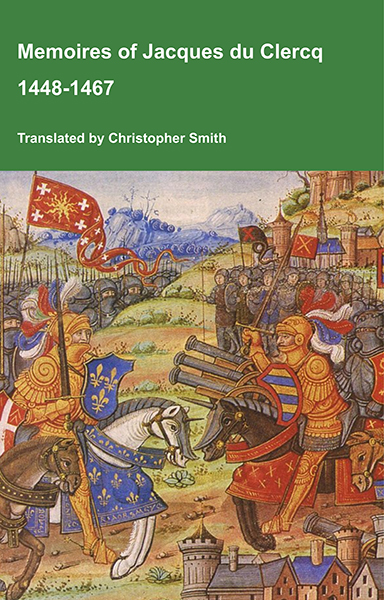
This is a translation of the 'Memoires of Jacques du Clercq', published in 1823 in two volumes, edited by Frederic, Baron de Reissenberg. In his introduction Reissenberg writes: 'Jacques du Clercq tells us that he was born in 1424, and that he was a licentiate in law and a counsellor to Philip the Good, Duke of Burgundy, in the castellany of Douai, Lille, and Orchies. It appears that he established his residence at Arras. In 1446, he married the daughter of Baldwin de la Lacherie, a gentleman who lived in Lille. We read in the fifth book of his Memoirs that his father, also named Jacques du Clercq, had married a lady of the Le Camelin family, from Compiègne. His ancestors, always attached to the counts of Flanders, had constantly served them, whether in their councils or in their armies.' The Memoires cover a period of nineteen years beginning in in 1448, ending in in 1467. It appears that the author had intended to extend the Memoirs beyond that date; no doubt illness or death prevented him from carrying out this plan. As Reissenberg writes the 'merit of this work lies in the simplicity of its narrative, in its tone of good faith, and in a certain air of frankness which naturally wins the reader’s confidence.' Du Clercq ranges from events of national and international importance, including events of the Wars of the Roses in England, to simple, everyday local events such as marriages, robberies, murders, trials and deaths, including that of his own father in Book 5; one of his last entries.
Available at Amazon in eBook and Paperback format.
Alexandre Cabanel is in Painters.
On 28th September 1823 Alexandre Cabanel was born.
In 1840 Alexandre Cabanel [aged 16] entered the École des Beaux-Arts in Paris where he studied with François-Édouard Picot.
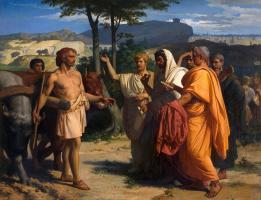
1843. Alexandre Cabanel [aged 19]. "Cincinnatus receiving the ambassadors of Rome".
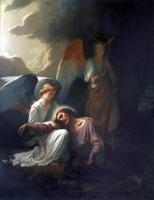
1844. Alexandre Cabanel [aged 20]. "Christ in the Garden of Olives".

1847. Alexandre Cabanel [aged 23]. "Fallen Angel".

1847. Alexandre Cabanel [aged 23]. Portrait of Emperor Napoléon III [aged 38].

1848. Alexandre Cabanel [aged 24]. "Albaydé".
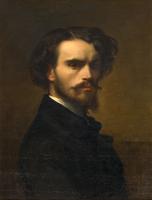
1852. Alexandre Cabanel [aged 28]. Self-portrait.
In 1855 Alexandre Cabanel [aged 31] and Marie-Clémentine Legrand were married.
Jean de Waurin's Chronicle of England Volume 6 Books 3-6: The Wars of the Roses
Jean de Waurin was a French Chronicler, from the Artois region, who was born around 1400, and died around 1474. Waurin’s Chronicle of England, Volume 6, covering the period 1450 to 1471, from which we have selected and translated Chapters relating to the Wars of the Roses, provides a vivid, original, contemporary description of key events some of which he witnessed first-hand, some of which he was told by the key people involved with whom Waurin had a personal relationship.
Available at Amazon in eBook and Paperback format.
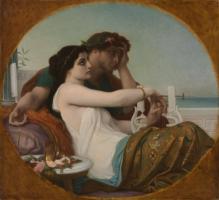
1857. Alexandre Cabanel [aged 33]. "Aglaida and Boniface".
In 1863 Alexandre Cabanel [aged 39] was elected a member of the Academy of Fine Arts.

1863. Alexandre Cabanel [aged 39]. "The Birth of Venus". Exhibited at the Salon of 1863, and which was immediately purchased by Napoleon III for his personal collection.
In 1864 Alexandre Cabanel [aged 40] was appointed professor at the École des Beaux-Arts where he taught until his death in 1889.
In 1867 [his wife] Marie-Clémentine Legrand died.

1870. Alexandre Cabanel [aged 46]. "The death of Francesca da Rimini and Paolo Malatesta".
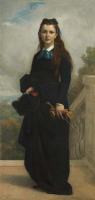
1871. Alexandre Cabanel [aged 47]. Portrait of Cornelia Warren.

1873. Alexandre Cabanel [aged 49]. "Pandora".

1873. Alexandre Cabanel [aged 49]. Portrait of the Countess de Keller.

1874. Alexandre Cabanel [aged 50]. "Thamar".

1874. Alexandre Cabanel [aged 50]. "Echo".

Anne Boleyn. Her Life as told by Lancelot de Carle's 1536 Letter.
In 1536, two weeks after the execution of Anne Boleyn, her brother George and four others, Lancelot du Carle, wrote an extraordinary letter that described Anne's life, and her trial and execution, to which he was a witness. This book presents a new translation of that letter, with additional material from other contemporary sources such as Letters, Hall's and Wriothesley's Chronicles, the pamphlets of Wynkyn the Worde, the Memorial of George Constantyne, the Portuguese Letter and the Baga de Secrets, all of which are provided in Appendices.
Available at Amazon in eBook and Paperback format.

1880. Alexandre Cabanel [aged 56]. "Phaedra".

1883. Alexandre Cabanel [aged 59]. "Ruth glanant dans les champs de Booz" aka Ruth harvesting in the fields of Booz.

1883. Alexandre Cabanel [aged 59]. "Ophelia".

1887. Alexandre Cabanel [aged 63]. Portrait of Mary Victoria Leiter Baroness Curzon Kedleston [aged 17].

1887. Alexandre Cabanel [aged 63]. "Cleopatra Testing Poisons on Condemned Prisoners".
On 23rd January 1889 Alexandre Cabanel [aged 65] died in his hotel at 14 rue Alfred de Vigny, in the 8th arrondissement of Paris. His funeral was on 26th January 1889 at the Saint-Philippe du Roule church. He was buried at Saint Lazaire Cemetery.