

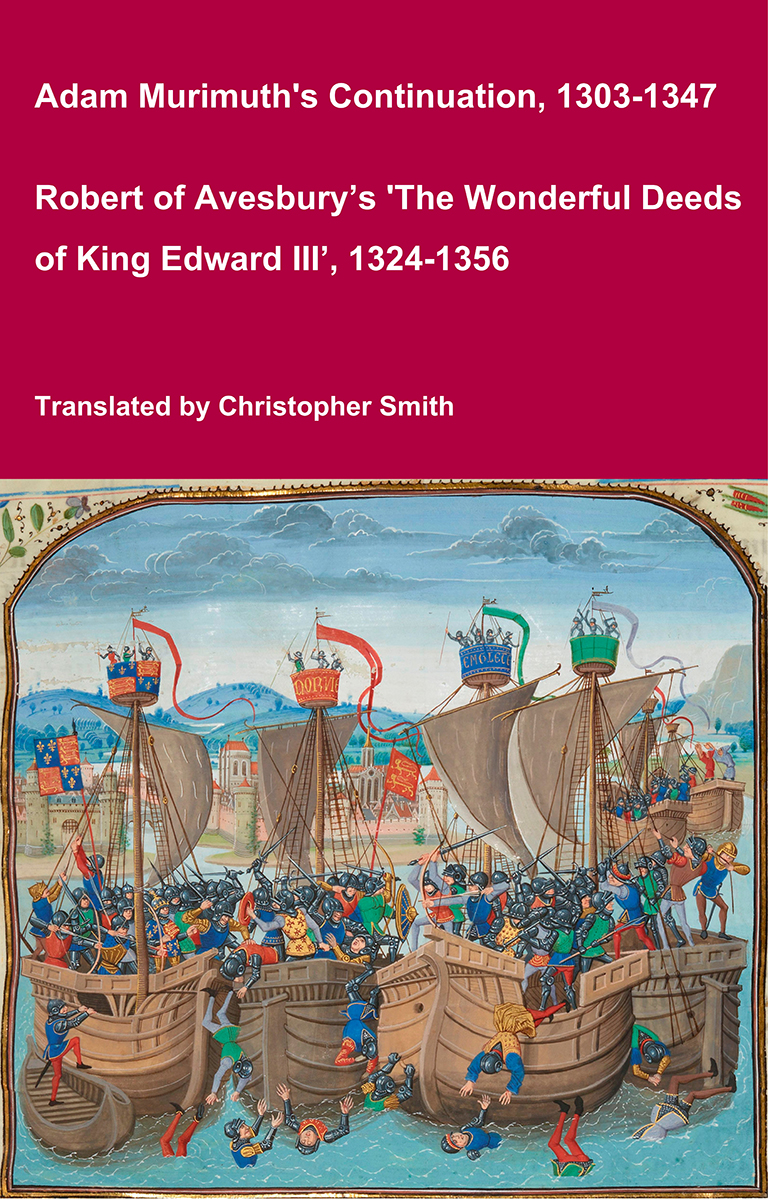
Adam Murimuth's Continuation and Robert of Avesbury’s 'The Wonderful Deeds of King Edward III'
This volume brings together two of the most important contemporary chronicles for the reign of Edward III and the opening phases of the Hundred Years’ War. Written in Latin by English clerical observers, these texts provide a vivid and authoritative window into the political, diplomatic, and military history of fourteenth-century England and its continental ambitions. Adam Murimuth Continuatio's Chronicarum continues an earlier chronicle into the mid-fourteenth century, offering concise but valuable notices on royal policy, foreign relations, and ecclesiastical affairs. Its annalistic structure makes it especially useful for establishing chronology and tracing the development of events year by year. Complementing it, Robert of Avesbury’s De gestis mirabilibus regis Edwardi tertii is a rich documentary chronicle preserving letters, treaties, and official records alongside narrative passages. It is an indispensable source for understanding Edward III’s claim to the French crown, the conduct of war, and the mechanisms of medieval diplomacy. Together, these works offer scholars, students, and enthusiasts a reliable and unembellished account of a transformative period in English and European history. Essential for anyone interested in medieval chronicles, the Hundred Years’ War, or the reign of Edward III.
Available at Amazon in eBook and Paperback format.
Ernest Hébert is in Painters.
On 3rd November 1817 Ernest Hébert was born.
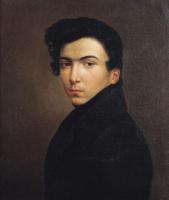
1833. Ernest Hébert [aged 15]. Self-portrait.
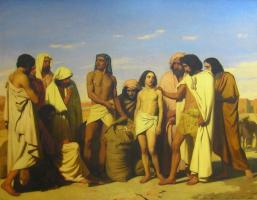
1839. Ernest Hébert [aged 21]. "Joseph's cup in Benjamin's sack". The Académie des Beaux-Arts awarded him the Prix de Rome in 1839 for this biblical composition.

1848 to 1849. Ernest Hébert [aged 30]. "Mal'aria". Exhibited in the Salon of 1850–51, and now hangs in the Musée d'Orsay, Paris. Painted in a Romantic style, it depicts a family of Italian peasants escaping an epidemic by raft, a scene inspired by events Hébert had witnessed while in Italy.

1850. Ernest Hébert [aged 32]. "Ophelia".
On 5th December 1908 Ernest Hébert [aged 91] died.