


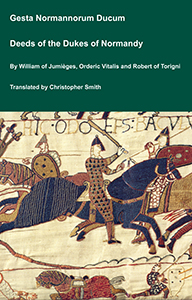
The Deeds of the Dukes of Normandy
The Gesta Normannorum Ducum [The Deeds of the Dukes of Normandy] is a landmark medieval chronicle tracing the rise and fall of the Norman dynasty from its early roots through the pivotal events surrounding the Norman Conquest of England. Originally penned in Latin by the monk William of Jumièges shortly before 1060 and later expanded at the behest of William the Conqueror, the work chronicles the deeds, politics, battles, and leadership of the Norman dukes, especially William’s own claim to the English throne. The narrative combines earlier historical sources with firsthand information and oral testimony to present an authoritative account of Normandy’s transformation from a Viking settlement into one of medieval Europe’s most powerful realms. William’s history emphasizes the legitimacy, military prowess, and governance of the Norman line, framing their expansion, including the conquest of England, as both divinely sanctioned and noble in purpose. Later chroniclers such as Orderic Vitalis and Robert of Torigni continued the history, extending the coverage into the 12th century, providing broader context on ducal rule and its impact. Today this classic work remains a foundational source for understanding Norman identity, medieval statesmanship, and the historical forces that reshaped England and Western Europe between 800AD and 1100AD.
Available at Amazon in eBook and Paperback format.
Sophie Germain is in Mathematicians.
On 1st April 1776 Sophie Germain was born to [her father] Ambroise-Francois Germain.
1804. Carl Friedrich Gauss Letter to Heinrich Olbers: "Recently I had the pleasure to receive a letter from Le Blanc [Sophie Germain [aged 27]], a young mathematician in Paris, who made himself enthusiastically familiar with higher mathematics and showed how deeply he penetrated into my Disquisitiones Arithmeticae."
1807. Carl Friedrich Gauss Letter to Sophie Germain [aged 30]: "But how can I describe my astonishment and admiration on seeing my esteemed correspondent Monsieur Le Blanc metamorphosed … But when a woman, because of her sex, our customs and prejudices, encounters infinitely more obstacles than men, in familiarizing herself with their knotty problems, yet overcomes these fetters and penetrates that which is most hidden, she doubtless has the most noble courage, extraordinary talent, and superior genius."
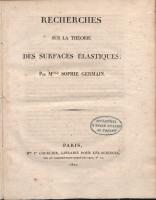
On 8th January 1816 Sophie Germain [aged 39] became the first woman to win a prize from the Paris Academy of Sciences for her paper "Recherches sur la théorie des surfaces élastiques" i.e. "Research into the theory of Elastic Surfaces". She later published her paper in 1821 at her own expense.
On 27th June 1831 Sophie Germain [aged 55] died from breast cancer at 13 rue de Savoie, Paris. She was buried at Père Lachaise Cemetery in Paris.