

The Deeds of the Dukes of Normandy
The Gesta Normannorum Ducum [The Deeds of the Dukes of Normandy] is a landmark medieval chronicle tracing the rise and fall of the Norman dynasty from its early roots through the pivotal events surrounding the Norman Conquest of England. Originally penned in Latin by the monk William of Jumièges shortly before 1060 and later expanded at the behest of William the Conqueror, the work chronicles the deeds, politics, battles, and leadership of the Norman dukes, especially William’s own claim to the English throne. The narrative combines earlier historical sources with firsthand information and oral testimony to present an authoritative account of Normandy’s transformation from a Viking settlement into one of medieval Europe’s most powerful realms. William’s history emphasizes the legitimacy, military prowess, and governance of the Norman line, framing their expansion, including the conquest of England, as both divinely sanctioned and noble in purpose. Later chroniclers such as Orderic Vitalis and Robert of Torigni continued the history, extending the coverage into the 12th century, providing broader context on ducal rule and its impact. Today this classic work remains a foundational source for understanding Norman identity, medieval statesmanship, and the historical forces that reshaped England and Western Europe between 800AD and 1100AD.
Available at Amazon in eBook and Paperback format.
Cannes is in France.
John Evelyn's Diary. 11th October 1644. We lay at Cannes, which is a small port on the Mediterranean; here we agreed with a seaman to carry us to Genoa, and, having procured a bill of health (without which there is no admission at any town in Italy), we embarked on the 12th. We touched at the islands of St. Margaret and St. Honore, lately retaken from the Spaniards with great bravery by Prince Harcourt. Here, having paid some small duty, we bought some trifles offered us by the soldiers, but without going on shore. Hence, we coasted within two leagues of Antibes, which is the utmost town in France. Thence by Nice, a city in Savoy, built all of brick, which gives it a very pleasant appearance toward the sea, having a very high castle which commands it. We sailed by Morgus, now called Monaco, having passed Villa Franca, heretofore Portus Herculis, when, arriving after the gates were shut, we were forced to abide all night in the barge, which was put into the haven, the wind coming contrary. In the morning, we were hastened away, having no time permitted us by our avaricious master to go up and see this strong and considerable place, which now belongs to a prince of the family of Grimaldi, of Genoa, who has put both it and himself under the protection of the French. The situation is on a promontory of solid stone and rock. The town walls very fair. We were told that within it was an ample court, and a palace, furnished with the most rich and princely movables, and a collection of statues, pictures, and massy plate to an immense amount.
Adeline Horsey Recollections. My last recollection of Cassiobury was in 1849, when I stayed there after the announcement of my engagement to the Count Montemolin [age 25]. The great Lord Brougham [age 65] was included in the house-party, and one day when he was walking in the gardens, talking about my approaching marriage, he suddenly dropped on one knee, and taking my hand, kissed it, saying as he did so, "Let me be the first to kiss your hand as future Queen of Spain".
This somewhat theatrical behaviour was exactly what Lord Brougham delighted in. He was a very ugly man, and like most ugly people he was very vain. He was a wonderful speaker, and few cared to provoke his powers of sarcasm; Hazlitt describes him as "a man of inordinate ambition and little heart"; but he certainly possessed some heart, for he adored his daughter Eleanor, who died at Cannes when she was only nineteen. The poor girl was an invalid all her short life, and her father resided at Cannes solely on her account. He built the Villa Eleanor for her, and until Lord Brougham's death her bedroom was always known as "Eleanor's room", and kept exactly as it had been when she occupied it.
The Villa is now an hotel, and Cannes is very different to what it was when Lord Brougham settled there. He told me that the town had only one hotel and one street when he first saw it.
Eleanor Brougham's body was brought to England, and she was buried in the small graveyard which belongs to Lincoln's Inn Chapel. I do not think any other woman has ever been interred there. The Marquis of Wellesley wrote her epitaph, and I believe it is a very beautiful and touching one.


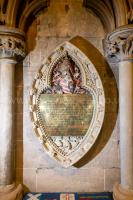
On 17th November 1877 Captain Augustus Henry Archibald Anson [age 42] died in Cannes where he was buried. Monument in Lichfield Cathedral [Map].
Captain Augustus Henry Archibald Anson: On 5th March 1835 he was born to Thomas William Anson 1st Earl Lichfield and Louisa Barbara Catherine Phillips Countess Lichfield. On 16th November 1857 Captain Augustus Henry Archibald Anson was awarded Victoria Cross.. For conspicuous bravery at Bolundshahur, on the 28th September, 1857. The 9th Light Dragoons had charged through the town, and were reforming in the Serai; the enemy attempted to close the entrance by drawing their carts across it, so as to shut in the cavalry and form a cover from which to fire upon them. Captain Anson, taking a lance, dashed out of the gateway, and knocked the drivers off their carts. Owing to a wound in his left hand, received at Delhi, he could not stop his horse, and rode into the middle of the enemy, who fired a volley at him, one ball passing through his coat. At Lucknow, at the assault of the Secundra Bagh, on 16th November, 1857, he entered with the storming party on the gates being burst open. He had his horse killed, and was himself slightly wounded. He has shown the greatest gallantry on every occasion, and has slain many enemies in fight. In 1859 Captain Augustus Henry Archibald Anson was elected MP Lichfield which seat he held until 1868.
On 14th November 1956 Elisabeth Hohenzollern Sigmaringen Queen Consort Greece Queen Consort Hellenes [age 62] died at Cannes.
On 24th March 1908 Spencer Cavendish 8th Duke Devonshire [age 74] died of pneumonia at Hotel Metropol. His nephew Victor [age 39] succeeded 9th Duke Devonshire, 12th Earl Devonshire, 4th Earl Burlington, 12th Baron Cavendish Hardwick. On 28th March 1908 he was buried in the Cavendish Plot, St Peter's Church, Edensor [Map].


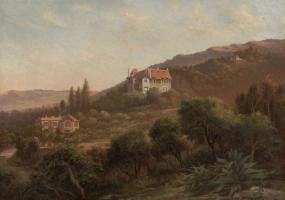
Around 1887. Edward Tanner. "View of Villa Edelweiss and Villa Nevade, Cannes.
In April 1887 Queen Victoria of the United Kingdom [age 67] visited Cannes. She stayed at the Villa Edelweiss, Cannes. She walked to the nearby Villa Nevada, Cannes where her son Leopold Saxe Coburg Gotha 1st Duke Albany had died three years before writing in her diary 'went in to see good Miss Perceval, who was most kind, & showed us her rooms, then taking us upstairs to the room, where poor darling Leopold breathed his last'. She commissioned a monument in Cannes over-looking the sea.


On 28th March 1884 Leopold Saxe Coburg Gotha 1st Duke Albany [age 30] died at the Villa Nevada, Cannes.
Around 1887. Edward Tanner. "View of Villa Edelweiss and Villa Nevade, Cannes.
In April 1887 Queen Victoria of the United Kingdom [age 67] visited Cannes. She stayed at the Villa Edelweiss, Cannes. She walked to the nearby Villa Nevada, Cannes where her son Leopold Saxe Coburg Gotha 1st Duke Albany had died three years before writing in her diary 'went in to see good Miss Perceval, who was most kind, & showed us her rooms, then taking us upstairs to the room, where poor darling Leopold breathed his last'. She commissioned a monument in Cannes over-looking the sea.