

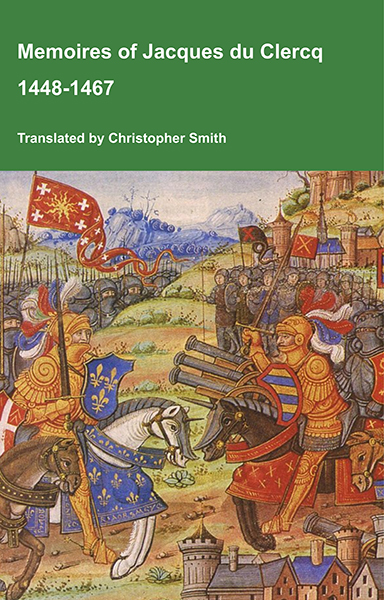
This is a translation of the 'Memoires of Jacques du Clercq', published in 1823 in two volumes, edited by Frederic, Baron de Reissenberg. In his introduction Reissenberg writes: 'Jacques du Clercq tells us that he was born in 1424, and that he was a licentiate in law and a counsellor to Philip the Good, Duke of Burgundy, in the castellany of Douai, Lille, and Orchies. It appears that he established his residence at Arras. In 1446, he married the daughter of Baldwin de la Lacherie, a gentleman who lived in Lille. We read in the fifth book of his Memoirs that his father, also named Jacques du Clercq, had married a lady of the Le Camelin family, from Compiègne. His ancestors, always attached to the counts of Flanders, had constantly served them, whether in their councils or in their armies.' The Memoires cover a period of nineteen years beginning in in 1448, ending in in 1467. It appears that the author had intended to extend the Memoirs beyond that date; no doubt illness or death prevented him from carrying out this plan. As Reissenberg writes the 'merit of this work lies in the simplicity of its narrative, in its tone of good faith, and in a certain air of frankness which naturally wins the reader’s confidence.' Du Clercq ranges from events of national and international importance, including events of the Wars of the Roses in England, to simple, everyday local events such as marriages, robberies, murders, trials and deaths, including that of his own father in Book 5; one of his last entries.
Available at Amazon in eBook and Paperback format.
Catherine Howard Tyburn Executions is in Catherine Howard Trials and Executions.
On 10th December 1541. At Tyburn [Map]...
Francis Dereham [aged 28] was hanged, drawn and quartered.
Thomas Culpepper [aged 27] was beheaded.
Both were buried at St Sepulchre without Newgate Church; their heads were spiked on London Bridge [Map].
Letters and Papers Foreign and Domestic Henry VIII 1541. 11th December 1441. Chapuys to Charles V. Spanish Calendar, VI.i., No. 213.
Wrote, on the 3rd, of the condemnation of Colpeper and Durem, who were both executed, the former, at his own request, by decapitation, the latter by a more cruel death. Not to leave the Tower empty, no sooner had these left for the place of execution than the old duchess of Norfolk, second wife of the father of the present Duke, was conveyed to it, along with the wife of lord William, who himself returned from France but eight days ago, and was also lodged in the Tower the day before yesterday. It would seem also that his said mother and wife and a sister [Lady Bridgewater] of his, who is detained in the house of Secretary Vrisley, have been arrested on account of a servant of lord William who was taken on St. Andrew's Eve, who said that his master and the said ladies knew of the Queen's unchastity before she attained the King's favour. No other cause of their imprisonment is pointed to. The duke of Norfolk, before his half-brother's return, had left for his estates in Norfolk; it is supposed not of his own free will, but sent on some pretence to be away from the Privy Council while matters were discussed affecting his own relations. On the 5th, M. de Morvillier arrived here on his way to Scotland, sent by the king of France, and also, as he himself gives out, on business of M. de Guise. He remained here till yesterday, the 10th, in the afternoon, waiting for his passports, which the resident French ambassador has obtained for him, without either himself or the other ambassador having seen the King or Privy Councillors about it. Is informed by the ambassador's secretary that Morvillier would have gone to Scotland by sea but for unfavourable winds and rough weather, and that he and the ambassador had been devising excuses for fear the King should refuse him a passport. One pretence was that Morvillier was going to condole with king James on the death of his mother. The ambassador's man sent Chapuys word that for two whole days after his arrival Morvillier had not left his room, showing that he did not wish it to be known that he was in England, since many must have seen him the last time the bp. of Tarbes, lately deceased in Spain, was here. The secretary, Chapuys's confidant, had been with him some time, and tried to find out what his mission was, but could get little out of him. The only person he spoke about was the duke of Cleves, whose wit, dexterity, and power he extolled beyond measure. He also sang the praises of the duke of Saxony, saying he was the sincere friend of the King, his master, ready to do his will in all matters, and that he had lately sent to Madame d'Alebret, whom these Frenchmen call queen of Navarre, the portraits of his wife and family.
Grafton's Chronicle [1507-1573]. At this time the Queene late before maried to the king called Queene Katheryn Hawarde was accused to the king of dissolute living before her maryage, with Fraunces Diram, and that was not secretely, but many knew of it. And sith her mariage shee was vehemently suspected with Thomas Culpeper, which was brought to her chamber at Lincolne in August last in the progresse time, by the Lady Rocheford, and were together alone, from a xj. of the clocke at night, till foure of the clocke in the morning, and to him shee gaue a Chayne, and a rich Cap. Vppon this the king remoued to London, & she was sent to Sion, and there kept close, but yet serued as Queene. And for the offence confessed by Culpeper and Diram, they were put to deth at Tiborne, the tenth day of December [1540]. And the two and twentie day of the same moneth, were arreyned at Westminster, the Lorde William Hawarde and his wife, which Lorde William was Vncle to the Queene, Katheryne Tilney which was of counsayle of her bauving to do with Diram, Elizabeth Tilney, Boulmer, Restwoulde, the Queenes women, and Walgraue and William Asby, and Damport Gentlemen, and seruaunts to the olde Duches of Norffolke, and Margaret Benet a Butter wife, all indited of misprision, for concealing the euill demeanor of the Queene, to the slaunder of the king, and his succession: all they confessed it, and had judgement to perpetuall prison, and to lose their goodes and the profite of their landes, duryog their lives: howbeyt shortely after, diverse of them were delivered by the kinges pardon.
Chronicle of Edward Hall [1496-1548]. 10th December 1541. At this tyme the Quene [aged 18] late before maried to the kyng called Quene Katheryne, was accused to the Kyng of dissolute livyng, before her mariage, with Fraunces Diram [aged 28], and that was not secretely, but many knewe it. And sithe her Mariage, she was vehemently suspected with Thomas Culpeper [aged 27], whiche was brought to her Chamber at Lyncolne, in August laste, in the Progresse tyme, by the Lady of Rocheforde [aged 36], and were there together alone, from a leven of the Clocke at Nighte, tyll foure of the Clocke in the Mornyng, and to hym she gave a Chayne, and a riche Cap. Upon this the kyng removed to London, and she was sent to Sion [Map], and there kepte close, but yet served as Quene. And for the offence confessed by Culpeper and Diram, thei were put to death at Tiborne [Map], the tenth daie of December.
Holinshed's Chronicle [1525-1582]. The tenth of December [1541], the said Culpeper [aged 27] and Diram [aged 28] were drawen from the tower unto Tiburne and there Culpeper had his head striken off, and Diram was hanged, dismembred and headed. Culpeper's bodie was buried in S. Sepulchers church, but both their heads were set on London bridge.
Chronicle of Greyfriars. 10th December 1541. This year the 10th daye of December was draune from the tower to Tyborne [Thomas] Culpeper [aged 27], and there was hongyd and heddyd.
Spanish Chronicle Chapter 39. [10th December 1541] The next day they brought Culpepper outside the Tower, and when he got on to the scaffold he turned to the people, and only said he hoped they would pray to God for him, and nothing more. He was then beheaded, and his head placed on London Bridge, and his body buried in Barking1 (el barquin); and so ended these two lovers.2
Note 1. The Church of All Hallows Barking, Tower Street [Map]
Note 2. The English chroniclers, Hollingshead, Grafton, and others, say that Culpepper and Diram were executed at Tyburn [10th] February, 1542.
Wriothesley's Chronicle [1508-1562]. 10th December 1541. And the tenth day of December the said Culpeper [aged 27] and Dorand [aged 28] were drawne from the Tower of London to Tybume [Map], and there Culpeper, after exhortation made to the people to pray for him, he standinge on the ground by the gallowes, kneled downe and had his head stiyken of; and then Dorand was hanged, membred, bowelld, headed, and quartered. Culpepers body buryed at St. Pulchers Church by Newegate, theyr heades sett on London Bridge.
Holinshed's Chronicle [1525-1582]. 22nd December 1541. The two and twentith of December were arreigned in the Kings bench at Westminster, the ladie Margaret Howard [aged 26], wife to the lord William Howard [aged 31], Katharine Tilneie, & Alice Restwold gentlewomen, Joane Bulmer [aged 22], wife to Anthonie Bulmer gentleman, Anne Howard, wife to Henry Howard esquier, and brother to the late queene, Malein Tilneie widow, Margaret Benet, wife to John Benet gentleman, Edward Walgraue gentleman, William Ashbie gentleman; all these were condemned of misprision of treason, for concealing the queenes misdemeanour. And the same daie in the afternoone, the lord William Howard, and Damport a gentleman were likewise arreigned, and condemned of the same offense, and as well these as the other were adiudged to lose their goods, & the profits of their lands during life, and to remaine in perpetuall prison.