

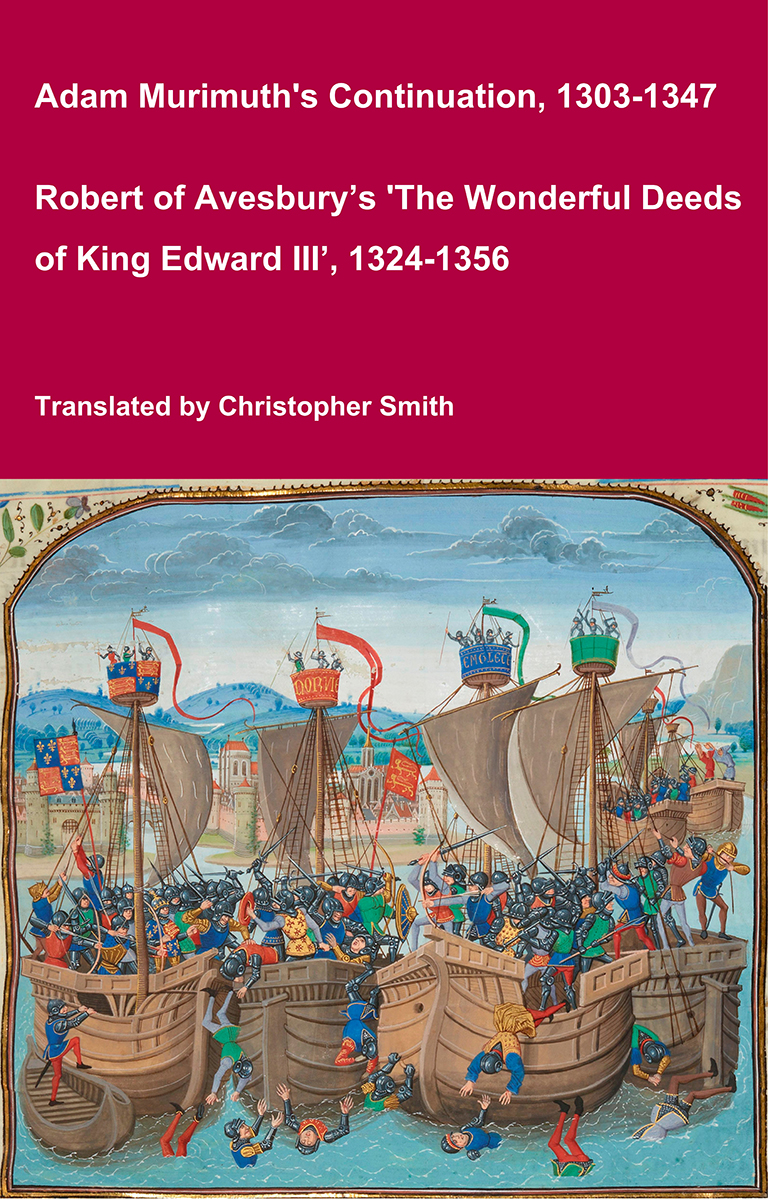
Adam Murimuth's Continuation and Robert of Avesbury’s 'The Wonderful Deeds of King Edward III'
This volume brings together two of the most important contemporary chronicles for the reign of Edward III and the opening phases of the Hundred Years’ War. Written in Latin by English clerical observers, these texts provide a vivid and authoritative window into the political, diplomatic, and military history of fourteenth-century England and its continental ambitions. Adam Murimuth Continuatio's Chronicarum continues an earlier chronicle into the mid-fourteenth century, offering concise but valuable notices on royal policy, foreign relations, and ecclesiastical affairs. Its annalistic structure makes it especially useful for establishing chronology and tracing the development of events year by year. Complementing it, Robert of Avesbury’s De gestis mirabilibus regis Edwardi tertii is a rich documentary chronicle preserving letters, treaties, and official records alongside narrative passages. It is an indispensable source for understanding Edward III’s claim to the French crown, the conduct of war, and the mechanisms of medieval diplomacy. Together, these works offer scholars, students, and enthusiasts a reliable and unembellished account of a transformative period in English and European history. Essential for anyone interested in medieval chronicles, the Hundred Years’ War, or the reign of Edward III.
Available at Amazon in eBook and Paperback format.
Crimean War is in 1850-1900 Second Half of the 19th Century.
On 20th September 1854 Charles Pierrepont Darcy Lane-Fox [aged 24] was wounded, Poulett George Henry Somerset [aged 32] fought.
Major-General John Douglas [aged 37] commanded the 79th Regiment of Foot.
William Frederick Waldegrave [aged 38] died from wounds received.
Henry Hugh Manvers Percy [aged 37] was shot through the arm.
General George Augustus Frederick Paget [aged 36], Godfrey Morgan 1st Viscount Tredegar [aged 23] and Hedworth Jolliffe 2nd Baron Hylton [aged 25] fought.
Arthur Williams-Wynn [aged 35], Captain of the 23rd Royal Welsh Fusiliers, was killed.


On 20th September 1854 Captain William Monck [aged 31] was killed at the Battle of Alma.
The London Gazette 21971. [24th February 1857]. Scots Fusilier Guards. Brevet Major Robert James Lindsay [aged 24]. When the formation of the line of the Regiment was disordered at Alma, Captain Lindsay stood firm with the Colours, and by his example and energy, greatly tended to restore order. At Inkerman, at a most trying moment, he, with a few men, charged a party of Russians, driving them back, and running one through the body himself.
On 25th October 1854 Poulett George Henry Somerset [aged 32] and William Archer Amherst 3rd Earl Amherst [aged 18] fought.
Major-General John Douglas [aged 37] commanded the 79th Regiment of Foot.
General George Augustus Frederick Paget [aged 36] and Henry Hugh Manvers Percy [aged 37] fought.
On 25th October 1854 during the Battle of Balaclava George Charles Bingham 3rd Earl Lucan [aged 54] gave the order for the Charge of the Light Brigade which was then led by his brother-in-law James Brudenell 7th Earl Cardigan [aged 57].
Hedworth Jolliffe 2nd Baron Hylton [aged 25] took part.
Godfrey Morgan 1st Viscount Tredegar [aged 23] was in command of a section of the Light Brigade. His horse "Sir Briggs" survived, died aged twenty-eight and was buried in the Cedar Garden at Tredegar House, Monmouthshire where there is a monument to him.
Thomas Hutton took part. He was shot through the right thigh during the advance, and on returning from the guns he was again severely wounded through the left thigh.
George Orby Wombwell 4th Baronet [aged 21] took part and survived. His horse was killed under him and he was shortly after pulled off and taken prisoner, his sword and pistols being taken from him by some Russian Lancers. He managed to escape, catch another loose horse and ride back to the British lines, pursued by Russians.
Fiennes Wykeham-Martin Cornwallis [aged 22] took part.
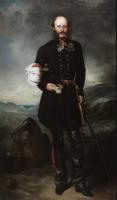

1905. John Charlton [aged 56]. The Charge of the Light Brigade, the Battle of Balaclava, 25th October 1854, with Godfrey Charles Morgan, 1st Viscount Tredegar [aged 73], Astride His Horse, "Sir Briggs".
On 5th November 1854 at the Battle of Inkerman..
Granville Charles Cornwallis Eliot [aged 26] and Cavendish Hubert Greville [aged 19] were killed.
Poulett George Henry Somerset [aged 32] fought; his horse was killed under him by a shell.
William Archer Amherst 3rd Earl Amherst [aged 18] was wounded.
Hedworth Jolliffe 2nd Baron Hylton [aged 25] and Edwyn Sherard Burnaby [aged 24] fought.
Captain William Kent Allix [aged 31] was killed in action whilst serving with the 1st Royal Regiment.
Robert Lydston Newman 2nd Baronet [aged 32] was killed in action. His brother Lydston [aged 30] succeeded 3rd Baronet Newman of Stokeley and Mamhead in Devon.
Charles Francis Seymour-Conway [aged 35] was killed in action.

After 5th November 1854. St Germans Priory [Map]. Memorial to Granville Charles Cornwallis Eliot [deceased] who fell at the Battle of Inkerman.
Granville Charles Cornwallis Eliot: On 9th September 1828 he was born to Edward Granville Eliot 3rd Earl St Germans and Jemima Cornwallis Countess St Germans.

After 5th November 1854. St Martin's Church, Ancaster [Map]. Memorial to Captain William Kent Allix [deceased] who was killed at the Battle of Inkerman.
Captain William Kent Allix: Before 5th November 1804 he was appointed Aide-de-Camp to General George de Lacy Evans. On 9th April 1823 he was born to Colonel Charles Allix and Mary Elizabeth Hammond at Willoughby Hall. He was educated at Harrow School where there is a memorial plaque to him.

The True Chronicles of Jean le Bel Volume 1 Chapters 1-60 1307-1342
The True Chronicles of Jean le Bel offer one of the most vivid and immediate accounts of 14th-century Europe, written by a knight who lived through the events he describes, and experienced some of them first hand. Covering the early decades of the Hundred Years’ War, this remarkable chronicle follows the campaigns of Edward III of England, the politics of France and the Low Countries, and the shifting alliances that shaped medieval warfare. Unlike later historians, Jean le Bel writes with a strong sense of eyewitness authenticity, drawing on personal experience and the testimony of fellow soldiers. His narrative captures not only battles and sieges, but also the realities of military life, diplomacy, and the ideals of chivalry that governed noble society. A key source for Jean Froissart, Le Bel’s chronicle stands on its own as a compelling and insightful work, at once historical record and literary achievement. This translation builds on the 1905 edition published in French by Jules Viard, adding extensive translations from other sources Rymer's Fœdera, the Chronicles of Adam Murimuth, William Nangis, Walter of Guisborough, a Bourgeois of Valenciennes, Geoffrey le Baker of Swinbroke and Richard Lescot to enrich the original text and Viard's notes.
Available at Amazon in eBook and Paperback format.
The London Gazette 21997. War-Office, May 5, 1857.
The Queen [aged 37] has been graciously pleased to signify Her intention to confer the Decoration of the Victoria Cross on the undermentioned Officers of Her Majesty's Army, who have been recommended to Her Majesty for that Decoration,—in accordance with the rules laid down in Her Majesty's Warrant of the 29th of January, 1856,—on account of acts of bravery performed by them before the Enemy during the late War, as recorded against their several names; viz.
Grenadier Guards. Colonel Hon. Henry Hugh Manvers Percy [aged 37]. Date of Act of Bravery, 5th November, 1854 [ at the Battle of Inkerman]
At a moment when the Guards were at some distance from the Sand Bag Battery, at the Battle of Inkerman, Colonel Percy charged singly into the battery, followed immediately by the Guards; the embrasures of the battery, as also the parapet, were held by the Russians, who kept up a most severe fire of musketry.
At the Battle of Inkerman Colonel Percy, found himself with many men of various regiments, who had charged too far, nearly surrounded by the Russians, and without ammunition. Colonel Percy, by his knowledge of ground, though wounded, extricated these men, and, passing under a heavy fire from the Russians then in the Sand Bag Battery, brought them safe to where ammunition was to be obtained, thereby saving some fifty men, and enabling them to renew the combat. He received the approval of His Royal Highness the Duke of Cambridge, for this action, on the spot.—Colonel Percy was engaged with, and put hors de combat, a Russian soldier.

1874. Elizabeth Thompson Lady Butler [aged 27]. "Calling the Roll After An Engagement, Crimea" aka "The Roll Call". Depicting a roll call of soldiers from the Grenadier Guards during the Crimean War. It was taken to depict an occasion following the Battle of Inkerman in 1854

1877. Elizabeth Thompson Lady Butler [aged 30]. "The Return from Inkerman".