


Anne Boleyn. Her Life as told by Lancelot de Carle's 1536 Letter.
In 1536, two weeks after the execution of Anne Boleyn, her brother George and four others, Lancelot du Carle, wrote an extraordinary letter that described Anne's life, and her trial and execution, to which he was a witness. This book presents a new translation of that letter, with additional material from other contemporary sources such as Letters, Hall's and Wriothesley's Chronicles, the pamphlets of Wynkyn the Worde, the Memorial of George Constantyne, the Portuguese Letter and the Baga de Secrets, all of which are provided in Appendices.
Available at Amazon in eBook and Paperback format.
Death of King Edward I is in 1300-1309 Scottish Succession.
On 7th July 1307 King Edward I of England [aged 68] died at Burgh by Sands [Map] whilst on his way north to Scotland. His son Edward [aged 23] succeeded II King of England. Earl Chester merged with the Crown.
Edward had gathered around him Thomas Plantagenet 2nd Earl of Leicester, 2nd Earl Lancaster, Earl of Salisbury and Lincoln [aged 29], Guy Beauchamp 10th Earl Warwick [aged 35], Aymer de Valence 2nd Earl Pembroke [aged 32] and Robert Clifford 1st Baron Clifford [aged 33] and charged them with looking after his son in particular ensuring Piers Gaveston 1st Earl Cornwall [aged 23] didn't return from exile.
Chronicle of Geoffrey le Baker of Swinbroke. Finally, around the Nativity of the Blessed Virgin, the king returned to Scotland with a large military force, where, throughout the entire following winter and summer, he successfully arranged many matters as he wished. However, overtaken by death after enduring immense labours, he left his tasks to his successors. Indeed, on the Feast of the Translation of St. Thomas the Martyr [7th July 1307], in the 69th year of his age, the 35th year from the death of his father, the 33rd from his coronation, and the year 1307 from the Incarnation of Jesus Christ, he departed from this life. His body was buried at Westminster on the 28th of October,1 where it awaits resurrection and eternal reign.
Demum, circa Nativitatem beate Virginis, Scociam repeciit rex cum milicia copiosa, ubi per totam hiemem et estatem sequentes prospere disponens multa que voluit, labores gravissimos morte prereptus suis posteris reliquit; nempe in festo Translacionis sancti Thome martyris, anno etatis sue LXIX, regni vero sui a morte patris 35, et a coronacione sui XXXIIJ, et ab incarnacione Iesu Christi MCCCVIJ, ab hac luce migravit; cuius corpus apud Westmonasterium XXVIIJ die Octobris sepultum exspectat resurreccionem et regnum sempiternum.
Note 1. Edward's body was buried at Westminster on the 27th rather than the 28th of October 1307.
Murimuth and Avesbury. In the year of our Lord 1306, in the first year of Pope Clement V, and in the thirty-fourth and last year of the reign of the aforesaid King Edward, beginning from the feast of Saint Michael, the king of England came with his forces to the Scottish border. There he remained throughout the whole winter at Lanercost and nearby, where on the feast of the Translation of Saint Thomas the Martyr [7th July 1307] he departed from this life, in the sixty-ninth year of his age and the thirty-fifth of his reign. This Edward was valiant in arms throughout his whole life in every circumstance, as clearly appears from the earlier chronicles, so much so that he recovered all England from the power of Simon de Montfort, the earls, and the barons who adhered to that same Simon, who had also held King Henry his father and Edward himself in prison, as is recorded above in the chronicles. Likewise he recovered all Wales from the power of Llywelyn and his brother David; likewise Aquitaine from the power of the king of France; likewise he repeatedly subdued Scotland to himself, as the earlier deeds testify. But after Scotland had been treacherously seized by Robert le Bruce, as is related in the previous chapter, he himself, lying there among his army upon his deathbed, with greatness of spirit commanded and ordered that his body should remain there unburied and be carried along with the army until all Scotland had finally been conquered. But this command could not be carried out; instead his body was taken to England and buried at Westminster in the following year, around the feast of Saint Andrew, on the twenty-eighth day of October. Concerning him a certain versifier wrote as follows:
Anno Domini millesimo CCC, sexto, papæ Clementis quinti anno primo, regni vero dicti regis Edwardi XXXIIIJ et ultimo, a festo sancti Michaelis incipiendo, dominus rex Angliæ cum suis accessit ad marchiam Scociæ. Ibi morabatur per totam hiemem apud Lanrecost et prope, ubi in festo Translationis sancti Thomæ martyris ab hac luce migravit, anno ætatis suæ LXIX, regni vero sui XXXV. Hic Edwardus fuit strenuus in armis per totam vitam suam in omni statu, sicut et ex superioribus chronicis evidenter apparet, adeo quod totam Angliam de manu Simonis de Monte forti, comitum, et baronum eidem Symoni adhærentium, qui etiam regem Henricum patrem suum et se ipsum tenuit in carcere, adquisivit, sicut superius in chronicis continetur; item, totam Walliam de manu Lewlini et David fratris ejus; item, Aquietaniam de manu regis Franciæ; item, Scociam sibi sæpius subjugavit, sicut superiora gesta testantur; sed, capta Scocia proditiose per Robertum le Bruys, ut supra proximo capitulo continetur, ipse ibidem, ut præscribitur, inter exercitum jacens suum in lecto mortis, ex magnanimitate cordis mandavit et jussit corpus suum ibi remanere non sepultum, sed deferri in exercitu, quousque tota Scocia esset finaliter adquisita. Sed hoc mandatum non potuit effectui demandari, sed fuit corpus delatum in Angliam, et sepultum apud Westmonasterium, anno proxime sequenti, circa festum sancti Andreæ, XXVIIJ die Octobris; de quo scripsit quidam versificator sic:
Annals of Six Kings of England by Nicholas Trivet [1258-1328]. After whose departure, the king began to suffer from dysentery; nevertheless, he set out [from Carlisle] on the fifth day before the Nones of July, proceeding toward Scotland by short stages. On the day before the Nones of July he reached Burgh-by-Sands, where, as his illness worsened, on the following day, that is, Friday [7th July 1307], he bade farewell to this present life and completed his days in goodness and his years in glory. He made a will, in which he bequeathed his heart to the Holy Land, along with stipends for one hundred knights to serve for a year in the service of the cross of Christ. He reigned for thirty-four years, seven months, and twenty-one days, and completed sixty-eight years and twenty days of age."
Post cujus discessum cœpit rex vexan dysenteria; movit tamen nihilominus [de Karleolo] quinto nonas Julii, parvis dietis versus Scotiam proficiscens. Pridie nonas Julii venit usque Burgum super Sande, ubi invalescente infirmitate, die crastina, scilicet feria sexta, præsenti vitæ valefaciens, dies suos in bono et annos suos in gloria consummavit. [Testamentum condidit, in quo cor suum Terræ Sanctæ legavit, cum stipendiis centum militum, qui per anni spatium militarent in obsequiam crucis Christi.] Regnavit autem annis triginta quatuor, mensibus septem, diebus viginti uno; complevitque ætatis suæ annos sexaginta octo et dies viginti.
Life of Edward II by a Monk of Malmesbury. Edward the First, after the Conquest, in the 35th year of his reign, on the Feast of the Translation of Saint Thomas [7th July 1307], paid the debt of nature. His son, Edward the Second, then assumed the kingdom, a young man of strong body, about twenty-three years of age. He did not fulfill the plans of his father, but changed course in his counsel.
Edwardus post conquæstum primus, anno regni sui xxxv in die Translationis Sancti Thomæ nature debitum solvens, suscepit regnum filius ejus Edwardus secundus, juvenis et fortis robore, statis sue annum agens circiter vicesimum tertium.
Chronicle of Walter of Guisborough. When, therefore, the malice of the new king [Robert the Bruce] became known, our king sent word to the magnates of the land that they should come to him at Carlisle, ready for battle, on the fifteenth day after the feast of Saint John the Baptist. Meanwhile, because the king was afflicted with a severe dysentery, and none could speak with him except his chamberlains, it was proclaimed among the people that the king was dead. When he learned of this, the king ordered that all be made ready for his march into Scotland, and he moved his camp from Carlisle on the third day of the month of July, about two miles distant; it was a Monday. On Tuesday he rode about another two miles; and on Wednesday he rested. On Thursday he came to Burgh-by-Sands, and there planned to remain on the following day. It was his custom to lie in bed almost every day until the ninth hour [around 3 p.m.]. But on Friday, when he was raised up by his attendants so that he might eat, he expired in their hands. The king, therefore, departed from this world on the feast of the Translation of Saint Thomas the Archbishop and Martyr [7th July 1307]. His followers concealed the king's death until his son and the magnates of the realm could arrive, and many were imprisoned for having spread word of the king's death. When the prince, his son, and the other magnates came, they arranged for the king's body to be taken in honour by his treasurer, the Bishop of Chester1, together with his whole household, to the southern parts, to remain in the church of the canons at Waltham until a decision had been made regarding the land of Scotland, so that they might have leisure to attend to his burial. And so it was done. The new king [King Edward II] remained, and received the homages and oaths of fealty of the magnates, and by their counsel set out as far as Roxburgh, where he received the homages and oaths of fealty of many of the magnates of the kingdom of Scotland. He appointed wardens2 in Scotland, and returned.
Cognita itaque malitia novi regis, misit rex noster magnatibus terræ ut sibi venirent Carliolum parati ad proelium in quindenam beati Johannis Baptistæ. Interim quia vexabatur rex dissenteria gravi, nec poterant ei loqui nisi cubicularii sui, prædicatum est in populo quia mortuus est rex. Quo cognito, jussit rex omnia præparari ut moveret in Scotiam, movitque castra sua a Carliolo tertio die mensis Julii quasi duobus milliariis, et erat dies Lunæ; die vero Martis equitavit quasi duo milliaria; et quarta feria requievit; die autem Jovis venit apud Burch-super-Sandes, et ibi disposuit in crastino permanere; erantque sibi modus et consuetudo singulis quasi diebus in lecto jacere usque ad horam nonam; die vero Veneris cum elevaretur a suis ut comederet, inter manus eorum expiravit. Translatusque est rex ex hoc mundo die translationis Sancti Thomæ archiepiscopi et martyris. Celaveruntque sui mortem regis quousque veniret filius ejus et magnates terræ, et incarcerabantur multi qui mortem regis prædicaverant. Cumque venisset princeps filius ejus et cæteri magnates, ordinaverunt de corpore regis, quod per thesaurarium suum episcopum Cestriæ et totam familiam suam honorifice duceretur ad partes australes, maneretque in ecclesia religiosorum de Waltham donec ordinaretur certum de terra Scotiæ, et vacaret eis intendere sepulturæ; factumque est ita. Remansitque novus rex, et cepit homagia et fidelitates magnatum, et de eorum consilio profectus est usque Rokesburch, et ibi cepit homagia et fidelitates multorum magnatum regni Scotiæ; ordinavitque custodes in Scotia, et reversus est.
Note 1. Walter de Langton, Bishop of Lichfield and Coventry. The prelates of this see were often styled Bishop of Chester by the ancient writers, until the erection of the latter place into a bishopric by Henry VIII.
Note 2. The King appointed Aylmer de Valence guardian and lieutenant of Scotland by letters patent dated at Tinwald, August 30. Rymer, Fœdera, 2.4.
He shortly after resigned his commission, which was then conferred on John, Earl of Richmond, by writ of Privy Seal, bearing date September 13. Rymer, Fœdera, 2.6.
 Become a Member via our Buy Me a Coffee page to read more.
John of Fordun's Chronicle. 123. Death of King Edward I, King of England
The same year died Edward I, king of England, on the 5th of April [Note 7th July 1307], at Burgh-upon-Sands [Map]. This king stirred up war as soon as he had become a knight, and lashed the English with awful scourgings; he troubled the whole world by his wickedness, and roused it by his cruelty; by his wiles, he hindered the passage to the Holy Land; he invaded Wales; he treacherously subdued unto him the Scots and their kingdom; John of Balliol, the king thereof, and his son, he cast into prison; he overthrew churches, fettered prelates, and to some he put an end in filthy dungeons; he slew the people, and committed other misdeeds without end. He was succeeded by his son Edward ii., who was betrothed to Elizabeth, daughter of Philip, king of France.
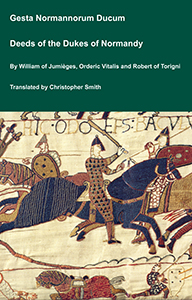
The Deeds of the Dukes of Normandy
The Gesta Normannorum Ducum [The Deeds of the Dukes of Normandy] is a landmark medieval chronicle tracing the rise and fall of the Norman dynasty from its early roots through the pivotal events surrounding the Norman Conquest of England. Originally penned in Latin by the monk William of Jumièges shortly before 1060 and later expanded at the behest of William the Conqueror, the work chronicles the deeds, politics, battles, and leadership of the Norman dukes, especially William’s own claim to the English throne. The narrative combines earlier historical sources with firsthand information and oral testimony to present an authoritative account of Normandy’s transformation from a Viking settlement into one of medieval Europe’s most powerful realms. William’s history emphasizes the legitimacy, military prowess, and governance of the Norman line, framing their expansion, including the conquest of England, as both divinely sanctioned and noble in purpose. Later chroniclers such as Orderic Vitalis and Robert of Torigni continued the history, extending the coverage into the 12th century, providing broader context on ducal rule and its impact. Today this classic work remains a foundational source for understanding Norman identity, medieval statesmanship, and the historical forces that reshaped England and Western Europe between 800AD and 1100AD.
Available at Amazon in eBook and Paperback format.
Scalaronica. [7th July 1307]. The aforesaid King Edward of England [aged 68] had remained at this same time exceedingly ill at Lanercost, whence he moved for change of air and to await his army which he had summoned to re-enter Scotland. Thus he arrived at Burgh-on-sands,1 and died there in the month of July, in the year of grace 1307, whence he was carried and was solemnly interred at Westminster beside his ancestors after he had reigned 34 years 7 months and 11 days, and in the year of his age 68 years and 20 days.
Note 1. Burch sure le Sabloun.
Britannia Volume 3. On the spot where Edward I died, the memory of which event was preserved by some great stones rolled on it, is erected a handsome square pillar nine yards and an half high with this inscription in Roman capitals on the west side:
Memoriæ æternæ Edvardi I. regis Angliæ longè clarissimi, qui in belli apparatu contra Scotos occupatus hic in castris obiit 7 Julii A. 0 . 1307.
On the south, Nobilissimus princeps Henricus Howard dux Norfolciæ comes mareshall. Anglia, comes Arund &c ...... ab Edvardo I. rege Angliæ oriundus. P. 1685.
On the north, Johannes Aglionby I. C. F. C. i. e. juris consultus fieri curavit.
Monument to King Edward I of England at the location [Map] at which he died. By Thomas or John Longstaff for the Duke of Norfolk [aged 29] and John Aglionby. Red sandstone ashlar. Tall square column on moulded plinth, moulded cornice, shaped cap surmounted by cross. Latin inscription on south side to memory of Edward I, who died in his camp at Burgh by Sands, 7 July 1307; east side inscription giving titles of Henry Howard, Duke of Norfolk and date 1685; west side inscription John Aglionby. Also had inscription, Tho Longstaff, Fecit 1685 (Ms 7/3f191, St Edmund Hall, Oxford). Bronze plaque records restoration by the Earl of Lonsdale 1803 (collapsed, March 1795); further restoration of 1876. For full inscription see W. Hutchinson, History of Cumberland, 1794, vol. 2, p504:
Mr. J. Norman, of Kirkandrews, favoured us with the annexed fouth view of King Edward's monument, with the infcriptions, which he took in 1793, which he assures us are very accurate. At that time it leaned much to the west, and on the 4th of March, 1795, it fell down:
South Side: MEMORIÆ ÆTERNÆ EDVARDI I. REGIS ANGLIÆ LONGE CLARISSIMI QVI IN BELLI APPARATV CONTRA SCOTOS OCCVPATVS HlC INI CASTRIS OBIIT 7. IVLII A. D. 1307.
East Side Side: NOBILISSIMVS PRINCEPS HENRIC. HOWARD DVX NORFOLC. COM. MARESCHAL ANGL. COM. ARVNDEL SVRR. NORFOLC. ET NORWIC. BARO HOWARD MOWBREY SEGRAVE BREWS DE GOWER FITSALAN WARREN ESCALES CLVN OSWALDTREE MALTRAVERS FVRNIVAL GRAYSTCH ET HOWARD DE CASTLRISING PRÆNO. ORD. GARTER. MIL. CONSTAB. ET GVBERNATOR REGAL. CASTRI ET HONOR. DE WINDSOR CVSTOS FOREST DE WINDSOR DOM. LOCVMTEN. NORFOLC. SVRR. BERKER. ET CIV. ET COM. CIV. NORWICI OB EDV. I. REGE ANGLIuE ORIVNDVS P. 1685.
West Side. JOHANNES AGLIONBY I. C. F. C.
A singularity which attends the above fact is, that the army must have lain, and the royal tent been pitched, in a most improper place, on marshy ground, on a dead level; when, within a quarter of a mile further fouthward, there was a fine inclining ground, dry and healthy, and not subject to any surprise or attack from superior heights. Any one who has viewed this place, would be inclined to believe a skillful general would not encamp an army on the spot that tradition and this monunnent point out.


Become a Member via our Buy Me a Coffee page to read more.