

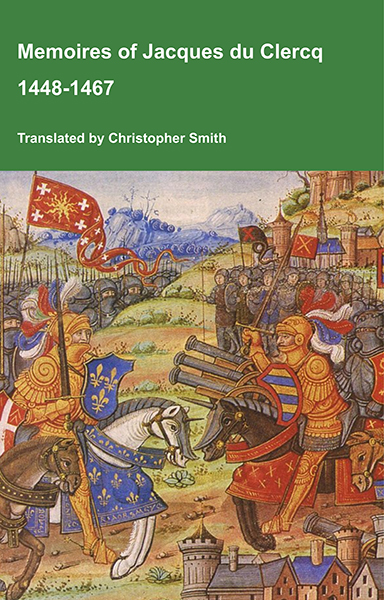
This is a translation of the 'Memoires of Jacques du Clercq', published in 1823 in two volumes, edited by Frederic, Baron de Reissenberg. In his introduction Reissenberg writes: 'Jacques du Clercq tells us that he was born in 1424, and that he was a licentiate in law and a counsellor to Philip the Good, Duke of Burgundy, in the castellany of Douai, Lille, and Orchies. It appears that he established his residence at Arras. In 1446, he married the daughter of Baldwin de la Lacherie, a gentleman who lived in Lille. We read in the fifth book of his Memoirs that his father, also named Jacques du Clercq, had married a lady of the Le Camelin family, from Compiègne. His ancestors, always attached to the counts of Flanders, had constantly served them, whether in their councils or in their armies.' The Memoires cover a period of nineteen years beginning in in 1448, ending in in 1467. It appears that the author had intended to extend the Memoirs beyond that date; no doubt illness or death prevented him from carrying out this plan. As Reissenberg writes the 'merit of this work lies in the simplicity of its narrative, in its tone of good faith, and in a certain air of frankness which naturally wins the reader’s confidence.' Du Clercq ranges from events of national and international importance, including events of the Wars of the Roses in England, to simple, everyday local events such as marriages, robberies, murders, trials and deaths, including that of his own father in Book 5; one of his last entries.
Available at Amazon in eBook and Paperback format.
Four Days' Battle is in Second Anglo Dutch War.
From 1st June 1666 to 04 Jun 1666 the English and Dutch fleets engaged in battle. The English lost ten ships and 1000 men. The Dutch lost four ships and 1500 men.
On 1st June 1666 William Berkeley [aged 27] was killed.
The Gloucester took part.
John Evelyn's Diary. 1st June 1666. Being in my garden at 6 o'clock in the evening, and hearing the great guns go thick off, I took horse and rode that night to Rochester, Kent [Map]; thence next day toward the Downs and seacoast, but meeting the Lieutenant of the Hampshire frigate, who told me what passed, or rather what had not passed, I returned to London, there being no noise, or appearance at Deal, Kent [Map], or on that coast of any engagement. Recounting this to his Majesty [aged 36], whom I found at St James' Park [Map], impatiently expecting, and knowing that Prince Rupert [aged 46] was loose about three at St. Helen's Point at N. of the Isle of Wight, it greatly rejoiced him; but he was astonished when I assured him they heard nothing of the guns in the Downs, nor did the Lieutenant who landed there by five that morning.


Samuel Pepys' Diary. 2nd June 1666. Up, and to the office, where certain newes is brought us of a letter come to the King [aged 36] this morning from the Duke of Albemarle [aged 57], dated yesterday at eleven o'clock, as they were sailing to the Gunfleete, that they were in sight of the Dutch fleete, and were fitting themselves to fight them; so that they are, ere this, certainly engaged; besides, several do averr they heard the guns all yesterday in the afternoon. This put us at the Board into a tosse. Presently come orders for our sending away to the fleete a recruite of 200 soldiers. So I rose from the table, and to the Victualling Office, and thence upon the River among several vessels, to consider of the sending them away; and lastly, down to Greenwich, Kent [Map], and there appointed two yachts to be ready for them; and did order the soldiers to march to Blackewall [Map]. Having set all things in order against the next flood, I went on shore with Captain Erwin at Greenwich, Kent [Map], and into the Parke, and there we could hear the guns from the fleete most plainly.


John Evelyn's Diary. 3rd June 1666. Whitsunday. After sermon came news that the Duke of Albemarle [aged 57] was still in fight, and had been all Saturday, and that Captain Harman's [aged 41] ship (the Henry) was like to be burnt. Then a letter from Mr. Bertie that Prince Rupert [aged 46] was come up with his squadron (according to my former advice of his being loose and in the way), and put new courage into our fleet, now in a manner yielding ground; so that now we were chasing the chasers; that the Duke of Albemarle was slightly wounded, and the rest still in great danger. So, having been much wearied with my journey, I slipped home, the guns still roaring very fiercely.

Samuel Pepys' Diary. 3rd June 1666. Lord's-day; Whit-sunday. Up, and by water to White Hall, and there met with Mr. Coventry [aged 38], who tells me the only news from the fleete is brought by Captain Elliott, of The Portland, which, by being run on board by The Guernsey, was disabled from staying abroad; so is come in to Aldbrough [Map]. That he saw one of the Dutch great ships blown up, and three on fire. That they begun to fight on Friday; and at his coming into port, he could make another ship of the King's coming in, which he judged to be the Rupert: that he knows of no other hurt to our ships. With this good newes I home by water again, and to church in the sermon-time, and with great joy told it my fellows in the pew.
Before 4th June 1666 William Clarke [aged 43] died after having had his leg amputated following the Four Days' Battle.

Samuel Pepys' Diary. 4th June 1666. THE FIGHT.
How we found the Dutch fleete at anchor on Friday half seas over, between Dunkirke and Ostend, and made them let slip their anchors. They about ninety, and we less than sixty. We fought them, and put them to the run, till they met with about sixteen sail of fresh ships, and so bore up again. The fight continued till night, and then again the next morning from five till seven at night. And so, too, yesterday morning they begun again, and continued till about four o'clock, they chasing us for the most part of Saturday and yesterday, we flying from them. The Duke [aged 32] himself, then those people were put into the catch, and by and by spied the Prince's [aged 46] fleete coming, upon which De Ruyter [aged 59] called a little council (being in chase at this time of us), and thereupon their fleete divided into two squadrons; forty in one, and about thirty in the other (the fleete being at first about ninety, but by one accident or other, supposed to be lessened to about seventy); the bigger to follow the Duke, the less to meet the Prince. But the Prince come up with the Generall's fleete, and the Dutch come together again and bore towards their own coast, and we with them; and now what the consequence of this day will be, at that time fighting, we know not. The Duke was forced to come to anchor on Friday, having lost his sails and rigging. No particular person spoken of to be hurt but Sir W. Clerke [aged 43], who hath lost his leg, and bore it bravely. The Duke himself had a little hurt in his thigh, but signified little. The King [aged 36] did pull out of his pocket about twenty pieces in gold, and did give it Daniel for himself and his companion; and so parted, mightily pleased with the account he did give him of the fight, and the successe it ended with, of the Prince's coming, though it seems the Duke did give way again and again. The King did give order for care to be had of Mr. Daniel and his companion; and so we parted from him, and then met the Duke [of York], and gave him the same account: and so broke up, and I left them going to the surgeon's and I myself by water to the 'Change [Map], and to several people did give account of the business.
John Evelyn's Diary. 5th June 1666. I went this morning to London, where came several particulars of the fight.
Samuel Pepys' Diary. 7th June 1666. Up betimes, and to my office about business (Sir W. Coventry [aged 38] having sent me word that he is gone down to the fleete to see how matters stand, and to be back again speedily); and with the same expectation of congratulating ourselves with the victory that I had yesterday. But my Lord Bruncker [aged 46] and Sir T. H. [aged 41] that come from Court, tell me quite contrary newes, which astonishes me: that is to say, that we are beaten, lost many ships and good commanders; have not taken one ship of the enemy's; and so can only report ourselves a victory; nor is it certain that we were left masters of the field. But, above all, that The Prince run on shore upon the Galloper, and there stuck; was endeavoured to be fetched off by the Dutch, but could not; and so they burned her; and Sir G. Ascue [aged 50] is taken prisoner, and carried into Holland. This newes do much trouble me, and the thoughts of the ill consequences of it, and the pride and presumption that brought us to it.

Samuel Pepys' Diary. 8th June 1666. After dinner Balty [aged 26] and I to my office, and there talked a great deal of this fight; and I am mightily pleased in him and have great content in, and hopes of his doing well.
The Deeds of the Dukes of Normandy
The Gesta Normannorum Ducum [The Deeds of the Dukes of Normandy] is a landmark medieval chronicle tracing the rise and fall of the Norman dynasty from its early roots through the pivotal events surrounding the Norman Conquest of England. Originally penned in Latin by the monk William of Jumièges shortly before 1060 and later expanded at the behest of William the Conqueror, the work chronicles the deeds, politics, battles, and leadership of the Norman dukes, especially William’s own claim to the English throne. The narrative combines earlier historical sources with firsthand information and oral testimony to present an authoritative account of Normandy’s transformation from a Viking settlement into one of medieval Europe’s most powerful realms. William’s history emphasizes the legitimacy, military prowess, and governance of the Norman line, framing their expansion, including the conquest of England, as both divinely sanctioned and noble in purpose. Later chroniclers such as Orderic Vitalis and Robert of Torigni continued the history, extending the coverage into the 12th century, providing broader context on ducal rule and its impact. Today this classic work remains a foundational source for understanding Norman identity, medieval statesmanship, and the historical forces that reshaped England and Western Europe between 800AD and 1100AD.
Available at Amazon in eBook and Paperback format.

Before 10th June 1666 Vice-Admiral Christopher Myngs [aged 40] died of wounds received at the Four Days' Battle. He was buried at St Mary's Church.
Samuel Pepys' Diary. 16th June 1666. At noon home to dinner and then down to Woolwich, Kent [Map] and Deptford, Kent [Map] to look after things, my head akeing from the multitude of businesses I had in my head yesterday in settling my accounts. All the way down and up, reading of "The Mayor of Quinborough", a simple play. At Deptford, Kent [Map], while I am there, comes Mr. Williamson [aged 32], Sir Arthur Ingram [aged 49] and Jacke Fen, to see the new ships, which they had done, and then I with them home in their boat, and a very fine gentleman Mr. Williamson is. It seems the Dutch do mightily insult of their victory, and they have great reason1. Sir William Barkeley [deceased] was killed before his ship taken; and there he lies dead in a sugar-chest, for every body to see, with his flag standing up by him. And Sir George Ascue [aged 50] is carried up and down the Hague for people to see. Home to my office, where late, and then to bed.
Note 1. This treatment seems to have been that of the Dutch populace alone, and there does not appear to have been cause of complaint against the government. Respecting Sir W. Berkeley's body the following notice was published in the "London Gazette" of July 15th, 1666 (No. 69 [Note. actually issue 70]) "Whitehall, July 15. This day arrived a Trumpet from the States of Holland, who came over from Calais in the Dover packet-boat, with a letter to his Majesty, that the States have taken order for the embalming the body of Sir William Berkeley, which they have placed in the chapel of the great church at the Hague, a civility they profess to owe to his corpse, in respect to the quality of his person, the greatness of his command, and of the high courage and valour he showed in the late engagement; desiring his Majesty to signify his pleasure about the further disposal of it". "Frederick Ruysch, the celebrated Dutch anatomist, undertook, by order of the States-General, to inject the body of the English Admiral Berkeley, killed in the sea-fight of 1666; and the body, already somewhat decomposed, was sent over to England as well prepared as if it had been the fresh corpse of a child. This produced to Ruysch, on the part of the States-General, a recompense worthy of their liberality, and the merit of the anatomist", "James's Medical Dictionary"..

Samuel Pepys' Diary. 4th July 1666. Thence home and dined, and then to the office, where busy all day, and in the evening Sir W. Pen [aged 45] come to me, and we walked together, and talked of the late fight. I find him very plain, that the whole conduct of the late fight was ill, and that that of truth's all, and he tells me that it is not he, but two-thirds of the commanders of the whole fleete have told him so: they all saying, that they durst not oppose it at the Council of War, for fear of being called cowards, though it was wholly against their judgement to fight that day with the disproportion of force, and then we not being able to use one gun of our lower tier, which was a greater disproportion than the other. Besides, we might very well have staid in the Downs without fighting, or any where else, till the Prince [aged 46] could have come up to them; or at least till the weather was fair, that we might have the benefit of our whole force in the ships that we had. He says three things must [be] remedied, or else we shall be undone by this fleete.
Note 1. That we must fight in a line, whereas we fight promiscuously, to our utter and demonstrable ruine; the Dutch fighting otherwise; and we, whenever we beat them.
Note 2. We must not desert ships of our own in distress, as we did, for that makes a captain desperate, and he will fling away his ship, when there is no hopes left him of succour.
Note 3. That ships, when they are a little shattered, must not take the liberty to come in of themselves, but refit themselves the best they can, and stay out-many of our ships coming in with very small disablenesses.
John Evelyn's Diary. 4th July 1666. The solemn Fast-day. Dr. Meggot preached an excellent discourse before the King [aged 36] on the terrors of God's judgments. After sermon, I waited on my Lord Archbishop of Canterbury [aged 49] and Bishop of Winchester [aged 47], where the Dean of Westminster [aged 31] spoke to me about putting into my hands the disposal of fifty pounds, which the charitable people of Oxford had sent to be distributed among the sick and wounded seamen since the battle. Hence, I went to the Lord Chancellor's [aged 57] to joy him of his Royal Highness's [aged 32] second son, now born at St. James's [Map]; and to desire the use of the Star-chamber for our Commissioners to meet in, Painters' Hall, Queenhithe not being so convenient.


Samuel Pepys' Diary. 18th July 1666. Up in good case, and so by coach to St. James's after my fellows, and there did our business, which is mostly every day to complain of want of money, and that only will undo us in a little time. Here, among other things, before us all, the Duke of Yorke [aged 32] did say, that now at length he is come to a sure knowledge that the Dutch did lose in the late engagements twenty-nine captains and thirteen ships. Upon which Sir W. Coventry [aged 38] did publickly move, that if his Royal Highness had this of a certainty, it would be of use to send this down to the fleete, and to cause it to be spread about the fleete, for the recovering of the spirits of the officers and seamen; who are under great dejectedness for want of knowing that they did do any thing against the enemy, notwithstanding all that they did to us. Which, though it be true, yet methought was one of the most dishonourable motions to our countrymen that ever was made; and is worth remembering.

Samuel Pepys' Diary. 28th October 1666. Lord's Day. Up, and to church with my wife, and then home, and there is come little Michell and his wife, I sent for them, and also comes Captain Guy to dine with me, and he and I much talk together. He cries out of the discipline of the fleete, and confesses really that the true English valour we talk of is almost spent and worn out; few of the commanders doing what they should do, and he much fears we shall therefore be beaten the next year. He assures me we were beaten home the last June fight, and that the whole fleete was ashamed to hear of our bonefires. He commends Smith, and cries out of Holmes [aged 44] for an idle, proud, conceited, though stout fellow. He tells me we are to owe the losse of so many ships on the sands, not to any fault of the pilots, but to the weather; but in this I have good authority to fear there was something more. He says the Dutch do fight in very good order, and we in none at all. He says that in the July fight, both the Prince [aged 46] and Holmes had their belly-fulls, and were fain to go aside; though, if the wind had continued, we had utterly beaten them. He do confess the whole to be governed by a company of fools, and fears our ruine.