


Chronicle of a Bourgeois of Valenciennes
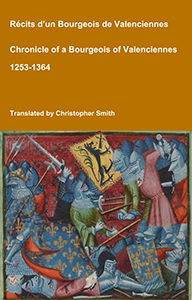
Récits d’un bourgeois de Valenciennes aka The Chronicle of a Bourgeois of Valenciennes is a vivid 14th-century vernacular chronicle written by an anonymous urban chronicler from Valenciennes in the County of Hainaut. It survives in a manuscript that describes local and regional history from about 1253 to 1366, blending chronology, narrative episodes, and eyewitness-style accounts of political, military, and social events in medieval France, Flanders, and the Low Countries. The work begins with a chronological framework of events affecting Valenciennes and its region under rulers such as King Philip VI of France and the shifting allegiances of local nobility. It includes accounts of conflicts, sieges, diplomatic manoeuvres, and the impact of broader struggles like the Hundred Years’ War on urban life in Hainaut. Written from the perspective of a burgher (bourgeois) rather than a monastery or royal court, the chronicle offers a rare lay viewpoint on high politics and warfare, reflecting how merchants, townspeople, and civic institutions experienced the turbulence of the 13th and 14th centuries. Its narrative style combines straightforward reporting of events with moral and civic observations, making it a valuable source for readers interested in medieval urban society, regional politics, and the lived experience of war and governance in pre-modern Europe.
Available at Amazon in eBook and Paperback format.
Pilgrimage of Grace is in June 1536-1540 Marriage to Jane Seymour and Rebellions.
Chronicle of Edward Hall [1496-1548]. Around June 1536.After this book which passed by the King's authority with the consent of the clergy, was published, the which contained certain articles of religion necessary to be taught unto the people, and among other it specially treated of no more than three sacraments, where always the people had bene taught seven sacraments, and beside this book, certain injunctions were that time given whereby a number of their holy days was abrogated and specially such as fell in the harvest time, the keeping of which was much to the hinderance of the gathering in of corn, hay, fruit, and other such like necessary and profitable commodities.
On 20th November 1539 Nicholas Tempest of Holmeside [aged 53] was hanged for his part in the Pilgrimage of Grace.
Around 30th May 1537 the Abbots of Fountains Abbey, North Yorkshire [Map], Marmaduke Bradley, and Guisborough Priory [Map], Robert Pursglove, were hanged, drawn and quartered at Tyburn [Map] for their role in the Pilgrimage of Grace. Their heads were displayed on London Bridge [Map].
On 2nd June 1537 Abbot Adam Sedbar [aged 35] and Prior William Wood were hanged, drawn and quartered at Tyburn [Map] for their role in the Pilgrimage of Grace. Their heads were displayed on London Bridge [Map].
Around October 1536 the North rose against religious policies of Henry VIII [aged 45]. Thomas Audley 1st Baron Audley Walden [aged 48] condemned the traitors. John Neville 3rd Baron Latimer [aged 42] was implicated. Thomas Howard 3rd Duke of Norfolk [aged 63], Henry Howard Earl of Surrey [aged 20] and Edmund Knyvet [aged 28] undertook the suppression of the rebels.
On 4th October 1536 the Lincolnshire Rising began. Dr Raynes, the chancellor of the Bishop of Lincoln, who was staying nearby at Bolingbroke, after having held a session of the commissionary's court there, was dragged from his sickbed and taken to Horncastle. Francis Aidan Gasquet writes in his book 'Henry VIII and the English Monasteries': "As the chancellor rode into the field with his captors the passions of the mob were stirred, and there occurred one of the two acts of violence, which alone in this or the subsequent Yorkshire rising, disgraced the movement!" "At his coming into the field," declares Brian Staines, "the rebels, whereof were many parsons and vicars, cried out with a loud voice, 'Kill him, kill him.' And upon that one William Hutchinson, of Horncastle, and William Balderstone, by the procurement of the said parsons and vicars, pulled him violently off his horse, kneeling upon his knees, and with their staves they slew him. And being dead, this deponent saith the priests continually crying, 'Kill him, kill him,' he also struck the said chancellor upon the arm with a staff."
The Lincolnshire Rising was sparked off by a sermon at evensong on the 1st October at St James's Church, Louth, and by a visitation from a registrar on 2nd October. Mary Polito, author of "Governmental Arts in Tudor England" describes how Nicholas Melton, a local shoemaker who came to be known as "Captain Cobbler", seized the registrar, burned his papers and then forced him and the priests to swear an oath of loyalty to the rebel cause. The rebels then marched to the nunnery at Legbourne where they took the royal commissioners hostage. The nunnery had been formally suppressed a few weeks earlier.
On 6th March 1537 Thomas Moigne [aged 27] was tried for treason at Lincoln, Lincolnshire [Map]. and sentenced to be hanged, drawn and quartered the following day which sentence was duly carried out. He was attainted, and his estates forfeited. These were recovered by his younger brothers in 1544.
The History of William Marshal was commissioned by his son shortly after William’s death in 1219 to celebrate the Marshal’s remarkable life; it is an authentic, contemporary voice. The manuscript was discovered in 1861 by French historian Paul Meyer. Meyer published the manuscript in its original Anglo-French in 1891 in two books. This book is a line by line translation of the first of Meyer’s books; lines 1-10152. Book 1 of the History begins in 1139 and ends in 1194. It describes the events of the Anarchy, the role of William’s father John, John’s marriages, William’s childhood, his role as a hostage at the siege of Newbury, his injury and imprisonment in Poitou where he met Eleanor of Aquitaine and his life as a knight errant. It continues with the accusation against him of an improper relationship with Margaret, wife of Henry the Young King, his exile, and return, the death of Henry the Young King, the rebellion of Richard, the future King Richard I, war with France, the death of King Henry II, and the capture of King Richard, and the rebellion of John, the future King John. It ends with the release of King Richard and the death of John Marshal.
Available at Amazon in eBook and Paperback format.
On 7th March 1537 Thomas Moigne [aged 27] was hanged, drawn and quartered.
On 12th May 1537 Abbot Adam Sedbar [aged 35] was captured. He was imprisoned in the Beauchamp Tower, Tower of London [Map] where his inscribed name on the wall "ADAM SEDBAR. ABBAS JOREVALL 1537" can still be seen.
Around 30th May 1537 the Abbots of Fountains Abbey, North Yorkshire [Map], Marmaduke Bradley, and Guisborough Priory [Map], Robert Pursglove, were hanged, drawn and quartered at Tyburn [Map] for their role in the Pilgrimage of Grace. Their heads were displayed on London Bridge [Map].
On 2nd June 1537 Abbot Adam Sedbar [aged 35] and Prior William Wood were hanged, drawn and quartered at Tyburn [Map] for their role in the Pilgrimage of Grace. Their heads were displayed on London Bridge [Map].