

The History of William Marshal was commissioned by his son shortly after William’s death in 1219 to celebrate the Marshal’s remarkable life; it is an authentic, contemporary voice. The manuscript was discovered in 1861 by French historian Paul Meyer. Meyer published the manuscript in its original Anglo-French in 1891 in two books. This book is a line by line translation of the first of Meyer’s books; lines 1-10152. Book 1 of the History begins in 1139 and ends in 1194. It describes the events of the Anarchy, the role of William’s father John, John’s marriages, William’s childhood, his role as a hostage at the siege of Newbury, his injury and imprisonment in Poitou where he met Eleanor of Aquitaine and his life as a knight errant. It continues with the accusation against him of an improper relationship with Margaret, wife of Henry the Young King, his exile, and return, the death of Henry the Young King, the rebellion of Richard, the future King Richard I, war with France, the death of King Henry II, and the capture of King Richard, and the rebellion of John, the future King John. It ends with the release of King Richard and the death of John Marshal.
Available at Amazon in eBook and Paperback format.
On 7th February 1741 Henry Fuseli was born at Zurich, Switzerland.

1778. James Northcote [aged 31]. Portrait of Henry Fuseli [aged 36].
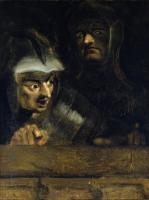
1780 to 1782. Henry Fuseli [aged 38]. "The two murderers of the Duke of Clarence".
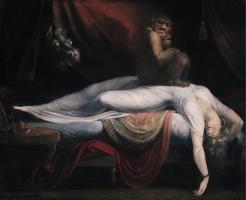
1781. Henry Fuseli [aged 39]. "The Nightmare".
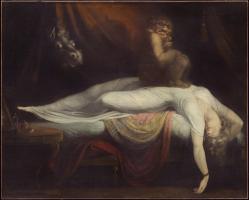
1781. Henry Fuseli [aged 39]. "The Nightmare". The painting was first shown in 1782 at the Royal Academy of London after which it became widely known. Fuseli painted other versions; the original was sold for twenty guineas.
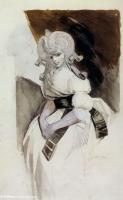
In 1788 Henry Fuseli [aged 46] and Sophia Rawlins were married. She originally one of his models.
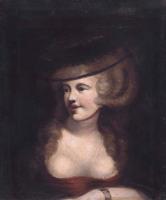
In or after 1788. Henry Fuseli [aged 46]. Portrait of Sophia Rawlins, the artist's wife.
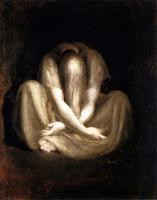
1789. Henry Fuseli [aged 47]. "Silence".
Around 1789 Henry Fuseli [aged 47] and Mary Wollstonecraft [aged 29] planned a trip with him to Paris. His wife Sophia Rawlins stopped any communication between the two.


The True Chronicles of Jean le Bel Volume 1 Chapters 1-60 1307-1342
The True Chronicles of Jean le Bel offer one of the most vivid and immediate accounts of 14th-century Europe, written by a knight who lived through the events he describes, and experienced some of them first hand. Covering the early decades of the Hundred Years’ War, this remarkable chronicle follows the campaigns of Edward III of England, the politics of France and the Low Countries, and the shifting alliances that shaped medieval warfare. Unlike later historians, Jean le Bel writes with a strong sense of eyewitness authenticity, drawing on personal experience and the testimony of fellow soldiers. His narrative captures not only battles and sieges, but also the realities of military life, diplomacy, and the ideals of chivalry that governed noble society. A key source for Jean Froissart, Le Bel’s chronicle stands on its own as a compelling and insightful work, at once historical record and literary achievement. This translation builds on the 1905 edition published in French by Jules Viard, adding extensive translations from other sources Rymer's Fœdera, the Chronicles of Adam Murimuth, William Nangis, Walter of Guisborough, a Bourgeois of Valenciennes, Geoffrey le Baker of Swinbroke and Richard Lescot to enrich the original text and Viard's notes.
Available at Amazon in eBook and Paperback format.
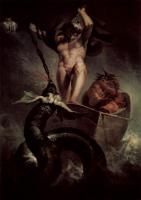
1790. Henry Fuseli [aged 48]. "Thor Battering the Midgard Serpent". Fuseli's diploma work for the Royal Academy
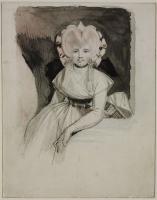
Around 1790. Henry Fuseli [aged 48]. Portrait of the artist's wife Sophia Rawlins.
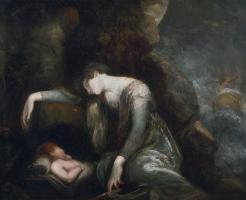
1790. Henry Fuseli [aged 48]. "Danaë and Perseus on Seriphos".

1792. Henry Fuseli [aged 50]. "The Apotheosis of Penelope Boothby".
Penelope Boothby: On 11th April 1785 she was born to Brooke Boothby 6th Baronet in Lichfield, Staffordshire [Map]. On 19th March 1791 Penelope Boothby died at Ashbourne Hall, Derbyshire [Map]. She was buried in St Oswald's Church, Ashbourne [Map].
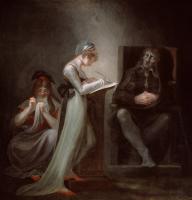
1794. Henry Fuseli [aged 52]. "Milton Dictating to His Daughter".

1794. John Opie [aged 32]. Portrait of Henry Fuseli [aged 52].
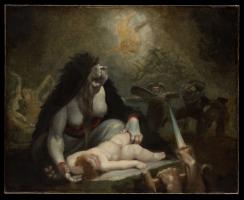
1796. Henry Fuseli [aged 54]. "The Night-Hag Visiting Lapland Witches". Hecate, the Greek goddess who presided over witchcraft and magical rites, was historically known as the "Night-Hag," hence the title that the artist gave this work. It illustrates a passage from Paradise Lost by the English poet John Milton
In 1799 Henry Fuseli [aged 57] was appointed Professor of Painting at the Royal Academy.
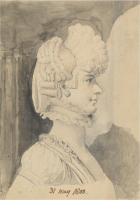
31st May 1800. Henry Fuseli [aged 59]. Sophia Rawlins, the artist's wife, in profile.
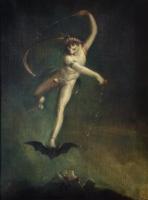
Around 1805. Henry Fuseli [aged 63]. "Ariel".
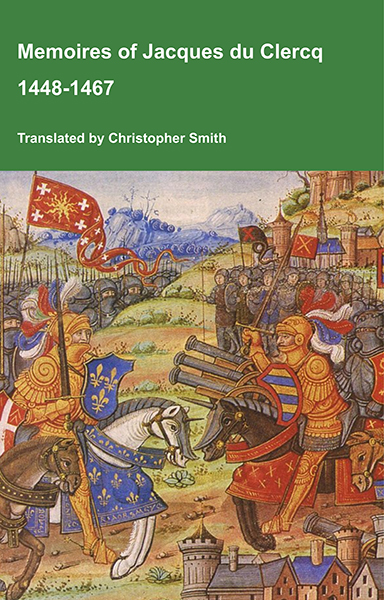
This is a translation of the 'Memoires of Jacques du Clercq', published in 1823 in two volumes, edited by Frederic, Baron de Reissenberg. In his introduction Reissenberg writes: 'Jacques du Clercq tells us that he was born in 1424, and that he was a licentiate in law and a counsellor to Philip the Good, Duke of Burgundy, in the castellany of Douai, Lille, and Orchies. It appears that he established his residence at Arras. In 1446, he married the daughter of Baldwin de la Lacherie, a gentleman who lived in Lille. We read in the fifth book of his Memoirs that his father, also named Jacques du Clercq, had married a lady of the Le Camelin family, from Compiègne. His ancestors, always attached to the counts of Flanders, had constantly served them, whether in their councils or in their armies.' The Memoires cover a period of nineteen years beginning in in 1448, ending in in 1467. It appears that the author had intended to extend the Memoirs beyond that date; no doubt illness or death prevented him from carrying out this plan. As Reissenberg writes the 'merit of this work lies in the simplicity of its narrative, in its tone of good faith, and in a certain air of frankness which naturally wins the reader’s confidence.' Du Clercq ranges from events of national and international importance, including events of the Wars of the Roses in England, to simple, everyday local events such as marriages, robberies, murders, trials and deaths, including that of his own father in Book 5; one of his last entries.
Available at Amazon in eBook and Paperback format.

1817. George Henry Harlow [aged 29]. Portrait of Henry Fuseli [aged 75].
On 17th April 1825 Henry Fuseli [aged 84] died at the house of the Countess of Guildford [aged 55], on Putney Hill