Annals of the six Kings of England by Nicholas Trivet
Translation of the Annals of the Six Kings of England by that traces the rise and rule of the Angevin aka Plantagenet dynasty from the mid-12th to early 14th century. Written by the Dominican scholar Nicholas Trivet, the work offers a vivid account of English history from the reign of King Stephen through to the death of King Edward I, blending political narrative with moral reflection. Covering the reigns of six monarchs—from Stephen to Edward I—the chronicle explores royal authority, rebellion, war, and the shifting balance between crown, church, and nobility. Trivet provides detailed insight into defining moments such as baronial conflicts, Anglo-French rivalry, and the consolidation of royal power under Edward I, whose reign he describes with particular immediacy. The Annals combines careful year-by-year reporting with thoughtful interpretation, presenting history not merely as a sequence of events but as a moral and political lesson. Ideal for readers interested in medieval history, kingship, and the origins of the English state, this chronicle remains a valuable and accessible window into the turbulent world of the Plantagenet kings.
Available at Amazon in eBook and Paperback format.
Acanthus is in Architectural Detail.
On 29th August 1582 Thomas St Paul died. He was buried at St Lawrence's Church, Snarford [Map]. Monument to Thomas St Paul and Faith Grantham. Fine freestanding tomb chest with canopy. The sides of the tomb chest have acanthus Pilasters, the panels between contain wreathed shields. The full length recumbent albaster effigies show the man in full plate armour holding sword and prayerbook, head on helm, feet on a cushion with flowers. His wife is in a long dress with cloak and close fitting hat, holding a bible. The inscription runs round the top edge of the chest. The canopy is supported on six pillars, those at the angles being circular and bulbous, the others in the form of obelisks decorated with fishscale Paterae, with elaborate Ionic Capitals with roses in the necking. The entablature has an egg and dart frieze. Above the heads of the columns are five female and one male weepers. At the centre of the canopy is a raised altar bearing shields and surmounted by the kneeling figure of the heir clad in armour. In front kneels a larger figure of a girl. the monument is all painted and gilded.
Thomas St Paul: he and Faith Grantham were married. he was appointed High Sheriff of Lincolnshire. In 1580 Thomas St Paul was knighted by Queen Elizabeth I of England and Ireland at Richmond, Surrey [Map].


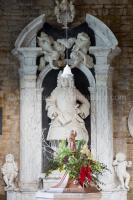
On 5th April 1713 Richard Welby [aged 55] died. Monument at St Andrew's Church, Denton [Map]. Sculpted by Thomas Green of Camberwell [aged 54]. The fully wigged standing life sized figure of the deceased stands in an arched surround flanked by fluted Pilasters with acanthus scrolls and broken segmental pediment contaning a cherub and putti leaning down from heaven holding a metal coronet, surmounted by an achievement. Beneath is he inscription panel and to either side putti holding memento mori, and mourning, one with tears.
The inscription reads:
M.S.
Here are deposited the Remains of
Richard Welby of Denton Esqr
Lord of the Mannours of Welby Streglethorp Saperton and
Swinsted and High Sheriff of the County of Lincoln 1705
A Gentleman of an ancient & Virtuous Family, a good Christian
a Loyal Subject, a true lover of the Church
a sincere Respector of its Clergy and
a daily Frequentor of its Worship
In His private Character, Modest, Humble and Courteous
of great Probity and universal Charity
The Poor lost in him a liberal and silent Benefactor
his Tenants, a forbearing Landlord;
his Servants, a kind and prudent master;
his Relations, an invaluable Friend;
his Children, a most indulgent Father and
his Mournfull Wife ye Best of Husbands.
He marry'd Mary Daughter & Sole Heiress of John Towers of
the Isle of Ely Esqr, by whom he had Issue;
Mary Interred here, Selina, William and John twins, Eleanor & Richard
After a tedious Sickness, which he bore with exemplary patience
and resignation, he dyed on Easter day 1713
In hopes of a Joyfull Resurrection; & lament his loss
the Righteous shall be had in everlasting Remembrance
MARY his once happy Wife now Sorrowfull Relict
??????? her own Affection
Erected this Monument Dec 10 1714.
Mary Welby
Ob June 8 1759
Ae 74
Richard Welby: In 1658 he was born. Before 1713 he and Mary Towers were married.