

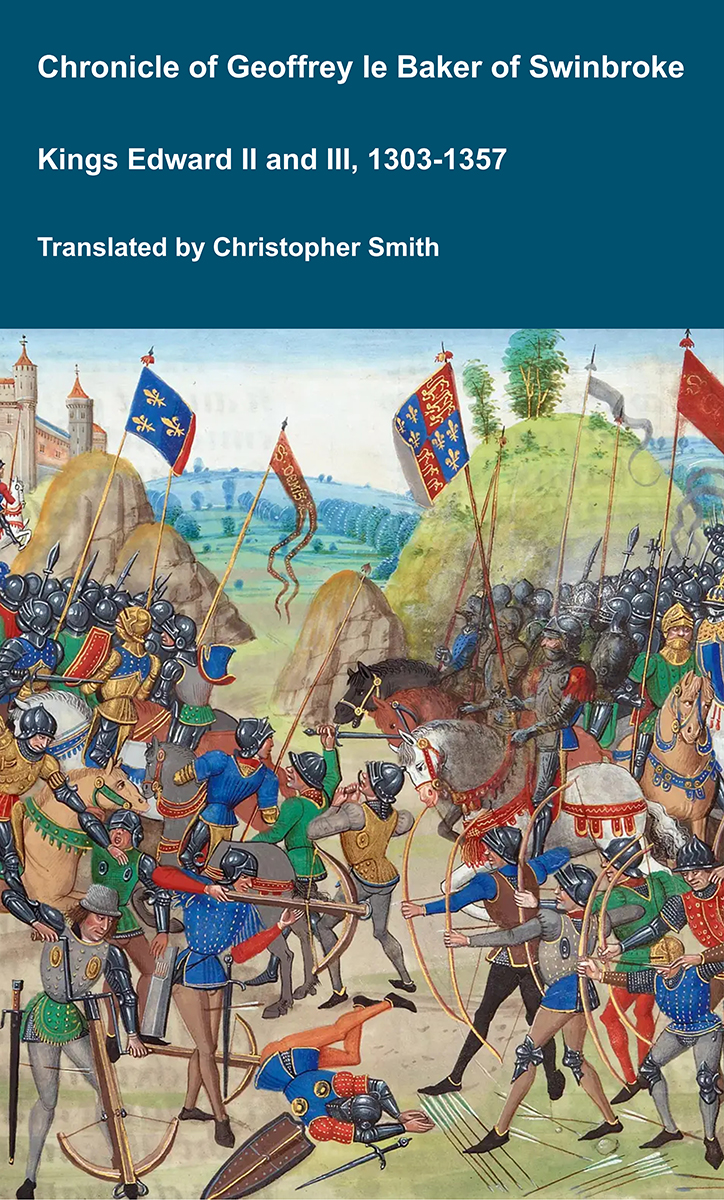
Chronicle of Geoffrey le Baker of Swinbroke
Baker was a secular clerk from Swinbroke, now Swinbrook, an Oxfordshire village two miles east of Burford. His Chronicle describes the events of the period 1303-1356: Gaveston, Bannockburn, Boroughbridge, the murder of King Edward II, the Scottish Wars, Sluys, Crécy, the Black Death, Winchelsea and Poitiers. To quote Herbert Bruce 'it possesses a vigorous and characteristic style, and its value for particular events between 1303 and 1356 has been recognised by its editor and by subsequent writers'. The book provides remarkable detail about the events it describes. Baker's text has been augmented with hundreds of notes, including extracts from other contemporary chronicles, such as the Annales Londonienses, Annales Paulini, Murimuth, Lanercost, Avesbury, Guisborough and Froissart to enrich the reader's understanding. The translation takes as its source the 'Chronicon Galfridi le Baker de Swynebroke' published in 1889, edited by Edward Maunde Thompson.
Available at Amazon in eBook and Paperback format.
Algebraic Numbers is in Real Numbers.
Real Numbers can be either Algebraic Numbers or Transcendental Number.
Irrational Number. An Irrational Number is a number that cannot be expressed as a Fraction.
Constructable Numbers are numbers that can be derived using a straight edge and a compass.
The Golden Ratio, also known as the Golden Mean and Golden Section, is 1.618033... It is the solution to the equation x^2 - x - 1 = 0, or ( a + b ) / a = a / b.
The Golden Ratio is usually represented by the Greek Letter phi φ.
The Fibaonacci Series converges on the Golden Ratio.
The formula ( 1 + SQRT(5) ) / 2 is the Golden Ratio.
Square Root of 2, or 2^(1/2) being the length of the diagonal of a square with sides of length 1. It is 1.4142135623...
99/70 = 1.4142857 approximates to the Square Root of 2.
Non-Constructable Numbers are the solution to algebraic equations with a cube root of higher eg 2^(1/3).
Fractions are an Integer divided by an Integer eg 1/2, 5/13, 241/98.
Rational Number. A Rational Number is a number that can be expressed as a Fraction of two Integers. Integers are Fractions with a divisor of 1.
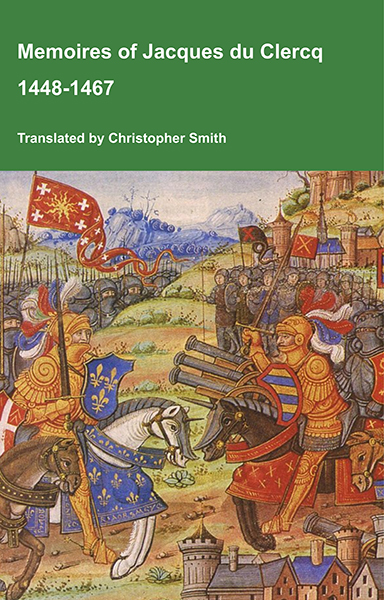
This is a translation of the 'Memoires of Jacques du Clercq', published in 1823 in two volumes, edited by Frederic, Baron de Reissenberg. In his introduction Reissenberg writes: 'Jacques du Clercq tells us that he was born in 1424, and that he was a licentiate in law and a counsellor to Philip the Good, Duke of Burgundy, in the castellany of Douai, Lille, and Orchies. It appears that he established his residence at Arras. In 1446, he married the daughter of Baldwin de la Lacherie, a gentleman who lived in Lille. We read in the fifth book of his Memoirs that his father, also named Jacques du Clercq, had married a lady of the Le Camelin family, from Compiègne. His ancestors, always attached to the counts of Flanders, had constantly served them, whether in their councils or in their armies.' The Memoires cover a period of nineteen years beginning in in 1448, ending in in 1467. It appears that the author had intended to extend the Memoirs beyond that date; no doubt illness or death prevented him from carrying out this plan. As Reissenberg writes the 'merit of this work lies in the simplicity of its narrative, in its tone of good faith, and in a certain air of frankness which naturally wins the reader’s confidence.' Du Clercq ranges from events of national and international importance, including events of the Wars of the Roses in England, to simple, everyday local events such as marriages, robberies, murders, trials and deaths, including that of his own father in Book 5; one of his last entries.
Available at Amazon in eBook and Paperback format.
Irrational Number. An Irrational Number is a number that cannot be expressed as a Fraction.
Integers aka whole numbers. Fractions with a divisor of 1.
Rational Number. A Rational Number is a number that can be expressed as a Fraction of two Integers. Integers are Fractions with a divisor of 1.
Prime Number. A Prime Number is an Integer that is only divisible by 1 and itself with the Remainder ie. 1, 2, 3, 5, 7, 11, 13, 17, 19, ...
Fermat Prime. A Prime Number that is a solution to 2^2^N + 1 eg 3, 5, 17, 65537, 4294967297, 18446744073709551617
2 ^ 2 ^ 0 + 1 = 3
2 ^ 2 ^ 1 + 1 = 5
2 ^ 2 ^ 2 + 1 = 17
With the exeception of the first and second terms Germat Primes always end in 7.
Mersenne Prime. A Mersenne Prime is a prime number that is one less than a power of two. Mersenne Primes do not include all numbers that are one less than a power of two eg 16 - 1 = 15 which is divisible by 1, 3 and 5.