


Animals
Animals is in Terms.
Boar
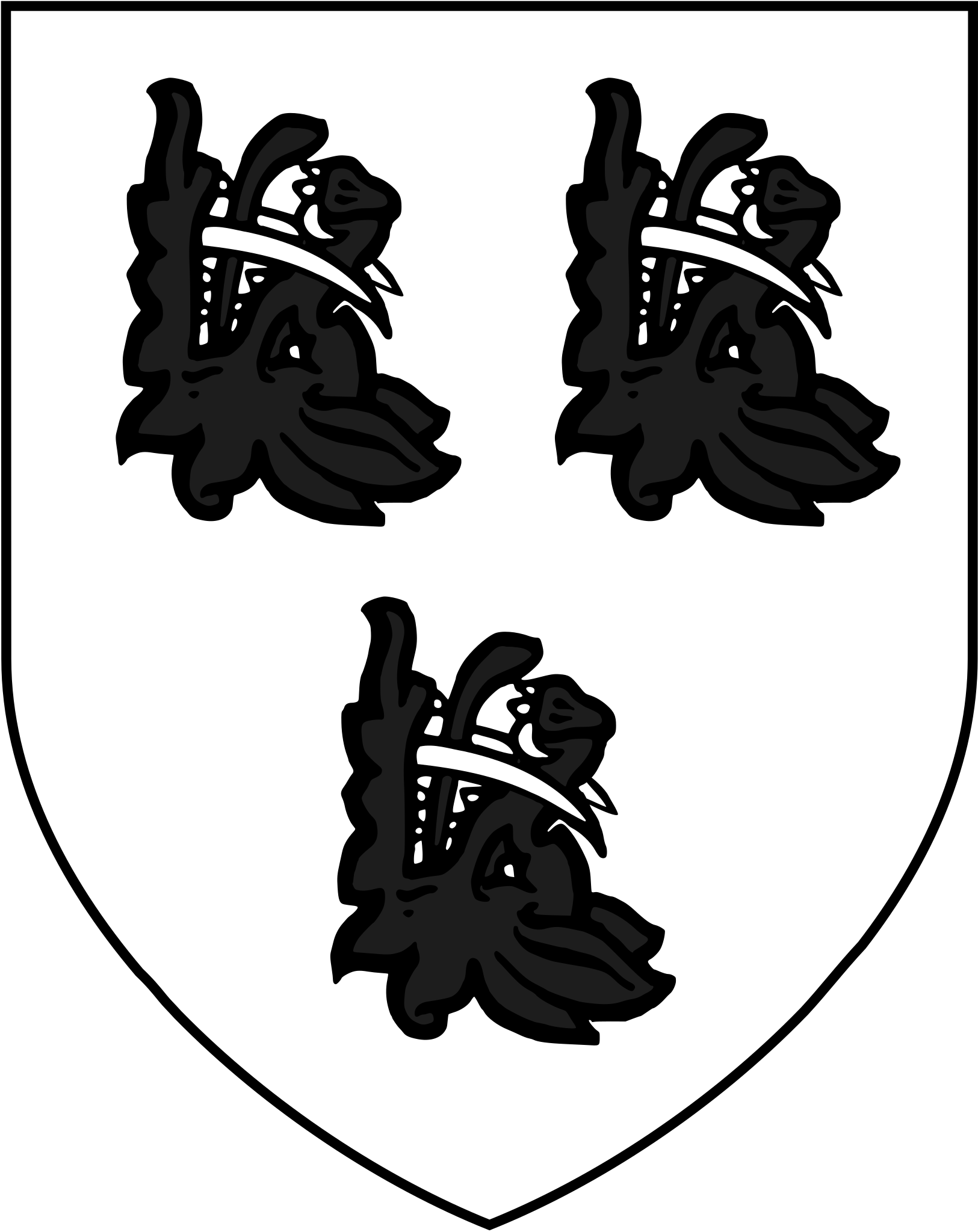
 Booth Arms. Argent, three boar's heads erect sable. Source.
 Earl Cadogan Arms. Quarterly: 1&4
  Cadogan Arms 2&3 argent, three boar's heads couped sable. Source.
 Tennant Arms. Argent, two crescents in fess sable on a chief gules a boar's head couped of the first. Source.
Buck
Buck's Head
 Duff Arms. Vert, a fess dancetté ermine, between a buck's head caboshed in chief and two escallops in base or.
Three buck's heads
 Cavendish Arms. Sable, three buck's heads caboshed argent. Source.
 Ferneley Arms. Or, on a bend vert three buck's heads caboshed argent.
 Roper Arms. Per fess azure and or, a pale counter-changed and three buck's heads erased of the second. Source.
 Stanley Arms. Argent, a bend azure three buck's heads caboshed or. Source.
Dog
Greyhound
Talbot's Heads
 Duncombe Arms. Per chevron engrailed gules and argent, three talbot's heads erased counterchanged. Source.
Dolphin
Henry Machyn's Diary. 16 Aug 1552. The xvj day of August was taken up a' Broke Warff iij grett fysses, and in odur plasys ij more, and sold in Fysh [strete] to them that wold by them.
Three great fishes. "The viij. daye of August, there were taken about Quynborough three great fyshes called dolphins, or by some called rygges: and the weke folowyng, at Blackwall, were syxe more taken and brought to London, and there sold; the least of them was greater then any horse." Stowe's Summarie, 1566.
 Blennerhassett Arms. Gules, a chevron ermine, between three dolphins naiant embowed argent. Source.
Elephants
Elephants Heads
On 14 Jan 1725 John Anstis, Garter King at Arms, by order of King George I granted by patent to Sir Andrew Fountaine (age 49), Knt then vice-chamberlain to the Princess of Wales, and tutor to his highness Prince William, for whom he was installed (as proxy) knight of the honourable Order of the Bath, supporters to his arms, viz on either side a lion gules with wings erected or, with the old family motto of, Vix Ea Nostra Voco, and the ancient arms of Fountaine, or, a fess gules between three elephants heads erased sable.
Fishes
 Kitson Arms. Sable three fishes hauriant in fess argent a chief or. Source.
Fox
 Fox Arms. Ermine, on a chevron azure three fox's heads and necks erased or on a canton of the second a fleur de lys of the third. The canton is an augmentation of honour to his paternal arms, granted out of the Royal Arms as a mark of esteem to him and his heirs forever, by King Charles II following the Restoration of the Monarchy. Source.
Leopards
Leopard's Faces
Three Leopard's Faces
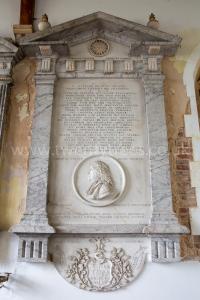
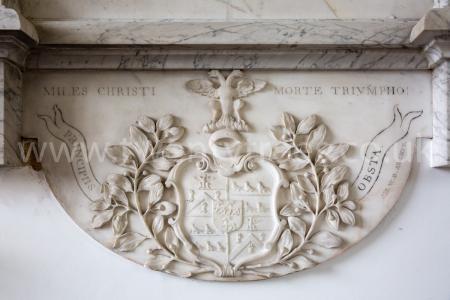
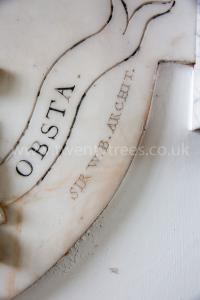
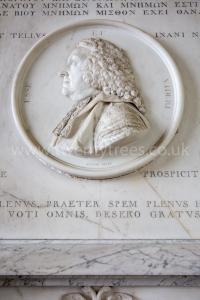
On 10 Mar 1774 William Browne (age 82) died. Church of St Mary, Hillington [Map]. Large mural marble tablet with plain open pilasters open pediment and relief rondal. Inscribed Sir W B Archit. Roundel sculpted by Joseph Wilton (age 51). Armorial quartered 1&4 Unknown three leopard's faces jessant de lys 2&3 appears to be  Temple Arms includes an escutcheon for his wife Mary Greene.

William Browne: In 1692 he was born. On 24 Aug 1717 he and Mary Greene were married.
Mary Greene: On 29 Sep 1699 she was born to Charles Greene.
 Cantilupe Arms. Azure three leopard's faces jessant-de-lys or.
 Clement Arms. Argent, two bendlets wavy sable on a chief gules three leopard's faces or a bordure compony or and azure. Source.
 De La Pole Arms. Azure, a fess between three leopard's faces or. .
 Newport Arms. Argent, a chevron gules between three leopard's faces sable. Source.
 Pulteney Arms. Argent, a fess dancetté gules in chief three leopard's faces sable. Source.
 Watkins Arms. Azure, a fess vair between three leopard's faces jessant-de-lys or. Source.
 Wentworth Arms. Sable, a chevron or three leopard's faces or. Source.
Unicorn
 Denison Arms. Ermine, a bend azure cotised sable between a unicorn's head erased in chief and a cross crosslet fitchy in base gules. Source.
Wings
 Drake of Ash Arms. Argent, a wyvern wings displayed and tail nowed gules. Source.
Segreant
Segreant. Having the wings expanded.
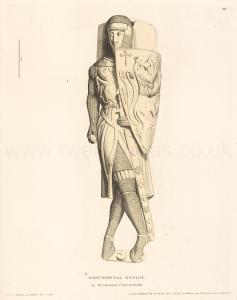
Effigy of Richard Wellesburne de Montfort. THIS very remarkable effigy lies on the north wall of the church of Hitchendon in Buckinghamshire. After the battle of Evesham in 1265, in which the famous Baron Simon de Montfort, with his eldest son Henry, lost their lives, his wifea and children fled the country, with the exception of the youngest son Richard, who assumed the name of Wellesburne (from a manor so termed in Warwickshire, an ancient possession of the family), and retired to Hinchendon as above, where he resided at a mansion called Wreck Hall. The armorial bearings on this effigy, and the peculiarities which mark the period of its execution, enable us very confidently to appropriate it to this identical personage. He became the founder of the family of Wellesburne, which was extant in the county of Buckingham, in the reign of Henry VI. In the church of Hitchendon down to that period were placed numerous monuments of his successors, one of which will be found in another place. A deed of this Wellesburne de Montfort has been printed in Nichols's History of Leicestershire, the faulty Latin of which is perhaps no proof of its being fictitious. There are two seals appended to this instrument, one of which has the legend "Sigillum Bellatoris, filii Simonis de Montefort; [Seal of the Warrior, son of Simon de Montefort]" the other bears the rampant lion of his house, the legend "Wellisburne de la Monteforte."

There is some reason to conjecture that Richard Wellesburn de Montfort was imbued with the martial character of his race. His effigy represents him in the attitude of a Crusader (he might, not improbably, have passed some of the years immediately after his father's overthrow, abroad, in the service of the cross); his right hand grasps a dagger, his left sustains a ponderous broad-bladed sword, on the scabbard of which are escutcheons of various armorial coats, borne doubtless by the connections of his noble family. On this and all the effigies of his descendants the pride of heraldry obtains, which shows that they resigned not, under adverse fortune and a change of name, the remembrance of their honours.
The quilted gambeson appears in bold folds under the hauberk and descends to the upper part of the knee. His feet rest on a lion, on which is a crescent for difference. The bearing of the shield is very remarkable; a lion rampant à la queue fourchée, holding in his mouth a childb the field semée with crosslets fitchée. The bearing is repeated on the surcoat quarterly, with a griffin segreant, holding in his paws a child, and with the addition of a chief cheque, no doubt for Mellent, to which Earldom the Montforts succeeded about the time of the Norman Conquest.
This effigy is executed in a truly noble style, and recalls to us at a glance the age of chivalry and romantic feeling; and it is somewhat remarkable, that it commemorates a name which has become hacknied among the writers of fiction, without allusion to the historic tacts connected with it, merely for its sound. The slender but striking circumstances which are known concerning Wellesburne de Montfort surely afford admirable ground-work for the writer of historical romance.
Note a. Eleanor, second daughter of King John and Isabella of Angoulesme, she retired to a nunnery at Montargis, in France. Simon her second son, was Count of Bigorre in France, where he founded a family bearing his patrimonial name; Almaric, her third son, was first a priest in York, but embraced the military profession abroad; Guy, the fourth son, was Count of Anglezia in Italy, progenitor of the Montforts of Tuscany, and of the Counts of Campobachi in Naples; Richard, the fifth son, is commemorated by the effigy.
Note b. Gules, a Hon rampant with two tails argent, was a bearing of Simon de Montfort, Earl of Leicester. See the vignette above, from an architectural decoration in Westminster Abbey. This shield with the addition of a child in the lion's mouth, was blazoned in the windows of Wreck Hall at Hitchendon, and carved on the reading desk of Hitchendon Church. Argent, a lion rampant, with ten cross-crosslets fitchée sable, are the Montforts of Warwickshire. Bendy of six. Or and Gules, changed temp. Edward 1. to bendy of ten, are the Montforts of Beldesert. Gules, a griffin segreant, a chief cheque Or and Azure, over all a bend Ermine, is a coat of the Wellesburn Montforts. There is at Hitchendon a monumental figure of a withered corpse, enshrouded in a loose shirt, having marked on his breast the figure of a priest and eight crosslets on his body. This represents, it may be well conjectured, some incumbent of the parish church of the Montfort family. Langley conceives (but the style of the figure by no means supports the idea) that it is a memorial for Peter, son of Peter de Montfort, who died at the battle of Evesham. See Hist, of Desborough Hundred, p. 478.
 Bligh Arms. Azure, a griffin segreant or, armes and langued gules, between three crescents argent.Source.
Wings conjoined in lure
Wings conjoined in lure. Wings pointed downwards like those used in falconry as a lure.
 Seymour Arms. Gules two wings conjoined in lure.
 Wingfield Arms. Argent, a bend gules three wings conjoined in lure of the field. Source.





_Arms.png)
#/media/File:Marquess_of_Downshire_COA.svg)
#/media/File%3AClement_OfIghtham_Arms_(Bordure_OrAndAzure).svg)


_Arms.png)

_Arms.png)
