


Chief
Chief is in Charges.
Chief. The Chief is the uppermost part of the arms occupying around one third of the arms.
 Fitzherbert Arms. Argent, a chief vairy or and gules a bend sable. Source.
 Acheson Arms. Argent, a double-headed eagle displayed sable, beaked and membered or, on a chief vert, two mullets or. Source.
 Kitson Arms. Sable three fishes hauriant in fess argent a chief or. Source.
 Clement Arms. Argent, two bendlets wavy sable on a chief gules three leopard's faces or a bordure compony or and azure. Source.
 Dormer Arms. Azure, ten billets or 4,3,2,1 issuant from a chief of the second a demi lion rampant sable langued gules.
 Babington Arms. Argent, ten torteau in chief a label three points azure. Source.
 Chichester Arms. Chequy or and gules, a chief vair. Source.
 Mortimer Arms. Barry or and azure, on a chief of the first two pallets between two base esquires of the second over all an inescutcheon argent. Source.
 Narborough Arms. Gules, a chief ermine. Source.
 Berkeley Arms. Gules a chevron between ten crosses pattee six in chief and four in base argent.
Chief Argent
 Bacon Arms. Gules, on a chief argent two mullets pierced sable. Source.
 Turner Baronets Arms. Sable, a chevron ermine between three fers de moline or on a chief argent a lion passant gules. Source.
Chief Azure
 Chaplin Arms. Ermine a chief azure three griffin's heads erased or.
 Clinton Arms. Argent, six cross crosslets fitchée sable three two and one on a chief azure two mullets or pierced gules. Source.
NO IMAGE. Argent, on a chief azure three mullets of the first.
 Saluzzo Arms. Argent, a chief azure. Source.
 Weston Arms. Ermine, on a chief azure five bezants.
Chief Gules
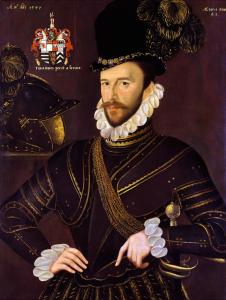 Around 1577 George Gower (age 37). Portrait of Richard Drake (age 42). The heraldic escutcheon shows seven quarters as follows:
1:  Drake of Ash Arms. Drake of Ash in the parish of Musbury, Devon.
2: Argent, on a chief gules three cinquefoils of the first; Billet of Ash.
3: Gules, on a fess argent two mullets sable; Hamton of Rockbere and Ash.
4: Ermine, on a chief indented sable three crosslets fitchee or; Orwey of Orwey and Ash.
5: Barry of seven argent and sable.
6: Azure, six lions rampant argent crowned Gules, 3, 2, 1; Forde of Forde.
7: Argent, two chevrons sable (Esse/Ash of Ash); Esse or Ash of Ash.
 Chaucer Modern Arms. Argent, a chief gules overall a lion rampant double queued or.
 Manners Arms. Or, two fess azure a chief gules.
 St John Arms. Argent, a chief gules two estoiles or. Source.
 Worsley Arms. Argent, a chief gules. Source.
Chief Indented
Around 1577 George Gower (age 37). Portrait of Richard Drake (age 42). The heraldic escutcheon shows seven quarters as follows:
1: Drake of Ash Arms. Drake of Ash in the parish of Musbury, Devon.
2: Argent, on a chief gules three cinquefoils of the first; Billet of Ash.
3: Gules, on a fess argent two mullets sable; Hamton of Rockbere and Ash.
4: Ermine, on a chief indented sable three crosslets fitchee or; Orwey of Orwey and Ash.
5: Barry of seven argent and sable.
6: Azure, six lions rampant argent crowned Gules, 3, 2, 1; Forde of Forde.
7: Argent, two chevrons sable (Esse/Ash of Ash); Esse or Ash of Ash.
 Butler Arms. Or, a chief indented azure. Source.
 Harsick Arms. Or, a chief indented sable.
 Lathom Arms. Or, on a chief indented azure three plates. Source.
 Perceval Arms. Argent, a chief indented gules three crosses pattee of the field. Source.
Chief Or
 St Leger Arms. Azure fretty argent, a chief or. Source.
Chief Sable
 Preston Arms. Or, a chief sable three crescents or.


#/media/File%3AClement_OfIghtham_Arms_(Bordure_OrAndAzure).svg)


#/media/File:BaconArms.svg)


_arms#/media/File:Butler_arms.svg)
#/media/File:Butler_arms_(Earl_of_Carrick).svg)
