

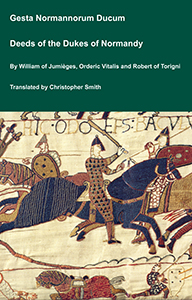
The Deeds of the Dukes of Normandy
The Gesta Normannorum Ducum [The Deeds of the Dukes of Normandy] is a landmark medieval chronicle tracing the rise and fall of the Norman dynasty from its early roots through the pivotal events surrounding the Norman Conquest of England. Originally penned in Latin by the monk William of Jumièges shortly before 1060 and later expanded at the behest of William the Conqueror, the work chronicles the deeds, politics, battles, and leadership of the Norman dukes, especially William’s own claim to the English throne. The narrative combines earlier historical sources with firsthand information and oral testimony to present an authoritative account of Normandy’s transformation from a Viking settlement into one of medieval Europe’s most powerful realms. William’s history emphasizes the legitimacy, military prowess, and governance of the Norman line, framing their expansion, including the conquest of England, as both divinely sanctioned and noble in purpose. Later chroniclers such as Orderic Vitalis and Robert of Torigni continued the history, extending the coverage into the 12th century, providing broader context on ducal rule and its impact. Today this classic work remains a foundational source for understanding Norman identity, medieval statesmanship, and the historical forces that reshaped England and Western Europe between 800AD and 1100AD.
Available at Amazon in eBook and Paperback format.
Corinthian Capitals is in Corinthian.
On 7th May 1592 Christopher Wray [aged 68] died. He was buried in St Michael's Church, Glentworth [Map]. Monument to Sir Christopher and his wife Anne Girlington. Elizabethan Period. Elephant and Castle Crest. Pink, white and blue-grey marble. Two recumbent effigies, Sir Christopher above and a little behind his wife, he in red robes, black cap and thick ruff; she in black robes, large ruff and hood. Four kneeling white marble daughters below. Ornate tomb recess above with flanking pink marble columns with white and gold Corinthian Capitals. Undersurface of Recess decorated with white and gold bay leaves. Plaque inscribed above with raised plaque above with Sir Christopher's son at prayer flanked by coats of arms and obelisks.
The general design, and in particular the scrollwork, suggest it may be the work of Nicholas Johnson.
The inscription: "The chief justice of England. Whoever thou art (or a stranger too) pay your respects to those who are buried. Christopher Wray, who lives here was the glory of our legal system. Pairing business, true by name who shone forth in duty, understanding and faith. Lo, he was here, lo he is not. Swift fate overturns everything. Alas, he is dead to us but he himself survives. Earth to earth, Ashes to Ashes, the heavenly to heavenly things. The spirit of the celestial world he occupies the stars of heaven. He died the seventh day of May 1592 in the 34th year of the reign of Queen Elizabeth."
Anne Girlington: she was born to Nicholas Girlington. Christopher Wray and she were married. After 7th May 1592 Anne Girlington was buried at St Michael's Church, Glentworth [Map]. Before 18th October 1602 John Darcy 2nd Baron Darcy Aston and Anne Babington were married. She by marriage Baroness Darcy of Aston. They were sixth cousins.


On 14th January 1657 John Dutton [aged 62] died. He was buried in Saint Mary Magdalene's Church, Sherborne [Map]. Sculpted by Thomas Burman [aged 39]. A shrouded upright effigy in white marble within a round-headed niche flanked by black marble columns with Corinthian Capitals and scrolled pediment with the Sherborne arms at the centre, above. Inscription plaques either side. Inscription to John Dutton below.
John Dutton: John Dutton and Elizabeth Bayntun were married. John Dutton and Anne King were married. She the daughter of Bishop John King. Before 5th October 1594 he was born to William Dutton. On 5th October 1594 John Dutton was baptised.
Thomas Burman: Around 1618 he was born. Around 1632 Thomas Burman was apprenticed to Edward Marshall. In the 1660s Thomas Burman employed six apprentices and assistants. On 17th March 1674 he died in the parish of St Martin in the Fields Church [Map]. He was buried at St Paul's Church, Covent Garden.
After 26th July 1723. Church of St Michael and All Angels, Edenham [Map]. Monument to Robert Bertie 1st Duke Ancaster and Kesteven [deceased] sculpted by Peter Scheemakers [aged 32] and Henry Cheere 1st Baronet [aged 20]. A Classical Period with Corinthian Capitals supporting open dentilated pediment with garland, urns and putti. Before the Aedicule a rounded Pedestal supports a marble image of the deceased attired as a Roman General.

