


Fane to Furnival
Fane to Furnival is in Armorials.
Fane Arms
Fanshawe Arms
 Fanshawe Arms. Or a chevron between three fleur de lys sable. Source.
Feilding Arms
 Feilding Arms. Argent, on a fess azure three lozenges or. Source.
Fermor Arms
 Fermor Arms. Argent, a fess sable between three lion's heads erased gules. Source.
Ferneley Arms
 Ferneley Arms. Or, on a bend vert three buck's heads caboshed argent.
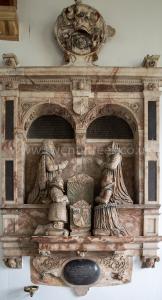
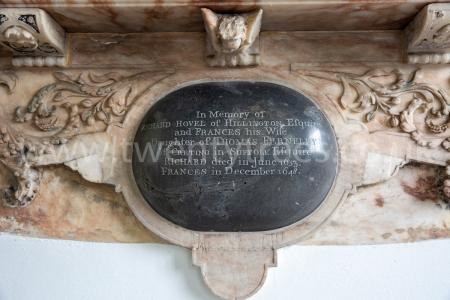
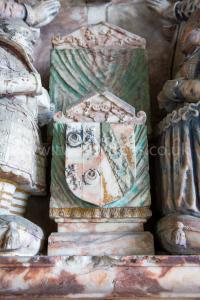
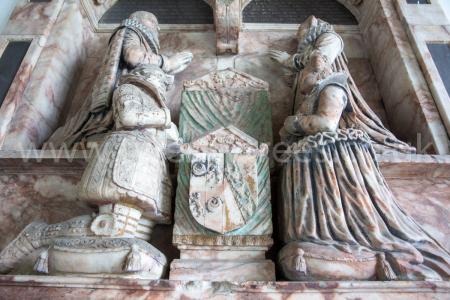
In Jun 1653 Richard Hovell of Hillington (age 80) died. In Dec 1648 Frances Ferneley (age 73) died. Wall monument in Church of St Mary, Hillington [Map]. Of alabaster with Renaissance arches and two pairs of figures each facing each other across faldstools. Armoirals Quarterly  Hovell Arms and
  Ford Arms impaled with Ferneley Arms.
Richard Hovell of Hillington:
In 1573 he was born to Richard Hovell of Hillington and Margery Ford.
On 01 Mar 1598 Richard Hovell of Hillington and Frances Ferneley were married at the Church of St Mary, Hillington.
Frances Ferneley: In 1575 she was born to Thomas Ferneley of Creting in Suffolk.
Ferrers Arms
 Ferrers Arms. Vairy or and gules.
 Robert Devereux 2nd Earl Essex 1565 1601 Arms. 1
  Devereux Arms 2
  Bourchier Arms 3
  Thomas of Woodstock 1st Duke of Gloucester Arms 4
  Bohun Arms 5 Gloucester Arms 6
  Mandeville Arms 7
  Louvain Arms 8
  Woodville Arms 9 Unknown Arms, 10
  Verdun Arms 11
  Marshal Arms 12 Unknown Arms 13 Ferrers Arms 14
  Kevelioc Arms 15
  De Quincy Arms 16 Unknown Arms.
Fiennes Arms
 Fiennes Arms. Azure three lions rampant or. Source.
Fitzalan Arms
Fitzgerald Arms
 Fitzgerald Arms. Argent, a #saltire gules. Source.
Fitzherbert Arms
 Fitzherbert Arms. Argent, a chief vairy or and gules a bend sable. Source.
On 13 Mar 1518 Thomas Babington of Dethick (age 69) died at Ashover, Derbyshire [Map]. He was buried at All Saints Church, Ashover, Derbyshire [Map].
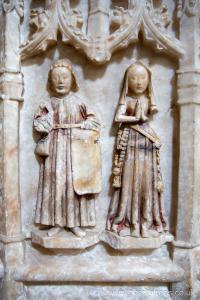
Monument to Thomas Babington of Dethick (age 69) and Editha Fitzherbert. Excellent painted alabaster monument of the Fluted Period with the colours much refreshed. Carved by Harpur and Moorecock of Burton on Trent. Chest with Angels with Rounded Wings. The monument was probably erected shortly after Edith died. Thomas's will requests the tomb not be disturbed when dies:
I will my body be buryed in my parish church of Ashover, nere by wif Edith, it it fortune me to deceas within xx. myles of the same. And ells in such place as shalbe thought by them that shalbe wt me at the tyme of my diceas; But I will not that the Tombe which I have made in the Church of Ashover be broken or hurt for my carkas, but that it be leyde nere the same, and over that place that I shall lye in, a stone with a scripture after myne executors and supervisour myndis or the more parte of them to be leyde."
Thomas Babington of Dethick: Around 1449 he was born to John Babington and Isabel Bradbourne. Before 1476 Thomas Babington of Dethick and Editha Fitzherbert were married.
Editha Fitzherbert: Around 1457 she was born to Ralph Fitzherbert and Elizabeth Marshall at Norbury, Derbyshire. In 1511 Editha Fitzherbert died at Ashover, Staffordshire.
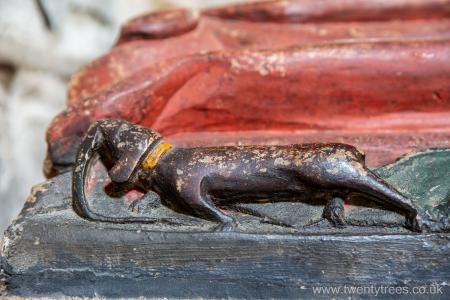
Dogs chewing at her dress suggests Harpur and Moorecock of Burton on Trent carved the monument.
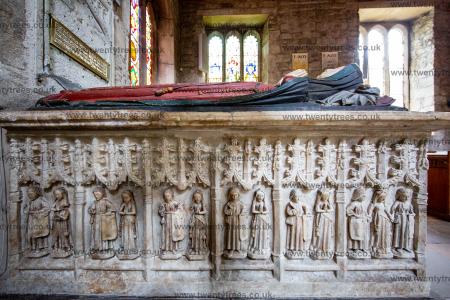
The chest tomb of exceptional quality with the fifteen weepers under crocketed canopies broadly undamaged. The weepers on the sides are believed to represent Thomas and Editha's children, possibly fourteen, and their respective spouses. The chest tomb now abuts the south wall of the chancel meaning only three sides visible.
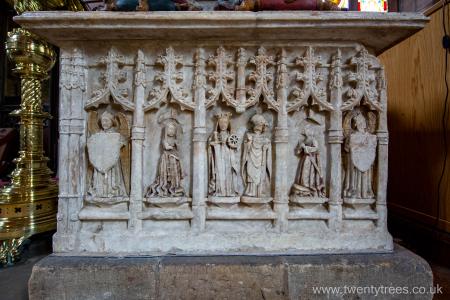
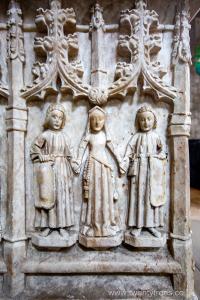
Thomas Babington of Dethick (age 69) and Editha Fitzherbert with Saints Catherine and Thomas of Canterbury in the centre.
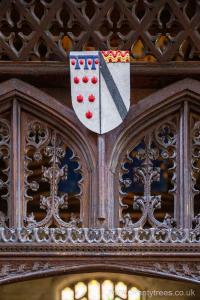
Babington Arms impaled Fitzherbert Arms.
Fitzhugh Arms
 Fitzhugh Arms. Azure, three chevrons interlaced in base or a chief of the last. Source.
Fitzpayn Arms
 Fitzpayn Arms. Gules, three lions passant guardant argent, overall a bend azure. Source.
Fitzwalter Arms
 Fitzwalter Arms. Or, a fess gules between two chevrons of the last. Source.
 Robert Radclyffe 1st Earl of Sussex 1483 1542 Arms. Quartered 1 Quartered 1&4
  Radclyffe Arms 2&3 Fitzwalter Arms 2 Unknown Arms 3
  Lucy Arms 4 Multon Arms.
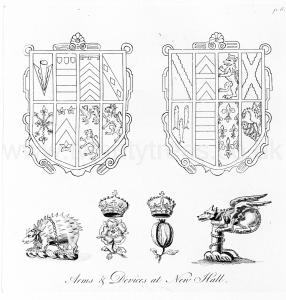
Vesta Monumenta. Over the door leading to the chapel are, or were, these arms and quarterings carved in stone of Thomas Ratcliffe earl of Sussex, with those of his lady Frances Sydney, daughter of Sir William Sydney of Penshurst in Kent, knt. the celebrated founderess of Sydney Sussex College, Cambridge, and whose time by these arms we may conclude some additions were made to this mansion:
1. A bend ingrailed. Ratcliffe earl of Sussex.
2. A fess between two chevrons. Fitzwalter Arms.
3. A lion rampant crowned, within a bordure. Burnell.
4. A saltire ingrailed. Botetourt.
5. Three lucies hauriant. Lucy Arms.
6. Three bars.  Multon Arms.
7. Semee Fleurs de lis. Mortimer of Attilborough.
8. An eagle and child. Culcheth.
Over the door leading to the hall those of Frances countess of Sussex, his consort:
1. A pheon. Sydney.
2. Two bars, in chief three shields. Clunford.
3. Three chevronells; a label of 3 points. Barrington.
4. On a bend three lozenges or muscles. Mercy.
5. Quarterly an escarbuncle. Mandeville Arms.
6. A chevron between three mullets. Chetwynd.
7. Three lions rampant. Baard.
8. Barry of 8 a lion rampant crowned.  Brandon Arms.
A bear chained: the crest of Dudley earl of Leicester.
A griffin chained.
A rose crowned. Henry VIII.
A pomegranate crowned. Catharine of Arragon, his queen.
These coats and devices are here engraved from drawings taken by Mr. Vertue at the same time that he made those of the house.
Fitzwilliam Arms
 Fitzwilliam Arms. Chequy gules and argent. Source.
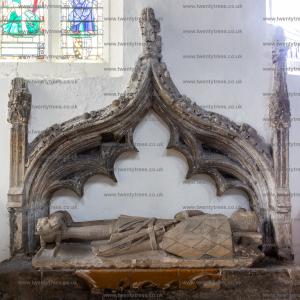
Around 1280. St Mary’s Church, Sprotbrough [Map]. Effigy of a Knight in 14th Century cusped, ogee recess. Probably of the Fitzwilliam Family - Fitzwilliam Arms.
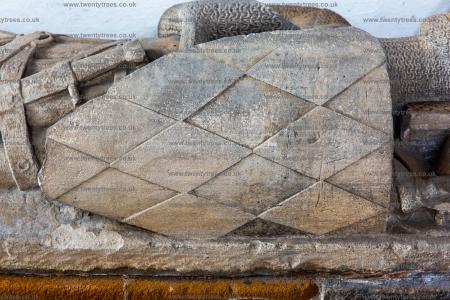
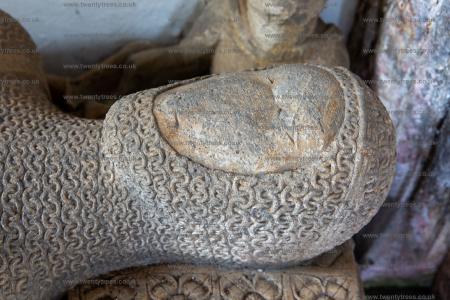
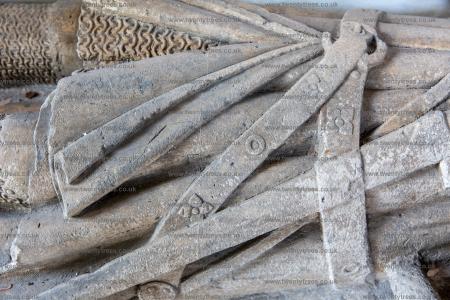
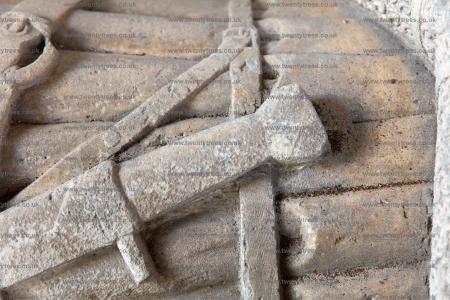
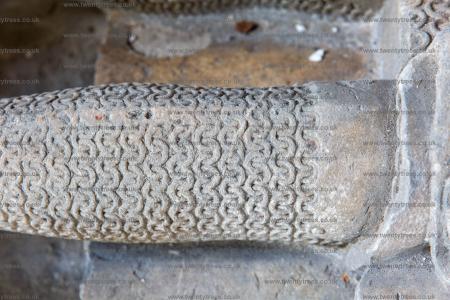
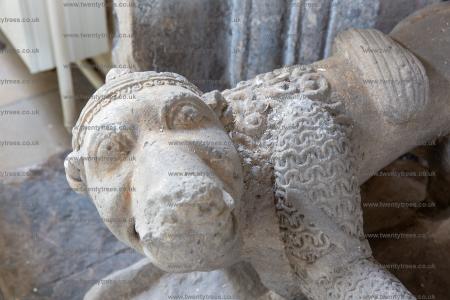
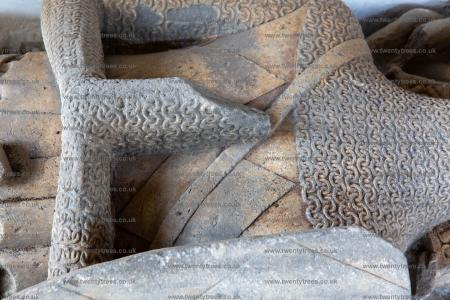
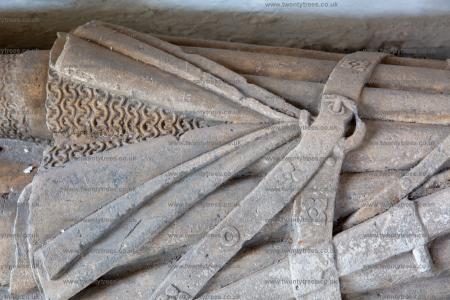
Wentworth Fitzwiliam Arms
NO IMAGE. Quartered 1&4 Fitzwilliam Arms 2&3  Wentworth Arms.
Fleetwood Arms
Foljambe Arms
 Foljambe Arms. Sable a bend between six escallops or.
Ford Arms
In Jun 1653 Richard Hovell of Hillington (age 80) died. In Dec 1648 Frances Ferneley (age 73) died. Wall monument in Church of St Mary, Hillington [Map]. Of alabaster with Renaissance arches and two pairs of figures each facing each other across faldstools. Armoirals Quarterly Hovell Arms and Ford Arms impaled with Ferneley Arms.
Richard Hovell of Hillington:
In 1573 he was born to Richard Hovell of Hillington and Margery Ford.
On 01 Mar 1598 Richard Hovell of Hillington and Frances Ferneley were married at the Church of St Mary, Hillington.
Frances Ferneley: In 1575 she was born to Thomas Ferneley of Creting in Suffolk.
Fortescue Arms
 Fortescue Arms. Azure a bend engrailed argent cotised or. Source.
Fox Arms
 Fox Arms. Ermine, on a chevron azure three fox's heads and necks erased or on a canton of the second a fleur de lys of the third. The canton is an augmentation of honour to his paternal arms, granted out of the Royal Arms as a mark of esteem to him and his heirs forever, by King Charles II following the Restoration of the Monarchy. Source.
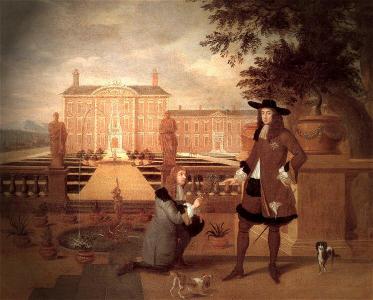
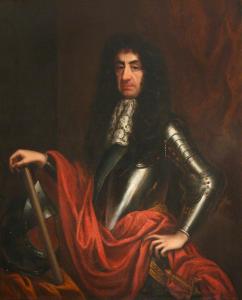
 Fox Strangways Arms. Quartered
  Strangeways Arms and Fox Arms.
France Royalty
Capet Arms
 Capet Arms. Azure, three Fleur de lys or. Source.
 Spencer Churchill Arms. Quartered 1&4
  Churchill Arms a canton of St George, 2&3
  Despencer Arms a bend sable three escallops, overall an escutcheon St George overall an escutcheon Capet Arms.
 England Henry IV Arms. Capet Arms quartered with
  Plantagenet Arms. Source.
 King George I of Great Britain and Ireland 1660 1727 Arms. Quartered 1 Plantagenet Arms impaled
  Dunkeld Arms 2. Capet Arms 3.
  Ireland Arms 4. 1&2
  Brunswick Luneburg Arms, 3
  Hanover Arms, an inescutcheon over all three, gules the Crown of Charlemagne Proper (As Archtreasurer of the Holy Roman Empire).
 John Stewart of Darnley 1st Count Évreux 1380 1429 Arms. Capet Arms within a bordure gules charged with eight buckles or. Awarded in 1427 by King Charles VII of France. Source.
France Ancient Arms
 France Ancient Arms. Azure semy-de-lis or. Source.
 England Edward III Arms. France Ancient Arms quartered Plantagenet Arms. Source.
Valois Arms
Freke Arms
NO IMAGE. Sable, two bars or in chief three mullets of the last. Source.
Freschville Arms
 Freschville Arms. Azure, bend argent between six escallops.
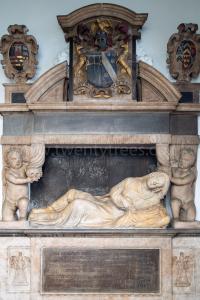
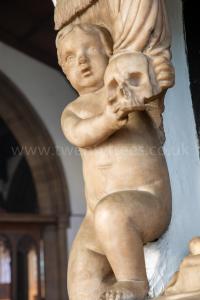
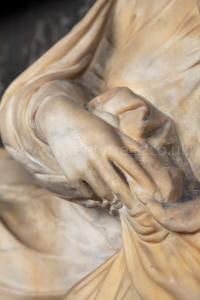
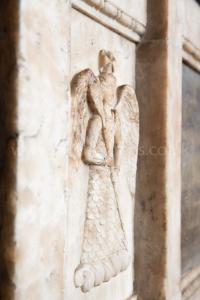
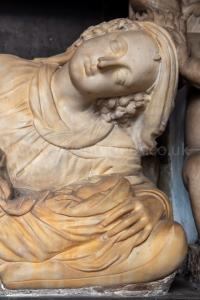
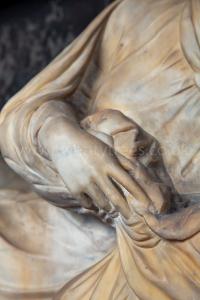
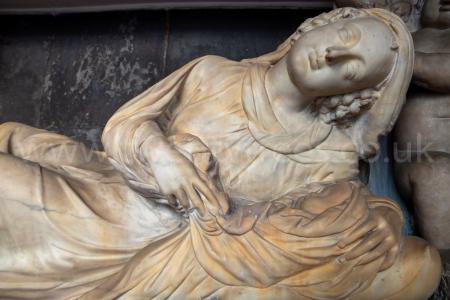
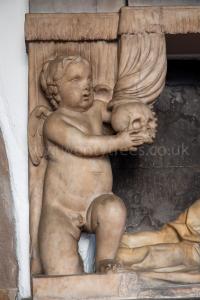
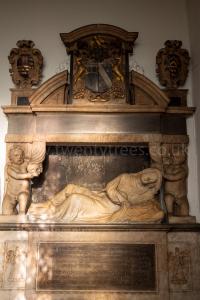
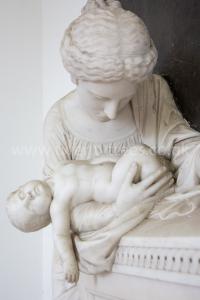
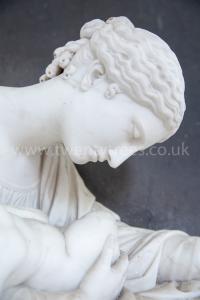
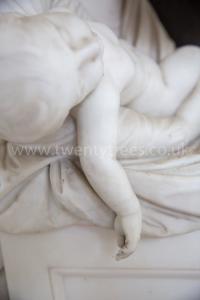
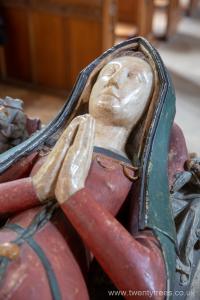
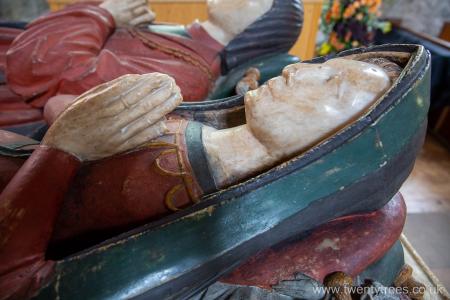
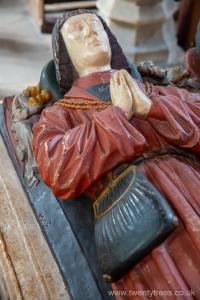
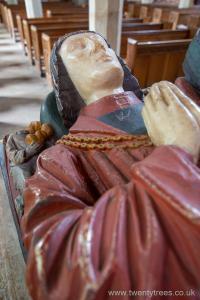
On 22 May 1653 unamed child was born to Charles Paulet 1st Duke Bolton (age 23) and Christian Freschville (age 19). She died in childbirth. The child died seven days later on 29 May 1653. Both were buried at the St John the Baptist's Church, Staveley [Map]. Monument erected by her husband Charles Paulet 1st Duke Bolton (age 23) the future Duke Bolton. Reclining figure with Chrisom Child.
Armorials...
Top Middle  Paulet Arms differenced with a label argent three points impaled Freschville Arms.
Top Left: His Arms, in sixths 1 Paulet Arms 2 Possibly  Seymour Arms although wings should be Or 3 Unknown Arms 4 Unknown Arms 5 Unknown Arms 6
  St John Arms with a label argent three points to reflect his status as son of the current owner of the Arms.
Top Right: Her Arms, in sixths 1 Freschville Arms 2 Unknown Arms 3 Unknown Arms 4 Unknown Arms 5 Unknown Arms 6  Harrington Arms.
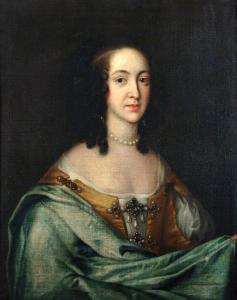
Christian Freschville: On 13 Dec 1633 she was born to John Freschville 1st Baron Frescheville and Sarah Harrington. On 28 Feb 1652 Charles Paulet 1st Duke Bolton and she were married. He the son of John Paulet 5th Marquess Winchester and Jane Savage Marchioness Winchester.
Furnival Arms
 Furnival Arms. Argent, a bend gules six martlets gules. Source.
ffolkes Arms
 ffolkes Arms. Per pale vert and gules, a fleur de lys argent. Source.
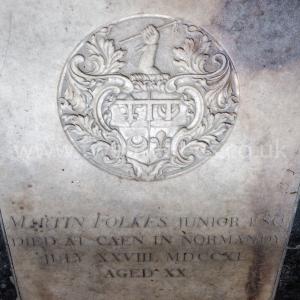
On 28 Jul 1740 Martin ffolkes (age 20) died. Grave slab in the Church of St Mary, Hillington [Map]. Arms quartered ffolkes Arms and Hovell Arms differenced with a label three points.
Martin ffolkes: In 1720 he was born to Martin Folkes and Lucretia Bradshaw Actor.
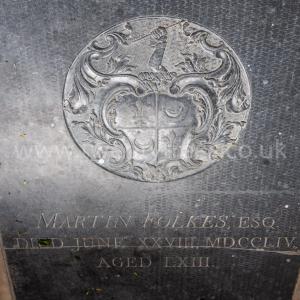
On 28 Jun 1754 Martin Folkes (age 63) died. Grave slab in the Church of St Mary, Hillington [Map]. Arms quartered ffolkes Arms and Hovell Arms.
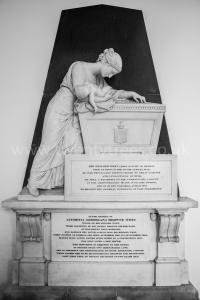
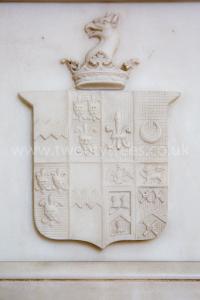
After 16 Aug 1828. Church of St Mary, Hillington [Map]. Monument to Edward West and Lucretia Georgiana ffolkes sculpted by Henry Hopper (age 61). The armorial Edward West Chief Justice of Bombay 1782-1828 arms and Lucretia Georgiana ffolkes impaled. His arms quartered  West Arms and Unknown Arms. Her arms quartered 1 ffolkes Arms 2 Hovell Arms 3 appears to be Browne as seen in the armorial to William Browne 4
  Turner Baronets Arms.
Edward West: he was born to John Balchen West. His parents died young so he was brought up by his uncle Martin ffolkes 1st Baronet. 26 Aug 1822 he and Lucretia Georgiana ffolkes were married at St Marylebone Church. She the daughter of his guardian and uncle Martin ffolkes 1st Baronet. On 16 Aug 1828 he died at Poonah.
Lucretia Georgiana ffolkes:
she was born to Martin ffolkes 1st Baronet and Fanny Turner.
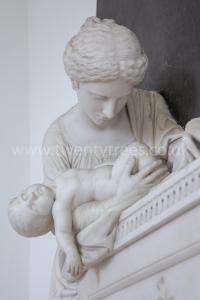
On 15 Oct 1828 Lucretia Georgiana ffolkes died in childbirth at Bombay, India eleven days after having given birth to a posthumous son who only lived at few hours.
William Browne: In 1692 he was born. On 24 Aug 1717 he and Mary Greene were married.






#/media/File:FleetwoodArms.svg)

_Arms.png)

.svg)


.svg)

#/media/File:FrekeArms.png)

.svg)